


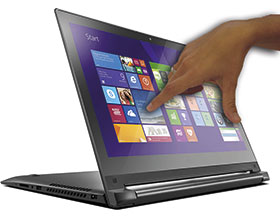
Touchscreens are everywhere: on mobile phones, personal tablets, information displays in shopping malls, fast food and restaurant counters, kiosks and factory and shop floor terminals. They make using applications easier and more productive if well designed, but frustrating and counterproductive if poorly designed.
Together with peripherals such as barcode and QR matrix scanners, users can input or find information quickly, often quicker than using a mouse or keyboard. Watch a teenager using a cellphone to text a message to a friend, or a clerk at a fast food checkout entering an order using a well designed interface, and one can see how touch technology has changed and improved the efficiency of information input. Use a touchscreen information display at a mall and see how easy it is to find the shop or item you want. A good touchscreen application is intuitive and a pleasure to use.
On the other hand, there are the applications that have been poorly designed and instead of improving the user’s interaction with the system, make it a frustrating and difficult task to enter or extract any information. Just watch a counter clerk scanning a screen on which there are ten rows of twenty blocks with tiny writing, all in a single colour, trying to find the item or option that the customer wants. Watch the look of frustration on the clerk’s and the customer’s face as the clerk tries to get the order correct with the many options available.
What is your application and can it benefit your company, your users and your customers by upgrading it to be interactive using a touch screen? Unless it is heavily data entry oriented, most applications can be adapted to be touchscreen friendly – friendly to the user of the application, that is.
Adapting an application for use on a touchscreen can also lead to other changes and improvements in the way a company works. Changing a desktop application to make use of touch and keyboard entry can then make it easy to migrate the application to a wireless tablet or mobile phone, allowing users to move about while using the application. For example a storeman in a warehouse can move about the warehouse instead of having to come back to a desk to enter information.
Integration of scanners for faster input of account information, documents or part codes can also prove beneficial. Consider how the SnapChat application has made payment for small and large traders quick, secure and easy; or how quick and easy it is to logon to WhatsApp on a desktop PC by scanning a QR code.
Here are 10 tips for designers of touchscreen applications to make them efficient and easy to use:
1. Use bright colours to highlight the possible selections on a screen.
2. If there is a default option, highlight it using a flashing or differently coloured button.
3. Avoid using black as a background for white or light coloured writing.
4. Colour groups of similar choices in the same colour.
5. Use the full screen if possible, removing title or menu bars.
6. Don’t use a cursor; it becomes a distraction.
7. Make buttons as large as possible.
8. Allow for selection using single touch/click, not double click.
9. Give users immediate feedback when they make a selection; consider how games make it interesting or even exciting when a selection is made.
10. Give users an option to ‘Go Back’ when they make an error.
Centurion Micro Electronics (CME) supplies touchscreens and panel PCs to industry in sizes from 5” to 24”, and even larger. Applications include fuel dispensing and management – an outdoor environment requiring sunlight readable, robust screens; fast food outlets – communicating to kitchen printers and management systems; gaming machines in casino and club environments; abattoir management – a wet, dirty environment ideally suited to IP66 touchscreens; as well as warehouse management, with integrated scanners and printers.
The selection of a touchscreen can improve a company’s efficiency and productivity, and CME can assist customers with selecting the best option from resistive or projected capacitive touchscreens, with IP ratings to suit the environment.
For more information contact Henry Hugo, Centurion Micro Electronics, +27 (0)83 581 4549, [email protected], www.cme.co.za
| Tel: | +27 12 666 9066/8 |
| Email: | [email protected] |
| www: | www.cme.co.za |
| Articles: | More information and articles about Centurion Micro Electronics |






© Technews Publishing (Pty) Ltd | All Rights Reserved
 printer friendly version