


With tens of billions of IoT nodes now in the process of being deployed across the globe, there are concerns about how all this hardware can be powered in a practical and environmentally friendly manner.
Since a large proportion of these connected nodes are going to be placed in remote and difficult to reach locations, relying on conventional battery resources alone will have clear drawbacks. In many applications it will just not be feasible to use this approach. There is an interesting alternative that could be used, however.
Acute space constraints, as well as unit costs, will often mean that the energy storage reserves that can be incorporated into an IoT node will not be particularly substantial. Consequently, it is paramount that the constituent electronics of any IoT node has a minimal power budget in order that as lengthy a period as possible can elapse before its battery needs replacing.
IoT nodes’ wireless power demands
One of the largest contributors to an IoT node’s power budget will come from the wireless chipset it relies upon for communication. Depending on the range over which data must be transmitted to and from nodes, the data rate that needs to be supported and how regularly data transmissions will occur, there are a variety of different wireless protocols that can be employed. Among the most common are LoRa, Sigfox, NB-IoT, LTE-M, Wi-Fi, Bluetooth LE, Z-Wave and Zigbee. The power consumed by the wireless chipset can be given as either an average value (over the course of a day, week, etc.) and as a peak value (relating to when it is transmitting/receiving data). This second figure will of course be considerably higher.
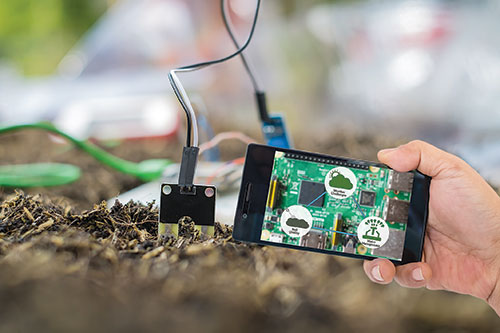
The operating life of a Li-Ion cell incorporated into an IoT node can be limited when there is reasonably regular wireless activity required, as the power budget will be too great for the cell to support it for a prolonged period. As well as storage capacity issues, there are other matters that need to be considered. High current peaks stemming from the battery’s equivalent series resistance (ESR) can impact on the supply voltage. They can result in the voltage dipping below the threshold that the wireless chipset requires, meaning the usefulness of the battery is further curtailed.
Let’s take an example where the IoT node has a Sigfox wireless chipset. Given that its average power consumption is 60 µW on a 3 V rail, then this will equate to a current draw of 20 µA. For a year’s worth (i.e. 8760 hours) of operation, it would mean a battery capacity of 20 x 10-6 x 8760 = 175 mAh would be adequate (which is comfortably within the parameters of a standard coin cell). During the transmit phase though, when 80 mW of power is required, close to 30 mA of current will be drawn. For a battery with a 6 Ω internal resistance, the voltage drops by 0,18 V. If the battery is reaching the end of its capacity, then the voltage being delivered to the load could be too low, thereby preventing it from functioning.
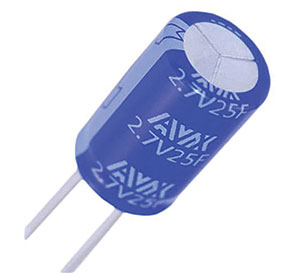
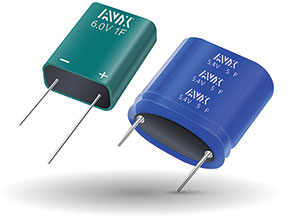
By taking measures to mitigate the peak demands on the battery, it is possible to avoid the debilitating voltage drops just outlined. This can be done by placing a supercapacitor in parallel with the battery cell. Though supercapacitors cannot match a battery cell’s energy storage, they exhibit much higher power densities. Because of this they are able to deliver high peak currents as requirements dictate, with very little voltage drop being experienced.
Using a supercapacitor to provide energy pulses that can supplement the battery’s power delivery, peak demands can be met and there is no risk of the wireless chipset being unable to function fully. The timeframe over which the node will be able to draw current will thereby be extended, as the battery will be able to keep supporting it even at a lower state of charge (SoC). A further advantage of this type of arrangement that is also worth noting is that, in scenarios where 24/7 operation is mandated, the battery can be replaced without any interruption in current flow. Data can continue to be transmitted, with power being drawn from the supercapacitor during the switchover.
Choosing the right supercapacitor
When specifying a supercapacitor for IoT deployment, there are several key points that need consideration. Firstly, the temperatures that the device is likely to be subjected to will need to be taken into account. If the IoT nodes are going to be placed in locations where they are likely to have to contend with extreme levels of heat (like in an industrial processing plant) or cold (such as on a pipeline that runs through the Arctic tundra), then these could have an effect on the operational performance. Exposure to excessive moisture can also have a detrimental effect, with the prospect of the supercapacitor’s lifespan being shortened. Engineers also need to be aware of the leakage current of the chosen supercapacitor, as this can prove to be significant when there are high capacitances involved. In order to run a supercapacitor in parallel with a battery cell effectively, it is recommended that the selected supercapacitor has an ESR which is no more than 25% of the battery’s ESR. So if the ESR of the battery is 100 mΩ then a supercapacitor with a ≤25 mΩ ESR should be sourced.
There are supercapacitors now being produced, by manufacturers like AVX, which are highly suited to working in conjunction with coin cell batteries. The company’s ultra-low SCC series of cylindrical devices have capacitances of up to 50 farads and can be fitted directly across a cell. They can cope with temperatures reaching +85°C. A 1 farad SCC device will have a maximum leakage current of just 6 µA. Through proprietary materials and packaging technology, AVX has been able to reduce moisture penetration in high humidity situations. Its SCM series has shown strong performance when subjected to 4000-hour tests at 40°C temperature levels with 95% relative humidity (RH).
By using supercapacitors alongside batteries, it will be possible to increase the period between battery replacements and keep the logistical costs involved down. If the right supercapacitor is specified, there is the potential to prolong the working life of IoT batteries significantly, in some cases extending it by as much as a decade. This means that energy storage is no longer the limiting factor in IoT deployment that it has been until now, with a multitude of new opportunities opening up as a result. By working with the leading manufacturers in this sector, Avnet Abacus is able to offer engineers a broad array of the supercapacitor products. Its team of experienced application engineers can help with specifying the best option for specific IoT use cases, matching the defined operational parameters with the most suitable device.
| Tel: | +27 10 447 0180 |
| Email: | avnet-abacus-sales-southafrica@avnet.eu |
| www: | www.avnet.com/wps/portal/abacus |
| Articles: | More information and articles about Avnet Abacus |






© Technews Publishing (Pty) Ltd | All Rights Reserved
 printer friendly version