


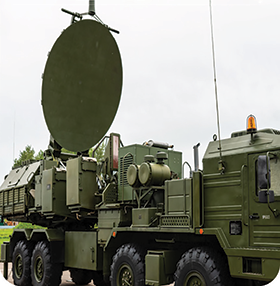
Most modern military conflicts begin beyond sight of the naked eye. Across all domains – land, air, sea, space and cyberspace – military forces fight for dominance of the electromagnetic (EM) spectrum. These forces use the EM spectrum to detect enemy forces, deceive them or disrupt their efforts. With different forms of electronic attack, they can weaken, disable or even devastate their enemy’s spectrum usage.
The adaptive nature of these EM spectrum operations makes it difficult to stay a step ahead of them. At the same time, widely available and greatly improved technology translates into more adversaries in the electronic warfare (EW) domain. Today’s EW environment increasingly features unknown actors producing responsive, unpredictable threats.
EW, defined as warfare in the EM spectrum, generally includes anything operating in the radio frequency (RF) spectrum. Electromagnetic operations target many aspects of the EW environment, ranging from radar and jammers to military communications. Anything that communicates over the air is a potential target.
EW systems use the EM spectrum to support communications, sensing and defence. Disarming these capabilities means disabling an adversary’s ability to communicate or navigate. Signal intelligence systems also gather intelligence or find targets.
The EM spectrum is a critical operational warfare domain. With successful electronic attacks, military units operating on land, air or sea fulfil their missions. As a result, those who perform spectrum manoeuvres most quickly achieve an advantage, as modern threats work to ensure success using responsive, unpredictable behaviour.
Prepare for a shifting battlefield
Today’s military units struggle to identify modern threats on time. In some cases, adversaries reportedly boast so much EW expertise that forces and allies respond by shrinking their EM footprint. They cannot safeguard their information and do not want to risk jamming (interference with their communications) or the enemy firing upon them.
Even small adversaries can leverage commercially available technology such as global positioning system (GPS) jamming equipment. An attack carried out on navigation systems, for example, could threaten the military’s ability to synchronise its operations. Even more frightening, the adversary’s cybersystem can provide inaccurate position, timing or navigation information. This possibility could cause problems ranging from confusion to horrific accidents. Threats do not have to conduct a visible attack but can instead cause failure in communications, coordination and other operations.
In any EW conflict, the winner is the one that can manoeuvre most quickly through the EM spectrum by leveraging technological advances. Due to the convergence of the following trends, threats have grown increasingly in number and sophistication:
1. Availability of technology: 10 years ago, very few players dominated this battlefield. The technological capabilities and investments required to dominate in EW prohibited others from developing competing EW capabilities. As commercial electronics became cheaper and more available, adversaries of all sizes entered the EW arena. Now, even smaller adversaries potentially have a competitive threat arsenal, making the threat environment more dangerous and unpredictable. With the barrier to entry being so low, anyone with the right skills and knowledge can secure enough equipment to be a threat.
2. Software-defined radio (SDR) systems: Originally, SDR translated to a reconfigurable radio based only on software. Analog-to-digital conversion occurred directly at the antenna. Modern SDRs often take more complex forms, changing their operating frequency, modulation, operating bandwidth and network protocol without having to change the system hardware. As speeds increase for both digital signal processing (DSP) and analog-to-digital converters
(ADC), more signal processing occurs digitally. By leveraging such systems, military forces can more easily upgrade their threat systems.
3. Artificial intelligence (AI): The rapid pace of change for commercially available dual-use technologies and software-defined systems drives both the diversity and complexity of future threats. With the addition of AI, those threats also learn from each conflict and are more likely to prevail in the future.

Types of EW threats
As a result of these technological leaps, threats grow increasingly sophisticated. Threats of the past were static, i.e., consistent in appearance and behaviour. Today’s threats are responsive, changing their behaviour based on the scenario. If an adversary is jamming a reactive threat, for example, it will switch frequencies or take another action to elude that jamming. Adversaries must now assume that a threat might change and prepare to react accordingly.
Cognitive or adaptive threats change and adapt over time. Although people use these terms interchangeably, many levels of adaptability exist, most of which do not come near the capabilities of cognitive EW.
Cognitive EW systems use machine learning to enter an environment with no prior knowledge of the adversary’s capabilities and rapidly understand the scenario. By doing something that makes the adversary’s system react, they can quickly evaluate it and develop an effective response suited for that particular adversary’s system.
By contrast, adaptive solutions cannot rapidly grasp and respond to a new scenario. For example, an adaptive radar senses the environment and alters its transmission characteristics, providing a new waveform for each transmission or adjusting pulse processing. This flexibility allows an adaptive radar to enhance its target resolution. Many adversary systems require only a simple software change to alter waveforms, which adds to the unpredictability of waveform appearance and behaviour. Military forces struggle to isolate adaptive radar pulses from other signals, friend or foe.
Much adaptive and cognitive development is in response to anti-access/area denial (A2/AD) threats. A2 threats prevent or hinder the deployment of ally forces into the conflict zone. For example, these threats may do something to force the adversary to engage from a less effective distance. Successful A2 threats prevent access or even passage of ally forces.
In contrast, AD threats take actions that impede friendly operations. These threats work to limit or eliminate an adversary’s ability to respond to its allies or other friendly forces. Examples of such threats include attack vessels or aircraft, as well as missiles. AD threats affect the operations within the domain. As these threats grow increasingly adaptive, their opponents must respond to them in a much shorter time.
Assess the impact of machine learning
With AI, intelligent machines work and respond much like humans to perform more complex tasks using capabilities like signal recognition. Machine-learning takes AI one step further, allowing machines to learn from data and adapt continuously.

These computers learn over time at a very rapid rate. Threats using machine learning continue to learn from every conflict and determine ways to prevail against future countermeasures. As the computer decides how to alter behaviours, evolution occurs without the need for human interaction.
Due to the unpredictable behaviour of the threat system, even the people who implemented it cannot foretell its exact behaviour.
As threat systems advance with machine learning technology, they will adapt and alter their behaviour or course of action at an increasingly rapid rate. For example, if a radar is trying to track a jet, the adversary’s countermeasures may stop it from succeeding. Using machine learning, that radar would repeatedly try new approaches to achieve success. Today’s machines possess intelligence that is an order of magnitude higher than a human expert in EW, as they learn from data that continues to aggregate over time.
Know how to prepare for the future
Due to the abundance of new, modern, responsive threats, military forces vie for control of the EM spectrum. Spectrum dominance enables them to detect, deceive and disrupt enemy forces while protecting their military. Military forces must continuously innovate their EW threats and countermeasures to dominate the EM spectrum and stay in the leading position. To keep pace with the ever-changing threat environment, military forces demand flexible, scalable solutions. A risk mitigated today may not be an issue six months from now. As a result, military forces continue to face new threats from enemy forces.
Incomplete, disaggregated data prevents military forces from attaining or creating a clear threat picture. They lack a methodology against which to test these threats, an issue that stems from traditional EW threat simulation systems. Instead they use databases of known threats, which usually have associated countermeasures. Such classified lists of known targets are no longer as effective and they quickly fall out of date. These systems were not built to identify and isolate threats in the EM environment and determine countermeasures on the fly.
Even when capable of processing new signals, traditional EW threat simulation systems involve a very time-consuming process. For example, military forces collect information from the field about a type of signal, such as frequency or pulse repetition interval (PRI). They send that information to a lab, where it is analysed to gather more information and develop countermeasures. Months pass before that information is available in the system for use.
In the future, adversaries will have a more complete picture of operations. Building on the past decade’s transformation, the next 10 to 20 years promise to deliver faster, more evolved technology developments. Industry experts predict that machine learning and artificial intelligence will drive powerful, continuous evolution in EW. The EW threat environment will leverage drastic processing improvements, like using multiple devices to provide more information in less time. Sensing technologies will also play a larger role, gathering information about the conflict zone. New coding techniques already result in increasingly complex, interconnected and correlated sensors.
These technology innovations will spawn knowledgeable, newly responsive threats that find novel ways to gain power in the EM spectrum. While the technologies will continue to evolve and new threats emerge, one constant remains: the military force that achieves and maintains spectrum dominance will control the EW domain.
| Tel: | +27 12 678 9200 |
| Email: | info@concilium.co.za |
| www: | www.concilium.co.za |
| Articles: | More information and articles about Concilium Technologies |






© Technews Publishing (Pty) Ltd | All Rights Reserved
 printer friendly version