Background
Sune von Solms grew up in Gqeberha and from an early age was exposed to academia through her family. Therefore, moving into an academic environment herself came as a natural progression once her schooling was completed. After studying electrical and computer engineering at North West University and completing both her Masters and PhD at the same university, she joined the CSIR as a researcher.
“From the first day I stepped into the university as a student, I knew that academia was where I would be for the rest of my life,” she says. With her parents occupying teachers’ roles at both school and university, they were around for every school sports day, debate and dance festival, and she knew that working in academia would not only allow her to pursue a career in both research and at the same time develop the enquiring minds of her students, but it would also provide a level of freedom to allow her to raise a family whilst doing what she loves.
The current state of education
Sune is currently an Associate Professor at the Department of Electrical and Electronic Engineering Science and the Head of the same department at the University of Johannesburg (UJ) where she is involved in research in the application of engineering technologies as well as in the field of cybersecurity.
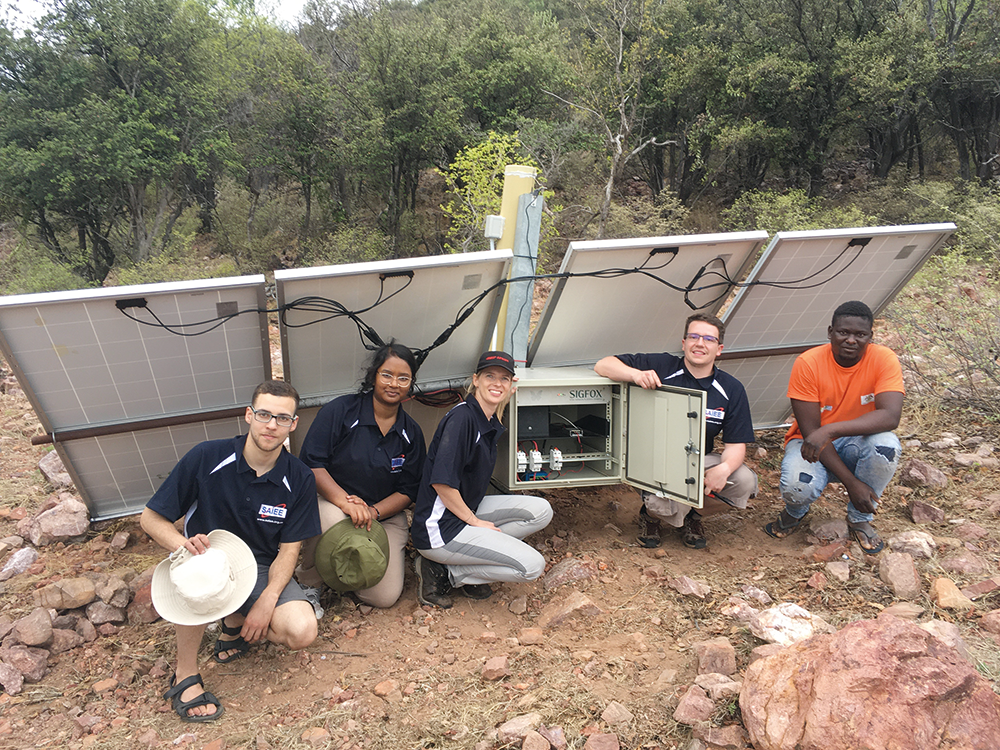
The time spent at the CSIR was invaluable as it afforded her the context of working as an engineer, something which can now be passed on to students. Exposure of engineering students to the real world of engineering is critical to their understanding of the field. She believes that studying towards engineering, which initially involves gathering information, is only one part of the academic equation. Sune says, “Understanding how to apply the obtained information can only be achieved when you see how the gained knowledge is applied in the real world. That is why I love to take students on community engagement or other research trips as they can then see how real engineering works.”
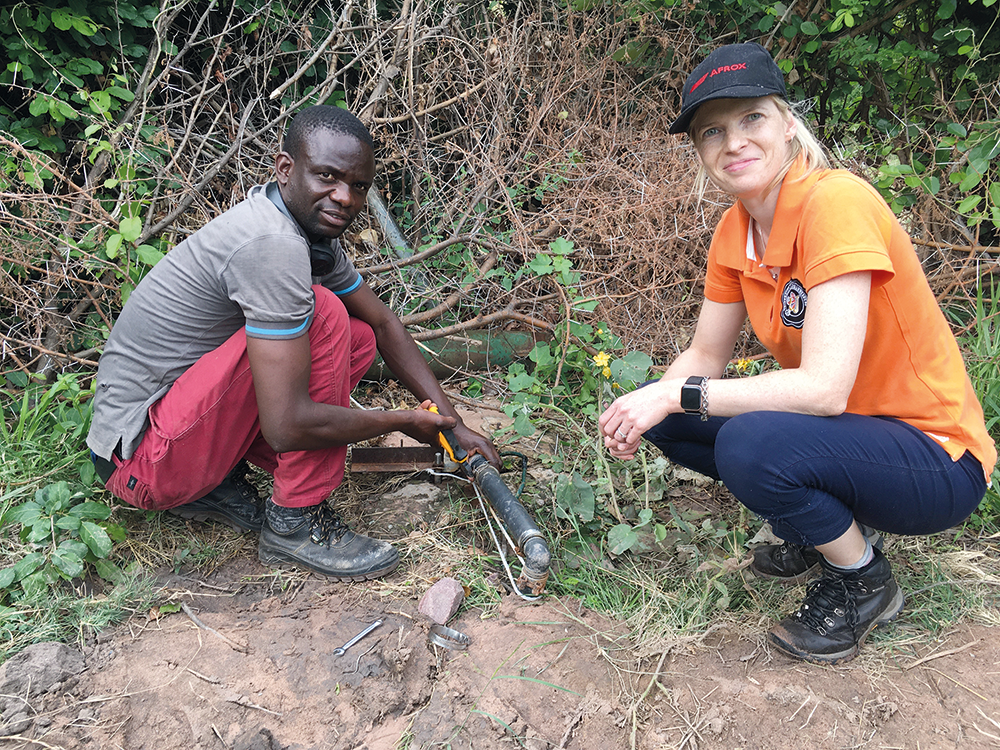
Technology has the power to change lives and the University of Johannesburg’s Faculty of Engineering and the Built Environment provides support to staff and students to allow the application of engineering knowledge and skills to uplift communities and provide assistance where necessary. Sune states, “I have seen how the installation of a solar borehole pump that provides water can bring life to a community and how a simple solar light and cell phone charger can enable a student to study when the sun goes down. I have also seen how students’ outlook on their own ability changes when they make these simple projects happen. Installing lightbulbs lights up huts, and hearts and minds at the same time. This is what engineering is to me – using technology to improve lives. So many students state that they are studying engineering to improve this country and communities, I want to help them see that this is indeed possible.”
Sune believes that the fourth industrial revolution is having a positive impact on their ability to complete projects and provide services to communities that were either not available or too costly to implement a few years back. “Technology enables us to monitor rural solar installations, track local weather for malaria research, build rural solar bakeries, track local wildlife to analyse and predict their movement patterns, and everything in between,” she says. “Affordable and accessible technology at your fingertips makes almost anything possible.”
Sune believes that the COVID-19 pandemic negatively affected education because the switch to online learning allowed students to survive but not thrive. ‘Engineers learn with their hands’ is a motto that is firmly entrenched in her teaching philosophy and she, along with countless other academics, are striving to get the current students back on track, to awaken the passion in them so that they may perform at the peak of their abilities both in the laboratories and in the field.
The role of women in engineering
Traditionally the idea remains that men are the ones who are interested in and wired for technical work. Because of this misguided notion, only a small group of women is seen in undergraduate engineering programmes. In fact, the percentage of women studying engineering at tertiary level is currently only 20% (according to ECSA Female Engineers Handbook). Many female students who come from smaller communities and villages state that women in STEM (science, technology, engineering and mathematics) is not something that is widely seen or understood by the community.
However, despite the low numbers of women in the engineering programmes, the ones that are enrolled are strong women who are determined to make a difference in the world and break the traditional mould. Sune believes that women bring compassion and softness into a traditionally hard field. However, she also acknowledges that most woman graduates end up in either a leadership role or a management position with only a small percentage remaining in a technical engineering role. Technical engineering work is, however, something that Sune is very passionate about and hopes to be both a positive role model and to inspire female students.
Being a woman in engineering, providing a balance between being a mother, a wife, an academic and an engineer is sometimes a struggle. However, Sune firmly believes that women are strong enough to take on these roles and to juggle them successfully, providing both a meaningful family life and a fulfilling engineering career.






© Technews Publishing (Pty) Ltd | All Rights Reserved
 printer friendly version