

Manufacturing / Production Technology, Hardware & Services


4IR and the role of abrasives in robotics

EMP 2023 Electronics Manufacturing & Production Handbook Manufacturing / Production Technology, Hardware & Services

It is well known that the most sustainable and productive manufacturers in Africa will be those embracing the fourth industrial revolution (4IR). To not embrace these technologies would mean lagging behind global peers.

In an age when all that 4IR has to offer, like accelerated digitalisation, artificial intelligence, cloud computing, 3D printing and robotics, no manufacturing entity utilising automation can hope to compete without being abreast of advances in these spheres. It is important for a business to invest in equipment and processes that improve efficiencies to boost both its growth and bottom line.

To endorse this, Dennis Phillips, national sales manager at PFERD South Africa, said, “The most significant benefits of 4IR are around automation, including automating routine and repetitive tasks to allow for better productivity and efficiencies. The manufacturing sector is ideally placed to benefit from these advances.”
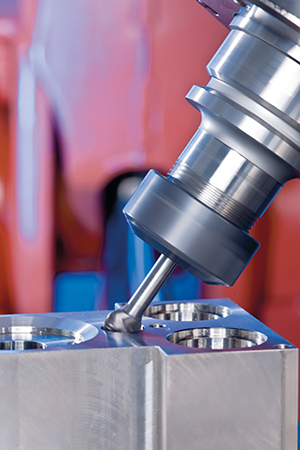

Abrasives in robotics

Robotic applications such as grinding, milling, and surface preparation and structuring, require a range of high-performance abrasives to have the desired impact on efficiency. PFERD can assist with the optimisation of automated processes by assessing the applications and advising on the correct tools.

Professional tools for automated processes

South Africa does, however, struggle with the infrastructure required to ensure that what 4IR has to offer, can be implemented to its fullest capabilities. These include:

• Being able to educate people to have the technical skills to employ the benefits of 4IR.

• Faster more streamlined internet connectivity and 5G mobile technology (which is being improved on).

However, having a reliable energy supply is vital and this is proving to be somewhat of a challenge.

SA manufacturers who implement robotics (probably the most meaningful addition to manufacturing operations) need to choose the most suitable consumables to maximise the efficiency, which in turn optimises the operations’ overall productivity:

• Milling, drilling and countersinking tools: Applications for these tools include chamfering, deburring, rounding edges, machining cast parts, together with trimming fibre-reinforced plastics. The milling tools’ precision design and dimensional stability allow for the easy programming of robots, while their performance and long tool life make them highly suitable for robotic applications because the frequency of tool changes is greatly reduced.
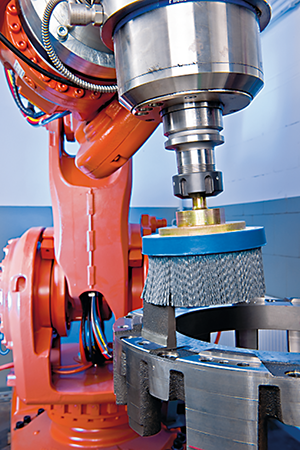

• Fine grinding and polishing tools: PFERD offers a wide range of high-performing coated and non-woven abrasives, suitable for numerous fine grinding and polishing jobs. Tasks such as automated stock removal, surface preparation and structuring can be done efficiently with consistent results.

• Diamond and CBN tools: Due to diamond and CBN tools’ constant tool geometry, they are highly suitable for robotic applications within the foundry industry. Their hardness and very long tool life reduces unproductive idle time attributed to tool changes, making them ideally suited for demanding applications within this industry.

• Composite filament brushes: High-quality technical brushes specifically developed for industrial, automated use. These brushes are particularly suitable for deburring complicated components such as cylinder heads and gear toothing.

Boosting the bottom line and gaining global recognition

The distinct advantage of robotic applications is that a workpiece can be produced and finished in fewer processing steps, resulting in less manual work, and with more consistent results.

Maximising the efficiency of business processes boosts local manufacturers’ bottom line and generates a better breed of SA manufacturers capable of competing on a global level.




Share this article:
Share via emailShare via LinkedInPrint this page

Further reading:

World-first 016008 mm component placement
Manufacturing / Production Technology, Hardware & Services
Fuji has achieved the world’s first placement of 016008 mm (0,16 x 0,08 mm or 006 x 003 inches) size components on printed circuit boards with its SMT pick and place machine, NXTR.

Read more...
Lifecycle and obsolescence: Protecting electronics through process
Production Logix Manufacturing / Production Technology, Hardware & Services
At Production Logix, we believe longevity is not accidental. It is engineered through early visibility, structured response, and disciplined execution, in partnership with our OEM customers.

Read more...
Maximising squeegee quality and durability
Testerion Manufacturing / Production Technology, Hardware & Services
Transition Automation has announced two new product advancements designed to improve SMT printing performance and extend squeegee life: laser-enhanced Permalex bonding and integrated edge protectors.

Read more...
NeoDen ND2 PCB screen printer
ZETECH ONE Manufacturing / Production Technology, Hardware & Services
The NeoDen ND2 PCB screen printing machine is a fully automatic stencil printer designed to deliver precise and consistent solder paste application in modern SMT production environments.

Read more...
Understanding the BGA rework process
Techmet Manufacturing / Production Technology, Hardware & Services
BGA rework is a highly technical process that involves removing the faulty component, preparing the circuit board, and installing a new or repaired device, while maintaining the integrity of the printed circuit board.

Read more...
Flexible three-process reflow soldering system
Truth Electronic Manufacturing Manufacturing / Production Technology, Hardware & Services
By combining multiple soldering technologies within a single system, the Vision TripleX system enables manufacturers to adapt easily to different assembly requirements, board designs, and production volumes.

Read more...
Inline vapour phase soldering for high-volume production
MyKay Tronics Manufacturing / Production Technology, Hardware & Services
The VP2200-100 vacuum inline vapour phase soldering system from ASSCON is designed for fully automated, high-volume electronics manufacturing where process consistency and solder joint quality are critical.

Read more...
Global electronics solutions since 1964
IMP Electronics Solutions Manufacturing / Production Technology, Hardware & Services
Over more than six decades, IMP Electronics Solutions has built a reputation for technical expertise, reliable supply chains, and strong partnerships with both customers and manufacturing partners.

Read more...
Driving excellence in electronics manufacturing
Jemstech Editor's Choice Manufacturing / Production Technology, Hardware & Services
Jemstech’s reputation for disciplined execution and client-focused service has earned it strong loyalty from companies operating in demanding industries.

Read more...
When do you need Nitrogen in reflow?
Truth Electronic Manufacturing Manufacturing / Production Technology, Hardware & Services
Nitrogen in reflow soldering is often seen as a performance enhancer, offering improved wetting, shinier joints, and fewer defects. But it is not always necessary.

Read more...


While every effort has been made to ensure the accuracy of the information contained herein, the publisher and its agents cannot be held responsible for any errors contained, or any loss incurred as a result. Articles published do not necessarily reflect the views of the publishers. The editor reserves the right to alter or cut copy. Articles submitted are deemed to have been cleared for publication. Advertisements and company contact details are published as provided by the advertiser. Technews Publishing (Pty) Ltd cannot be held responsible for the accuracy or veracity of supplied material.


© Technews Publishing (Pty) Ltd | All Rights Reserved