


The revolution for a carbon-neutral era goes beyond an environmental commitment. With premiums on energy-saving solutions that reduce emissions, markets and individual companies are shifting their industrial and energy infrastructures to produce unique and environmentally conscious products. Across various power categories such as photovoltaic and wind power generation, energy storage, battery management systems, and power supplies, high-power solutions are vital for creating safe and green systems.
MPS has introduced a series of dedicated controllers for high-power applications, as well as power ICs with high-voltage capacitive isolation technology. These MPS controllers provide the industry with efficient, simple, and reliable choices that can reduce the carbon footprint.
Energy efficient products
The MP18831 is an isolated half-bridge gate driver with up to 4 A of peak current capacity on the sink. Using MPS’s proprietary, high-voltage capacitive isolation technology, the MP18831 can withstand voltage of up to 5 kV RMS, and a common-mode transient immunity (CMTI) rated above 100 kV/µs. The gate driver drives several types of power switching devices with a short propagation delay and low pulse-width distortion. With package options including the wide body SOIC-16, narrow body SOIC-16, and LGA-13, the MP18831 can be integrated into many different systems.
The MPQ27800 is a four-channel digital isolator with an integrated isolated power supply. The device can provide a transmission rate up to 150 Mbps, and an isolated power supply of 5 V/200 mA. In place of a traditional optocoupler isolator, the signal transmission direction has a variety of options to improve performance. Like the MP18831, the MPQ27800 uses high-voltage capacitive isolation technology, which can withstand an isolation voltage of 5 kV RMS.
For certain isolated communication applications, a separate power supply must be utilised to supply power to the interface. In this scenario an isolated power supply module like the MID1W0505A can be considered. This is a semi-regulated, 3 kV DC isolation voltage power module that is available in an SOICW-16 package. The device supports a 4,5 to 5,5 V input voltage range, 1 W of output power, and excellent linear load regulation. Functional blocks such as power switch tubes, transformers, and feedback circuits are integrated in the package.
The high-power PSU typically consists of a two-stage circuit: a power factor correction (PFC) solution for AC/DC power conversion and an LLC converter for DC/DC power conversion. Because controllers are the main components of the power conversion circuit, MPS introduced the MPF32010, a PFC totem pole digital controller for AC/DC power conversion. The MPF32010 can be fully configured through the VB Pro 4.0 tool to customise the digital control loops and set protection limits and alarm functions. In addition, these devices can also be controlled and configured through the integrated RS-485 bus.
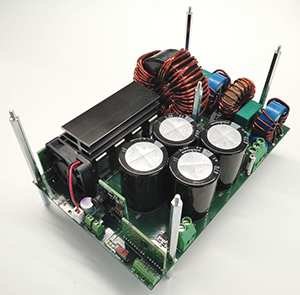
MPS offers a reference design for a power conversion module incorporating these latest products such as an isolated gate driver (the MP18831), a PFC + LLC combo controller (the MPF32010), and the MCS1802, an isolated current sensor. This collaborative design achieves a power density of 2,14 W/cm3, with an overall conversion efficiency of up to 96%.
| Tel: | +27 11 608 0144 |
| Email: | sales@nuvisionelec.co.za |
| www: | www.nuvisionelec.com |
| Articles: | More information and articles about NuVision Electronics |






© Technews Publishing (Pty) Ltd | All Rights Reserved
 printer friendly version