


Energy Harvesting is the process of capturing, transforming, and storing energy from various ambient sources like solar power, RF waves, and physical vibration. This technology plays an essential role in the foundation of ambient IoT, a new generation of ultra-low power connected devices that operate by drawing energy from their environment instead of relying on traditional batteries.
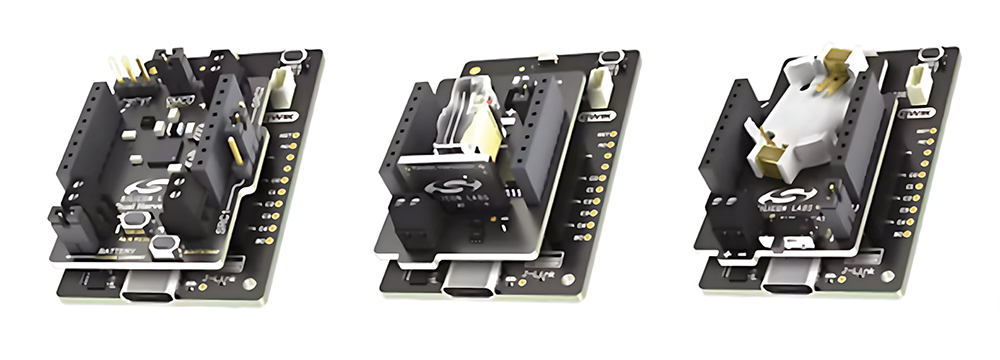 The Dual Harvester, Kinetic Button, and Battery shields.
By eliminating the need for batteries, energy harvesting technologies are transforming IoT devices by improving scalability, extending the lifespan of devices, increasing reliability, and reducing maintenance and costs associated with frequent battery replacement. These advancements also contribute to a more sustainable future of IoT by significantly lowering the detrimental impact that batteries have on the environment.
Light-based energy harvesting through photovoltaic technologies is leading the way, thanks to its ease of integration, reliability, and consistent performance in both indoor and outdoor environments.
Challenges of energy harvesting
An estimated 15 billion batteries are discarded every year, creating a significant ecological footprint. Ambient IoT addresses this environmental impact as well as the logistical challenges of battery-powered devices. Harvesting energy and battery-less solutions reduces waste and enables longer device life, making it ideal for applications like asset tracking, smart agriculture, and industrial monitoring.
However, adopting energy harvesting technologies, particularly PV-based energy harvesting solutions, comes with its own challenges and requirements.
A typical light-based energy harvesting system should include four main components:
• PV Cell to convert light into electrical energy. The efficiency of this conversion depends on light intensity, angle, and cell material.
• PMIC (Power Management IC) to regulate voltage, boost power, and perform maximum power point tacking (MPPT) to optimise energy capture.
• Energy storage to store harvested energy using supercapacitors, rechargeable batteries, or hybrid solutions. The choice depends on the application’s energy profile and duty cycle.
• Load: The embedded system that consumes energy, such as a sensor node or wireless transmitter.
When designing these systems, it is important to understand how energy flows from source to consumption, especially when relying on PV cells to power the IoT device. You need to know how much energy the PV cell generates under specific lighting conditions, how efficiently that energy is transferred and stored, and most importantly, whether it is enough to support your device’s workload and operation.
Energy harvesting hardware
xG22-EK8200A
The xG22E Energy Harvesting Explorer Kit is designed to enable functionality and accelerate the development of energy-harvesting powered devices using the RF protocols Bluetooth LE and Zigbee Green Power. Built on the Silicon Labs EFR32xG22E Explorer Board, it offers ultra-fast low-energy cold start and low-energy deep sleep wake-up, making it ideal for a multitude of energy-constrained applications. It includes three shields co-developed with industry leading PMIC provider e-peas that fit securely into the Explorer Kit Board, enabling evaluation of sources including PV cells.
BRD8201A – Dual Harvester Shield
This shield uses e-peas’ latest and most advanced PMIC, the AEM13920, and allows developers to experiment with dual harvest sources simultaneously, debug standalone operation scenarios, and evaluate battery lifetime.
BRD8202A – Kinetic Button Shield equipped with BRD8206A – Kinetic button
This shield allows the demonstration of a specific application using a kinetic switch to power the wireless SoC. It is dedicated for kinetic/pulse harvest applications and uses the e-peas AEM00300.
BRD8203A - Battery Shield
This shield allows for experimentation with alternative battery chemistries and supercapacitors.
By leveraging PV cells and advanced PMICs like the e-peas AEM13920, developers can design systems that dynamically adapt to environmental conditions, optimise energy capture through maximum power point tracking (MPPT), and maintain energy balance even in fluctuating light scenarios.
| Tel: | +27 11 608 0144 |
| Email: | sales@nuvisionelec.co.za |
| www: | www.nuvisionelec.com |
| Articles: | More information and articles about NuVision Electronics |






© Technews Publishing (Pty) Ltd | All Rights Reserved
 printer friendly version