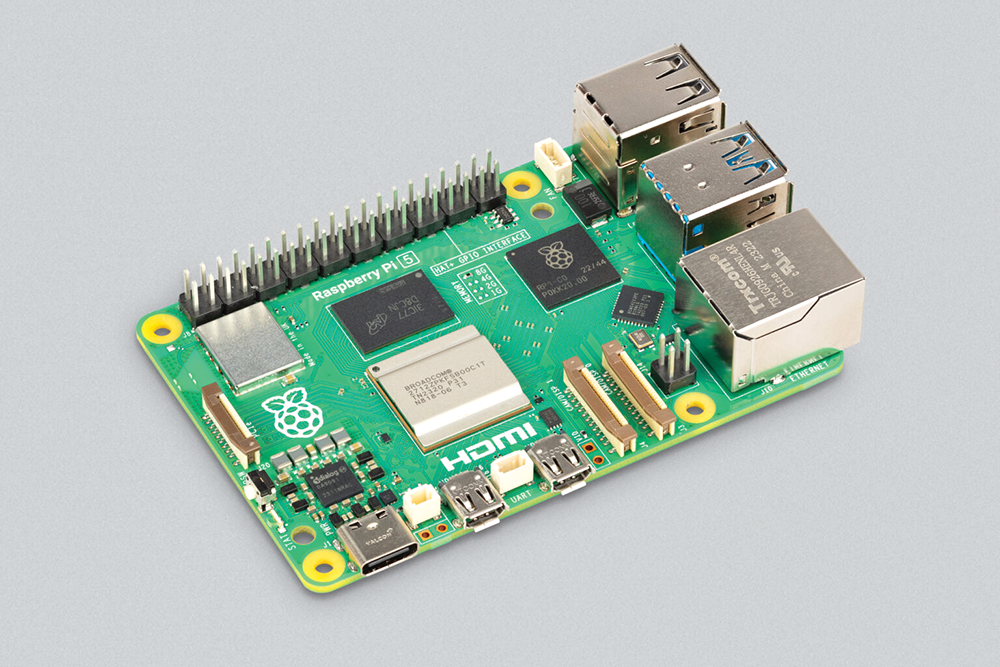
The Raspberry Pi Foundation has just announced the new Raspberry Pi 5 SBC, available from the end of October 2023. The R-Pi 5 comes with new features and is over twice as fast as its predecessor, the R-Pi 4, thanks to an upgrade to the main processor.
Changes over the older model include:
• 2,4 GHz quad-core 64-bit Arm Cortex-A76 CPU.
• VideoCore VII GPU, supporting OpenGL ES 3.1, Vulkan 1.2.
• Dual 4Kp60 HDMI display output.
• 4Kp60 HEVC decoder.
• Dual-band 802.11ac Wi-Fi.
• High-speed microSD card interface with SDR104 mode support.
The upgraded Arm Cortex-A76 CPU has four 2,4 GHz cores, effectively improving the performance by 2,5 times. This will come in handy when driving the two 4K display outputs at 60 Hz. Also included are dual four-lane MIPI transceivers, each capable of connecting to either two cameras, two displays, or one of each.
A welcome addition to the R-Pi form factor is the PCIe 2.0 interface. This will allow the addition of a raft of high-speed peripherals that can utilise the interface. At launch, a HAT connecting to the PCIe bus will be available, which will support NVMe SSDs with the M.2 format.
Another new feature is the real-time clock. A battery connector has been provided on the board to allow the clock to keep time when power is removed. This will allow applications to keep time in the absence of a network connection.
Finally, a power button has been included on the side of the SBC. Users will no longer have to connect/disconnect the power supply to boot up or shut down the computer.
The OS has also been given an upgrade to support the new features present in the R-Pi 5.
Women and the future of engineering in South Africa
Editor's Choice
With women making up just 16% of registered engineering professionals in South Africa, AvenirHoldings CEO, Tshidi Mndzebele, is calling on women engineers and graduates to pursue formal professional registration as a key step to unlocking career growth and industry leadership.
Read more...The effect of seasonal changes on ESD performance in South Africa Actum
Editor's Choice Circuit & System Protection Manufacturing / Production Technology, Hardware & Services
Electrostatic discharge performance is influenced by several environmental factors, with relative humidity being one of the most important. This is particularly relevant in South Africa, where seasonal changes can result in significant differences in humidity levels.
Read more...Compact RTK design: More than just the receiver iCorp Technologies
Editor's Choice Telecoms, Datacoms, Wireless, IoT
In practice, engineers building compact RTK products keep discovering the same thing: the hardest component in the system is no longer the receiver. It is the antenna.
Read more...The signal-to-noise challenge in large-scale IIoT Sigfox South Africa
Editor's Choice Telecoms, Datacoms, Wireless, IoT
For much of the last decade, the industrial IoT industry has been driven by a relatively simple assumption: if a little data is useful, more data must be better. That thinking shaped countless deployments.
Read more...Women building South Africa’s power infrastructure
Editor's Choice
As South Africa celebrates Women’s Month in August, women are increasingly taking their place on the factory floor, in technical workshops and across engineering environments, helping manufacture the infrastructure that keeps the country’s electricity network running.
Read more...More efficient production with optimised procurement
Editor's Choice
The smallest part on the BOM is usually the one that holds it up. Interconnect, passive and electromechanical components rarely get attention until they are missing. That is starting to change, and it is reshaping how procurement teams think about risk.
Read more...Locate underground cable faults faster with the Fluke AF2082 A-Frame Comtest
Editor's Choice Test & Measurement
Underground cable faults can lead to costly downtime, service disruptions, and extensive excavation if the fault location is uncertain. The AF2082 simplifies this process by guiding operators directly to the fault point.
Read more...Compact direct Time-of-Flight 3D LiDAR module Altron Arrow
AI & ML DSP, Micros & Memory
The VL53L9 from STMicroelectronics is the first direct Time-of-Flight (dToF) 3D LiDAR all-in-one module in ST’s portfolio, offering a resolution of 2,3K zones, wide field of view, on-chip processing, 100 frames per second, and sensing range from 5 centimeters to 9 meters.
Read more...Here is what we learnt from three supply chain crises Seven Labs Technology
Editor's Choice
Component crises are not random events. They follow a pattern. After fifteen years and three major disruptions, Seven Labs knows exactly what that pattern demands, and what it takes to keep production lines moving.
Read more...The new reality of PCB material supply Jemstech
Editor's Choice Manufacturing / Production Technology, Hardware & Services
How resilient manufacturing strategies are helping OEMs navigate a changing global supply chain.
While every effort has been made to ensure the accuracy of the information contained herein, the publisher and its agents cannot be held responsible for any errors contained, or any loss incurred as a result. Articles published do not necessarily reflect the views of the publishers. The editor reserves the right to alter or cut copy. Articles submitted are deemed to have been cleared for publication. Advertisements and company contact details are published as provided by the advertiser. Technews Publishing (Pty) Ltd cannot be held responsible for the accuracy or veracity of supplied material.









 printer friendly version