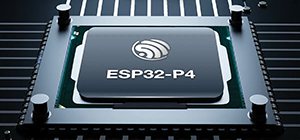
Espressif Systems has announced the upcoming release of its latest SoC, the ESP32-P4. It is powered by a RISC-V CPU, with an AI instructions extension, an advanced memory subsystem, and integrated high-speed peripherals.
Powered by a dual-core RISC-V CPU running up to 400 MHz, ESP32-P4 also supports single-precision FPU and AI extensions, thus providing all the necessary computational resources. In addition, ESP32-P4 integrates an LP-Core, which can run up to 40 MHz. This is critical in terms of supporting ultra-low-power applications which may occasionally require high computing. In such scenarios, the HP cores can be kept off for most of the time, for power-saving purposes.
The ESP32-P4 HP core system has 768 kB of on-chip SRAM, which can become accessible as cache when external PSRAM is available. In addition, the ESP32-P4 HP core system has 8 kB of zero-wait TCM RAM, which can be used for fast data buffers or time-critical sections of code. This high-performance memory system, along with the support for external PSRAM and Flash, ensures that the memory-access latency and the available size of memory are not limited.
The ESP32-P4 has more than 50 programmable GPIOs, and the SoC supports all the commonly used peripherals, such as SPI, I2S, I2C, LED PWM, MCPWM, RMT, ADC, DAC, UART, and TWAITM. Furthermore, the ESP32-P4 supports USB OTG 2.0 HS, Ethernet, and SDIO Host 3.0 for high-speed connectivity.
ESP32-P4 is designed for high-performance applications that require strong security, and aims to cater to the next era of embedded applications, which will rely on solid support for rich Human-Machine Interfaces, efficient edge computing, and increased IO-connectivity requirements.
Quectel’s single-board computers put industrial edge computing on one PCB iCorp Technologies
Computer/Embedded Technology
Quectel Pi series of single-board computers (SBCs), designed for a broad range of industrial applications, include three compact development platforms – the Quectel Pi M1, L1, and H1 boards.
Read more...Simplifying system design iCorp Technologies
Telecoms, Datacoms, Wireless, IoT
The FGMC63N tri-band MCU Wi-Fi 6E module from Quectel addresses offers integrated connectivity across 2,4 GHz, 5 GHz, and 6 GHz bands in a compact, highly optimised design.
Read more...Low-power memory born for edge AI iCorp Technologies
DSP, Micros & Memory
As intelligence moves from the cloud to the device, memory become one of the most important design decisions in modern electronics. Edge-AI products – from smart speakers and surveillance cameras to ADAS modules and wearables – need to move data fast, but they also need to sip power. Winbond’s low-density LPDDR4/LPDDR4X SDRAM range is built to strike that balance.
Read more...Compact direct Time-of-Flight 3D LiDAR module Altron Arrow
AI & ML DSP, Micros & Memory
The VL53L9 from STMicroelectronics is the first direct Time-of-Flight (dToF) 3D LiDAR all-in-one module in ST’s portfolio, offering a resolution of 2,3K zones, wide field of view, on-chip processing, 100 frames per second, and sensing range from 5 centimeters to 9 meters.
Read more...SoC brings scalable edge AI to life Altron Arrow
AI & ML
The NXP i.MX 937 applications processor is optimised for performance without excessive power draw and bridges the gap between entry-level chips and high-end processors.
Read more...Wall-mount cooling for Edge IT
AI & ML
Designed to run 24/7 in critical compute environments, Vertiv CoolPhase Wall delivers up to 60% greater airflow than comfort cooling.
Read more...Compact MCU for IoT endpoints iCorp Technologies
DSP, Micros & Memory
Quectel’s FCM266D combines single-band 2,4 GHz Wi-Fi 6 with Bluetooth LE 5.4 in an ultra-compact LCC package measuring just 20 x 18 x 2,4 mm.
Read more...Compact direct Time-of-Flight 3D LiDAR module Altron Arrow
Opto-Electronics Electronics Technology AI & ML
The VL53L9 from STMicroelectronics is the first direct Time-of-Flight (dToF) 3D LiDAR all-in-one module in ST’s portfolio, offering a resolution of 2,3K zones, wide field of view, on-chip processing, 100 frames per second, and sensing range from 5 centimeters to 9 meters.
While every effort has been made to ensure the accuracy of the information contained herein, the publisher and its agents cannot be held responsible for any errors contained, or any loss incurred as a result. Articles published do not necessarily reflect the views of the publishers. The editor reserves the right to alter or cut copy. Articles submitted are deemed to have been cleared for publication. Advertisements and company contact details are published as provided by the advertiser. Technews Publishing (Pty) Ltd cannot be held responsible for the accuracy or veracity of supplied material.









 printer friendly version