Equipment suppliers are racing to integrate AI into their solutions. Equally, manufacturers are racing to integrate the technology into their processes. As surface-mount electronics assembly is already highly automated, AI brings the opportunity to extend machine-like speed and repeatability further into complex tasks that require learning, judgement, and adaptability. Automatic optical inspection (AOI) is a prime example.
AI’s skills in image classification, already widely used in applications such as disease diagnosis, automated driving, content moderation, and others, are a great fit with industrial quality control, and AOI in particular. Conventional approaches to AOI are heavily dependent upon the judgement of experts when setting up the system, introducing new products, and subsequently while production is ongoing to inspect images of suspected defect areas.
AI first became available in commercial AOI software to help with setting up and running the equipment. Automatic component library matching uses deep learning to identify component types from images and so enable the optimum library to be selected automatically. AI is also used to assist 3D measurement of components to generate data for parts that are not found in any existing library.
While AI has simplified and accelerated library management, the technology is now ready to offer greater value to manufacturers by applying its learning and classification skills to improve inspection accuracy on the production line. Here, relying on human judgement to classify defects as real defects, false positives, or false negatives can be time consuming and introduces variability into the manufacturing process.
When judgement is left to human experts, individual operators can apply different criteria based on their experience level and opinions. Introducing AI to assist these judgements offers the opportunity to relieve dependence on experts and eliminate inaccuracies, thereby delivering a boost to productivity.
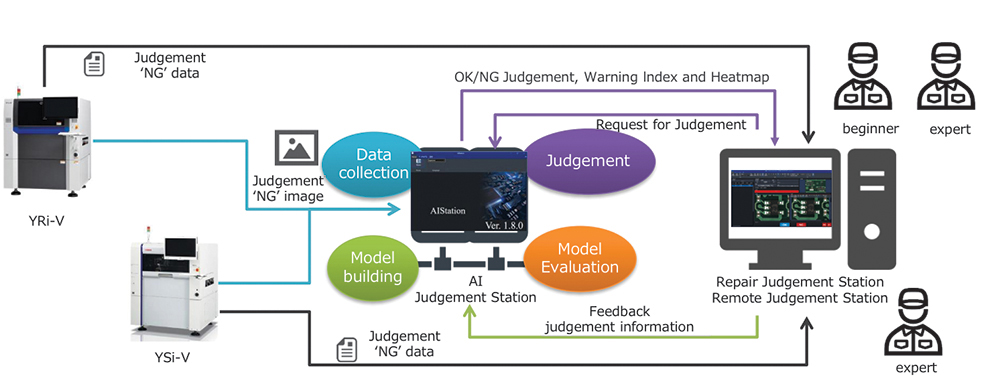 Figure 1. Data collection, assisted judgement, and improvement through automated learning.
Figure 1 shows how AI can enhance secondary judgement, helping to increase the value of human skills and minimise the effects of human errors. The AOI system shares images of detected defect areas with both human operators and the AI Judgement software application that hosts machine-learning models. The human experts assess the nature of the defects, and their judgements are fed back to the AI software. By repeatedly adjusting as the experts’ judgements are logged, the model quickly acquires the experts’ best judgement skills and eliminates human errors. When trained, the model makes judgements allowing the operators to work confidently and more quickly as well as maintaining a consistently high level of accuracy. Thus, the operators can match the performance of skilled inspectors.
AI-assisted secondary judgement can enhance repeatability to prevent defective units escaping from the factory, and can quickly identify false positives to prevent non-defective assemblies being sent for unnecessary rework. This stabilises the factory’s quality performance and increases productivity.
Confidence index
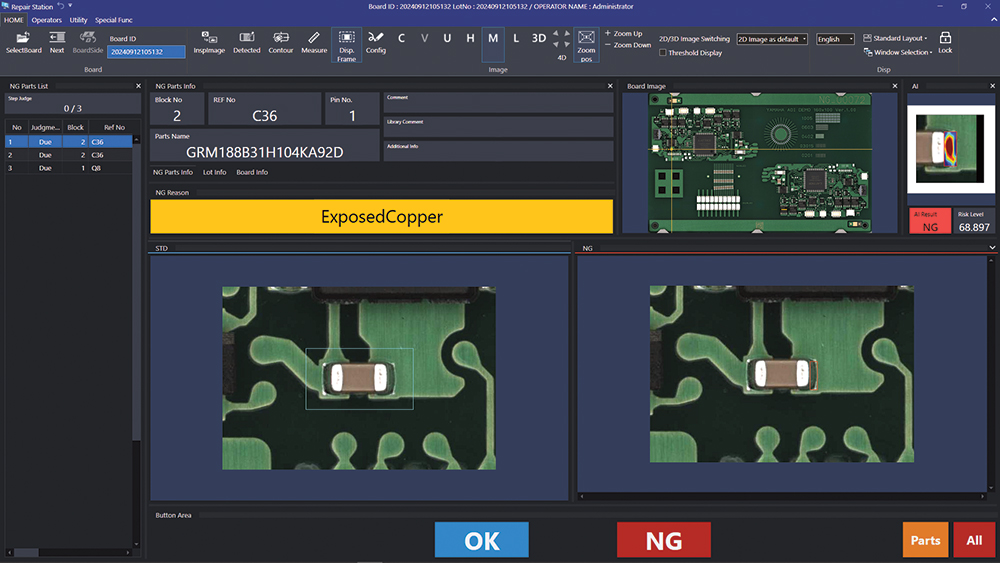
Yamaha’s AI Judgement software for AOI provides comprehensive information for the operator that explains its own Good/NoGood decisions, including images, tables, and a confidence indicator (figure 2). In the case of soldering defects, such as bridges or contamination, this index is shown as a graphical heatmap and calculated anomaly index. Judgements of other defects such as character recognition are expressed with a matching ratio. The software also reports its own performance with calculations of the anomaly detection rate and over-detection suppression.
From assistance to automation
Moving forward from AI-assisted secondary judgement by human operators, the next step is for fully autonomous AOI that performs consistently up to the standard of the best human experts in the company. Yamaha’s AI Judgement software is ready to connect seamlessly with the remote repair station and can share AI-judgement results directly with inline AOI systems, to continuously improve inspection accuracy. Leveraging AI to automate secondary judgement lets inline AOI systems operate continuously without intervention, at a high rate, with minimal false negatives or false positives.
Conclusion
Artificial intelligence can enhance multiple aspects of AOI, including accelerating library creation and automatically generating missing component data. With its image classification capabilities, AI is ready for deployment in the production line to assist and eventually automate secondary judgement. Historically, this task has demanded the attention of highly trained inspectors. AI now allows operators to quickly reach a comparable level of proficiency.






© Technews Publishing (Pty) Ltd | All Rights Reserved
 printer friendly version