


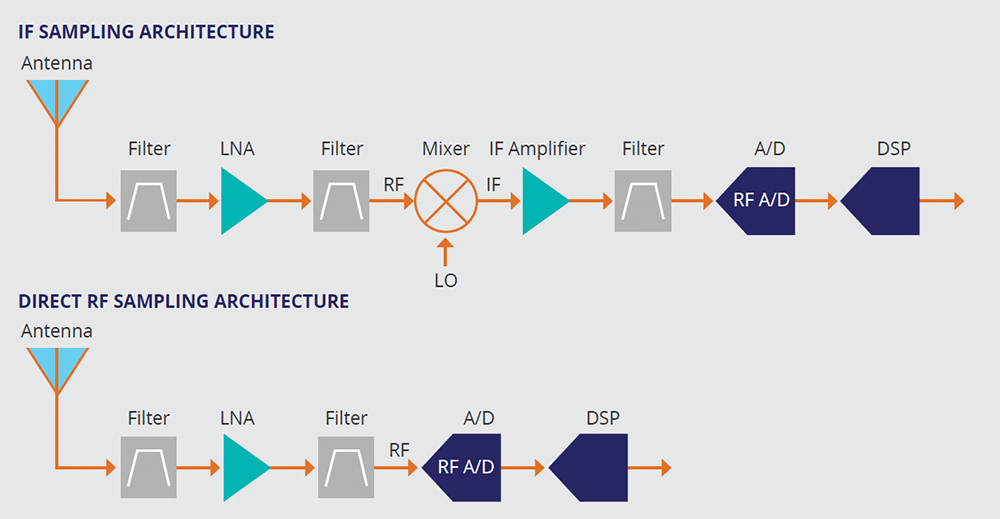
 Figure 1. Direct RF vs IF: receive-application architecture.
Electronic warfare (EW) involves the acquisition of RF signals of interest followed by signal processing to extract information and deliver an effective response. Adversaries on the electronic battleground steadily evolve their systems to attain an advantage over their opponents. The latest boost comes from emerging FPGA architectures that combine advanced RF converters and high-performance processing engines in a single package. The following tips can help designers apply these devices to increase the effectiveness of EW systems.
1. Direct RF technology saves SWaP
The key challenges of modern EW systems involve capturing and generating high-frequency wideband RF signals using data converters. Traditionally, these data converters have operated not at the antenna’s RF frequency, but rather at a lower intermediate frequency (IF), and they have required a frequency-translation stage to convert IF to RF and vice versa. In emerging modern architectures, ‘direct RF’ data converters operate directly at the antenna frequency, eliminating the need for IF stages, thereby saving SWaP (figure 1).
2. Defence companies can leverage advances in the 5G commercial wireless market
Commercial 5G installations require large numbers of massive-MIMO phased-array antennas. Each antenna typically contains 64 elements, and each element requires its own signal-processing channel. Anticipating the need to save SWaP, Xilinx AMD, in 2017, introduced. a radio-frequency system on chip (RFSoC) with eight 5 Gsps ADCs, eight 9,8 Gsps DACs, multicore processors, and the ability to operate at RF frequencies to 6 GHz. The defence industry quickly embraced the device. Today, direct RF converters offer sample rates up to 64 Gsps and RF performance up to 38 GHz. Although these converters are not yet integrated into the latest FPGAs, they are available as packaged BGA devices, or in chiplet form and are compatible with the latest FPGA processing architectures.
3. FPGA processing architectures include a heterogeneous mix of computing resources to best adapt to the tasks at hand.
AMD now offers Versal ACAP (adaptive compute acceleration platform) devices in a series of six SoC architectures, each with specific blends of processing engines and peripherals. The engines include application and real-time scalar processors as well as adaptable engines that utilise FPGA programmable logic plus various types of memory.
4. Intelligent engines augment FPGA performance with digital signal processing, artificial intelligence, and machine learning.
Versal ACAP also offers two types of intelligent engines: DSP and AI. The DSP engines are efficient, real-time signal-processing blocks that include fixed and floating-point multipliers, accumulators, arithmetic units, data multiplexers, and barrel shifters for both scalar and vector data types. The AI engines, each consisting of a 2D array of AI tiles, come in two versions: general AI and AI-ML. The general AI engines support both ML applications and advanced signal processing for beamforming, radar, FFTs, filters, video enhancement, and image processing. The AI-ML engines are optimised for ML tasks including image and speech recognition and predictive analytics. They also offer extended support for ML data types.
5. The Versal ACAP devices with direct RF converters can be applied to EW systems today.
To begin applying Versal ACAP technology with direct RF converters, an RF system-in-package (RFSiP) or open-architecture VPX board can be chosen. Mercury Systems offers multi-chip modules combining industry FPGAs with high-speed IO. In addition, Mercury’s SCFE6931 VPX card features two VC1902 Versal AI Core FPGAs and optical I/O interfaces that can connect to wideband direct RF data converters, while Mercury’s 5560 VPX card features one Versal HBM ACAP FPGA with a mezzanine card site for direct RF data converters.
6. Chiplet fabrication capabilities enable the integration of FPGAs and direct RF data converters.
Another FPGA maker, Intel, offers two families of direct RF FPGAs, the Stratix 10 AX and the new Agilex. Intel employs its embedded multi-die interconnect bridge (EMIB) and 2.5D packaging processes to fabricate these multi-chip modules, attaching various combinations of chiplets to the main FPGA chip. Those chiplets include Jariet Electra-MA 64-GS/s 10-bit data converters for the Stratix 10 AX device and two Agilex versions. A third Agilex version will incorporate 4 Gsps 14-bit ADCs and 12 Gsps 14-bit DACs.
7. An OpenVPX card containing the Stratix 10 AX device can be used in EW systems.
In January 2023, Mercury introduced the DRF3182 OpenVPX card, which features the Stratix 10 AX. It provides direct RF conversion of four transceiver channels across a 2- to 18-GHz frequency band to support numerous EW applications. Eight PCIe Gen3 x4 data-plane ports deliver 64 GB/s of data across a backplane to other cards.
8. FPGAs with direct RF conversion reduce latency and capture fast transients.
In addition to saving SWaP by eliminating IF stages, FPGAs with direct RF conversion boost performance by reducing latency, minimising analogue phase and amplitude uncertainties, and simplifying channel synchronisation. In addition, direct RF converters can instantaneously tune across a very wide frequency span, identifying transient signals that typical scanning receivers can easily miss.
9. Innovation in FPGAs with direct RF data conversion will continue.
FPGA and direct RF data-converter makers will continue to boost the performance and flexibility of their offerings and Mercury Systems will build on its experience in the aerospace and defence industry to make new direct RF innovations fully accessible for all EW and related mission-critical applications.
| Tel: | +27 12 667 5212 |
| Email: | sales@rfibersolutions.com |
| www: | www.rfibersolutions.com |
| Articles: | More information and articles about RFiber Solutions |






© Technews Publishing (Pty) Ltd | All Rights Reserved
 printer friendly version