


There is well documented historical proof that post-reflow circuit assemblies, when subjected to harsh environments, are particularly vulnerable to failure mechanisms that can drastically reduce their performance and longevity. However, modern electronic assemblies are far more susceptible to this phenomenon. Among the critical issues affecting these assemblies is ionic contamination, which can lead to a series of deleterious processes, including electrochemical migration (ECM). This paper explores the relationship between harsh environmental conditions, ionic contamination, and the resulting electrochemical effects on circuit assemblies.
Harsh environments and its effect on circuit assemblies
Harsh environments for electronic assemblies typically include high humidity, extreme temperatures, salt spray, and exposure to corrosive chemicals. Such conditions are encountered in a wide variety of applications, from automotive electronics to aerospace systems and industrial machinery. These environments impose stress on circuit assemblies, accelerating degradation mechanisms that may remain dormant under milder conditions.
While most assemblers may view the above statement with a degree of relief, knowing their assemblies are not exposed to salt spray and/or exposure to corrosive chemicals, the degree for which a climactic environment may be considered harsh is far less than that.
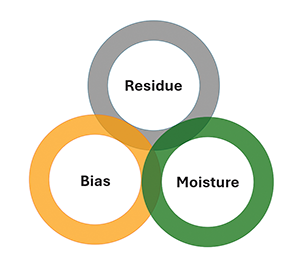
In reality, there are three factors [figure 1.] which, when combined, have the potential to result in electrochemical migration. These three factors are an electrical bias, ionic residues, and moisture.
What is electrochemical migration and what are its associated failure mechanisms?
Electrochemical migration (ECM) is a degradation mechanism that occurs in the presence of moisture, a biasing voltage, and ionic contamination. It involves the movement of metal ions across a substrate, leading to the formation of conductive metal filaments. This phenomenon is particularly problematic in high-density circuits, where tight spacing between conductors increases the likelihood of short circuits.
Electrochemical migration typically involves the following steps:
1. Dissolution of metal: Under the influence of an applied electric field and in the presence of an electrolyte (water containing dissolved ions), metal atoms at the anode dissolve and become positively charged ions.
2. Migration of metal ions: The dissolved metal ions migrate through the electrolyte, driven by the electric field, towards the cathode.
3. Deposition and growth: At the cathode, the metal ions are reduced back into solid metal, forming dendritic structures, also known as metal filaments. Over time, these dendrites grow and can bridge adjacent conductors, causing short circuits.
The most common metals involved in ECM are silver, copper, and tin, which are widely used in circuit assembly components. Silver, in particular, is highly susceptible to ECM due to its relatively high solubility in water and tendency to form dendrites under humid conditions.
Ionic contamination and its sources
Ionic contamination refers to the presence of ionisable substances on the surface of circuit assemblies. These contaminants may originate from various sources during the manufacturing process, including solder flux residues, improperly cleaned solder joints, fingerprints, or airborne pollutants. The most common ionic species found on post-reflow assemblies are halides (chlorides, bromides), sulphates, and nitrates. These ions, when exposed to moisture, can dissolve and become conductive, leading to an increase in surface conductivity.
Post-reflow assemblies are particularly vulnerable to contamination from flux residues. During the soldering process, flux is used to remove oxides from metal surfaces, ensuring a clean, reliable connection. However, if flux residues are not adequately cleaned, they can leave behind ionic species that attract moisture from the environment, particularly in humid settings.
In the early 1990s, many assemblers, in an effort to eliminate a cleaning process, switched to the use of ‘no clean’ fluxes. While this strategy was largely successful for the greater part of two decades, miniaturisation along with accompanying high density component placement, reduced the circuit assembly’s tolerance for residue. Adding insult to injury, the elimination of a cleaning process not only allowed no-clean flux residues, albeit minimal, to remain on the assembly, it also allowed all other forms of contamination to remain. This includes residues from board and component fabrication, various process residues, and human residues. These residues, in totality, have proven to be problematic on modern circuit assemblies.
Electrochemical migration: A consequence of ionic contamination and the manifestations of electrochemical migration
The primary manifestation of electrochemical migration is the growth of metal dendrites, which can bridge conductors, leading to catastrophic failure. These dendrites typically form between pads, traces, or solder joints on printed circuit boards (PCBs). The consequences of dendritic growth can vary depending on the location and nature of the circuit:
1. Short circuits: In the most severe cases, the dendritic growth will connect two adjacent conductors, creating a direct short circuit. This can result in immediate malfunction, damage to components, or even complete failure of the electronic system.
2. Intermittent faults: In some cases, the dendritic filaments may not fully bridge conductors, but may create intermittent connections that lead to sporadic failures. These types of faults can be difficult to diagnose and often require time-consuming troubleshooting.
3. Leakage currents: Even without full bridging, ECM can cause increased leakage currents between conductors. This is the result of parasitic electrical leakage and can degrade the performance of sensitive analogue circuits, cause signal integrity issues, or increase power consumption.
The role of harsh environments in accelerating ECM
Harsh environmental conditions, particularly high humidity, are key accelerants of electrochemical migration. Humid environments provide the moisture needed to dissolve ionic contaminants into a conductive electrolyte. The higher the humidity, the greater the amount of water available to form this electrolyte, increasing the likelihood of ECM.
To make matters worse, some of the post reflow residue species may be hygroscopic (readily taking up and retaining moisture).
In environments where temperature fluctuations are common, condensation can also occur on the surface of circuit assemblies. This condensation can dissolve ionic residues left on the board and create localised wet areas where ECM is likely to take place. Additionally, in environments with high salt content, such as marine or coastal areas, the introduction of chlorides into the system further increases the potential for ECM and corrosion.
To continue reading the full paper, browse to www.dataweek.co.za/ex/jan26-Aqueous.pdf
| Tel: | +27 11 869 0049 |
| Email: | [email protected] |
| www: | www.mykaytronics.co.za |
| Articles: | More information and articles about MyKay Tronics |






© Technews Publishing (Pty) Ltd | All Rights Reserved
 printer friendly version