



[Sponsored] PCI Express (PCIe) has become the backbone of modern high-performance systems, enabling everything from AI accelerators to storage and embedded computing platforms. Each new generation promises higher bandwidth; but that performance comes with a cost. As data rates increase, the physical layer becomes significantly more challenging to manage.

At lower speeds, it was often possible to treat the interconnect as a secondary concern. Today, that is no longer the case. Faster edge rates, tighter timing windows, and reduced signal margins mean that the physical channel must be considered as a primary design constraint from the outset.
Why PCIe gets harder at higher speeds
One of the key shifts with modern PCIe is that frequency alone is not the problem. The combination of higher frequencies and faster edge rates increases sensitivity to loss and discontinuities.
As data rates rise:
• Insertion loss increases, reducing signal amplitude over distance.
• Reflections become more significant, driven by impedance mismatches.
• Crosstalk and noise coupling increase, especially in dense layouts.
• Timing margins shrink, leaving less room for error.
To compensate, PCIe devices now include advanced equalisation techniques, such as transmitter pre-emphasis and receiver-side adaptive equalisation. These mechanisms are powerful, but they are not unlimited. They can only compensate for loss within the available channel budget.
In other words, equalisation can extend performance, but it cannot compensate for a poorly designed channel.
Where control really sits
It is tempting to assume that modern silicon ‘solves’ signal integrity through training and adaptation. In reality, these features operate within the constraints imposed by the physical interconnect.
The channel, which includes PCB traces, vias, connectors, and cables, defines the starting point. Every element in that path contributes to loss, reflections, and distortion. The role of the transceiver is to work within those limits, not to remove them entirely.
PCIe performance is not determined solely by the device. It is shared between the silicon and the physical architecture.
The channel begins at the architecture level
In many designs, PCIe is initially defined in terms of lanes, generations, and bandwidth targets. Only later does the focus shift to layout and interconnect selection. At higher data rates, this sequence can introduce risk.
• Whether to use direct board-to-board connections.
• How many connectors are included in the path.
• Whether to introduce cable assemblies.
• The overall topology of the system.
These are not just mechanical considerations. They define the electrical environment in which PCIe must operate.
Once these decisions are made, the available signal integrity margin is largely fixed.
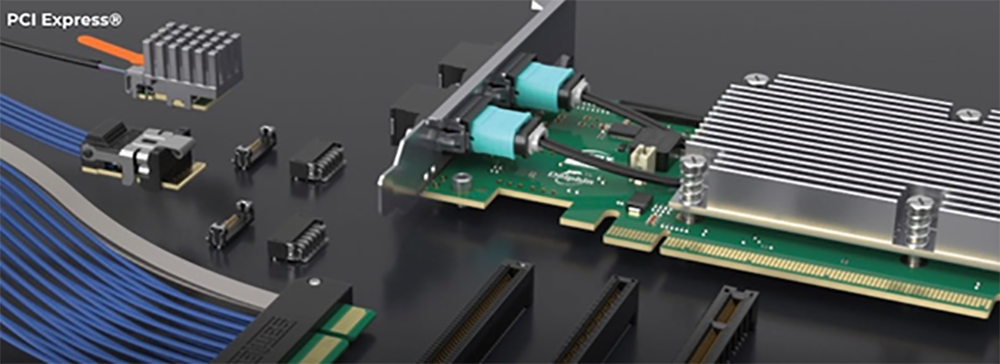
Understanding interconnect trade-offs
Each interconnect strategy delivers advantages, but their impact on system performance must be considered:
• Direct board-to-board connections offer the lowest loss by minimising interfaces. However, they can constrain system layout and limit serviceability.
• High-speed mezzanine connectors enable dense, modular designs and are widely used in embedded and compute platforms. Their performance depends on careful optimisation of signal paths and mating interfaces.
• High-speed cable assemblies provide flexibility in routing and allow separation between functional blocks. They can also reduce PCB complexity, but introduce their own requirements around shielding, skew control, and connector transitions.
• Backplane systems support scalability and maintainability in larger systems. However, they often result in longer channels, which can challenge higher PCIe generations without careful design or the use of re-timers.
There is no single solution that fits every system. The ideal approach depends on balancing electrical performance, mechanical constraints, cost, and scalability.
Margin as a finite resource
PCIe system design can be made easier by treating signal integrity margin as a finite budget. Every element in the channel consumes part of that budget:
• Trace length contributes to attenuation.
• Vias introduce discontinuities.
• Connectors add insertion loss and potential reflections.
• Materials influence dielectric losses.
Individually, these effects may appear to be within acceptable limits, but collectively they determine whether the channel meets the required performance.
If too much margin is consumed early, for example through long routing paths or multiple interconnects, there is little remaining headroom for optimisation. This is why late-stage fixes can be difficult and costly.
Designing for the newest generations
As PCIe continues to evolve towards Gen5, Gen6 and beyond, these challenges become more pronounced. Channel budgets tighten further, and design tolerances shrink.
Successful designs increasingly depend on:
• Early consideration of interconnect strategy.
• Close collaboration between mechanical, electrical, and SI teams.
• Use of simulation and modelling tools at the architectural stage.
Choosing the right interconnect design is a critical part of the overall system. A wide range of high-speed solutions are available to support these design challenges. For example, Samtec offers board-to-board, mezzanine, backplane, and cable assembly technologies specifically engineered for high data rate applications, with careful attention to signal integrity, density, and scalability.
In South Africa, these solutions are available through Spectrum Concepts, providing local access to components, application support, and design expertise. This enables engineers to evaluate different architectural choices and select interconnect strategies aligned with their system requirements.
Conclusion
As PCIe data rates continue to increase, system performance is no longer defined solely by the capabilities of the silicon. The physical channel plays a central role, and its characteristics are largely determined by early architectural decisions.
For design engineers, this represents a shift in perspective. Interconnect strategy is not simply an implementation detail. It is a key factor that defines whether a system can successfully operate at the required performance level.
| Tel: | +27 11 425 1400 |
| Email: | [email protected] |
| www: | www.spectrumconcepts.co.za |
| Articles: | More information and articles about Spectrum Concepts |






© Technews Publishing (Pty) Ltd | All Rights Reserved
 printer friendly version