


One of the biggest assumptions in modern tracking systems is that connectivity will always be available.
From an engineering perspective, this creates an interesting problem.
Many tracking solutions are designed around GPS location services combined with GSM communications. Under normal operating conditions, the architecture works well. Position data is collected, transmitted, and displayed in near real time.
The challenge arises when the communications layer becomes unavailable.
At that point, the system may continue generating data, but it loses the ability to communicate that data back to the user.
In practical terms, the visibility layer fails.
For Rory Atkinson, director at Orange Logistics and an electrical and electronic engineer, this is not a theoretical design consideration. It is a real-world operational challenge encountered in South Africa’s logistics environment.
Orange Logistics specialises in transporting FMCG goods across the country, operating in conditions where communications reliability cannot always be assumed.
“We realised that the challenge was not whether we could track assets. The challenge was whether we could still see what was happening when conditions became difficult.”
This distinction highlights a broader engineering principle.
Systems should not only be designed to perform under ideal conditions. They should also be designed to continue providing useful information when components of the system fail.
In South Africa, one of the most common causes of failure within traditional tracking environments is communications disruption. This can occur through poor coverage, infrastructure limitations, environmental conditions, or deliberate interference through GSM jamming.
From a systems architecture perspective, this creates a single point of failure.
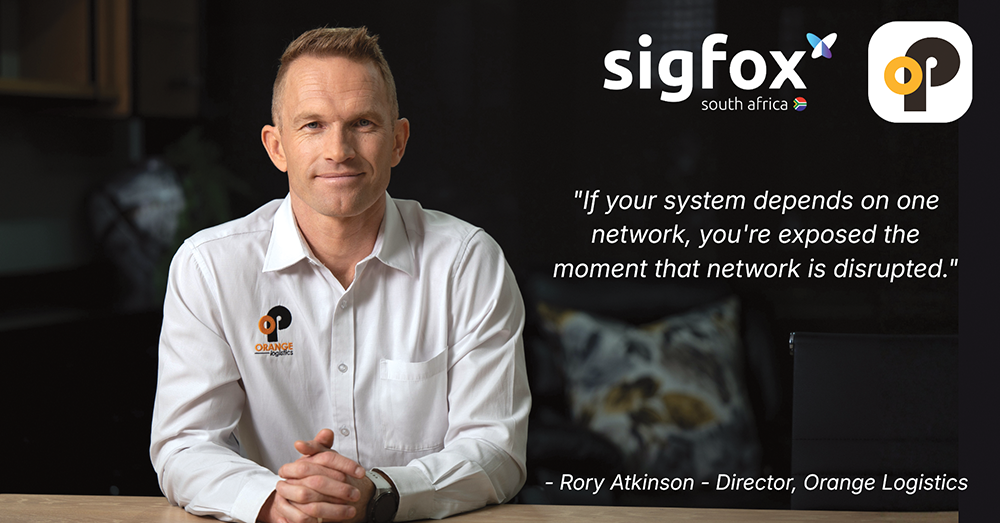
“If your system depends on one network, you are exposed the moment that network is disrupted.”
The result is not necessarily a failure of the tracking device itself. GPS positioning may still be functioning correctly. Sensors may continue collecting information. The failure occurs within the transport layer responsible for moving data from the asset to the monitoring platform.
This creates a telemetry problem. Without telemetry, operational awareness is lost.
The solution
The challenge led Orange Logistics to evaluate alternative communications approaches capable of operating independently from traditional GSM infrastructure.
The solution adopted was Sigfox 0G technology, a low-power wide-area network (LPWAN) specifically designed for the transmission of small data payloads over long distances.
Unlike traditional cellular technologies that prioritise bandwidth, Sigfox prioritises message delivery, energy efficiency, and network reach. For many industrial and logistics applications, this is often a more appropriate design philosophy.
The most valuable piece of information is frequently not a continuous stream of telemetry, but a small event indicating that something has changed:
• A route deviation.
• An unexpected stop.
• Asset movement.
• A tamper event.
• A status change.
In these scenarios, the value lies in receiving a reliable message rather than transmitting large volumes of data.
By introducing Sigfox as a complementary communications layer, Orange Logistics was able to create additional resilience within its tracking architecture. Rather than replacing existing GPS and GSM systems, Sigfox provides an independent path for transmitting critical operational information.
“The difference between loss and recovery is often just a few minutes of visibility.”
From an engineering perspective, this approach introduces redundancy at the communications layer, while maintaining low device complexity and power consumption.
The architecture is also applicable beyond fleet tracking.
The same LPWAN infrastructure can support a wide range of telemetry applications, including asset tracking, infrastructure monitoring, utility metering, environmental sensing, and industrial monitoring systems.
The low-power nature of the network makes it particularly attractive for deployments where battery life is a primary design consideration. Many IoT deployments are constrained by power availability rather than communications capability. In these scenarios, reducing transmission requirements can significantly extend operational life, while maintaining adequate visibility.
This becomes especially important when devices are deployed across large geographic areas or in locations where maintenance access is limited.
For Orange Logistics, the operational outcome has been improved visibility and faster response when issues occur.
For engineers, however, the more interesting lesson is architectural. Reliable systems are not necessarily those with the highest performance specifications. They are the systems that continue delivering useful information when conditions move outside expected operating parameters.
“You do not need perfect systems. You need to know you are never completely blind.”
As industrial IoT deployments continue to scale, engineers will increasingly need to focus on resilience, redundancy, and communications independence rather than simply bandwidth and throughput.
Because in many applications, the most important message is often the one that arrives when everything else has stopped working.
For more information about Orange Logistics, visit www.orangelogistics.co.za or watch their customer story at https://www.youtube.com/watch?v=7ZJJZ78GRAs
For more information contact Sigfox South Africa,
| Tel: | +27 10 497 5432 |
| Email: | [email protected] |
| www: | www.sigfoxsa.co.za |
| Articles: | More information and articles about Sigfox South Africa |






© Technews Publishing (Pty) Ltd | All Rights Reserved
 printer friendly version