


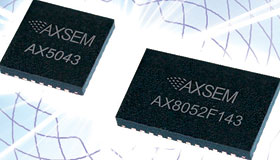
Axsem has developed two new ICs for narrowband wireless communication systems in the 70–1050 MHz frequency bands.
Narrowband transceiver for multiple standards
The AX5043 is a true single-chip ASK and FSK RF transceiver offering low power consumption for transmit and receive operation combined with high sensitivity and selectivity.
A link budget of 143 dB is achieved; if the built-in forward error correction (FEC) is used, this can be extended to 146 dB without extra external components. The AX5043 works down to 1 Kbps in a 6,25 kHz channel; although a TCXO is recommended for such operation, the IC can also be operated with a normal XTAL if the necessary precautions are taken into account.
An integrated voltage regulation system allows the direct use of batteries and short startup times enable time- and energy-efficient protocols. The transmit power varies no more than 1 dB over the supply voltage range of 1,8–3,6 V. This makes the AX5043 ideal for battery powered portable applications. It features a low-power wakeup clock and timer which typically consume 500 nA, allowing it to autonomously handle wake-on-radio cycling.
The device supports FSK, MSK, 4-FSK, GFSK, GMSK, AFSK and ASK modulations. In transmit mode all modulations are shaped. For FSK, Gaussian filters with BT = 0,3 or BT = 0,5 are available to meet the most stringent regulatory requirements.
Power ramping can be configured without restrictions. Maximum output power levels are 16 dBm at 868 MHz and 20 dBm at 70 MHz carrier frequency. The configurable packet engine supports a wide range of packet formats that are handled without microcontroller intervention.
The AX5043 is supported by the DVK-2 development kit. This is a complete and flexible ready-to-go solution for easy testing, evaluation and development with AXSEM RF ICs. It is suited for real performance tests using professional lab equipment, as well as for application code development.
The DVK-2 is based on the AX8052F100 MCU and AXSEM offers both the AX-RadioLab GUI as well as the advanced graphic integrated development environment AX8052-IDE together with the freely usable SDCC C-compiler.
Low-power RF microcontroller
The AX8052F143 targets the highest performance narrowband market with demands for many kilometres of communication range. A sensitivity of -126 dBm (-129 dBm with FEC) at 868 MHz and 1,2 Kbps with a current consumption of only 12,5 mA (RF and MCU together) make the IC stand out.
The16 dBm transmitter exhibits low phase noise and high efficiency, with data rates ranging from 1 to 100 Kbps. The frequency range from 70 MHz to 1050 MHz makes this RF microcontroller well suited for many applications including automatic meter reading and security. The device boasts average 6 A duty-cycle receive current.
The AX8052F143 microcontroller core executes the industry standard 8052 instruction set, with a system clock that can be programmed freely from DC to 20 MHz. As instructions are executed in a single cycle, the core can deliver 20 MIPS. A 64 KB Flash memory is provided, allowing designers to program applications in C.
A fully associative cache and a pre-fetch controller hide the latency of the Flash memory. Four system clock sources can be selected on the fly, allowing the system speed to be adapted to varying application needs. Targeting ultra-low-power applications, the core consumes 150 A/MHz and 950 nA in sleep mode with the wake-up timer running and with 256 Byte SRAM retention.
The AX5052F143 features a dual-channel DMA engine that can transfer data to and from XRAM to any peripheral on the chip. A dedicated AES engine with its own DMA engine is provided for encryption. Further peripherals include three general purpose timers with optional sigma-delta output mode. The timers can be used as baud rate generators for the two UARTs.
A master/slave SPI interface is provided, while a 10-bit, 500 KSps ADC with flexible input modes, as well as comparators, allow interfacing with analog data streams. A hardware debug unit considerably eases debugging compared to other 8052 microcontrollers. The debug unit communicates with a host PC running the debugger using a 3-wire interface.
The AX8052F143 is also supported by the DVK-2 development kit as described above.
For more information contact Andrew Hutton, RF Design, +27 (0)21 555 8400, andrew@electrocomp.co.za, www.electrocomp.co.za
| Tel: | +27 21 555 8400 |
| Email: | sales@rfdesign.co.za |
| www: | www.rfdesign.co.za |
| Articles: | More information and articles about RF Design |






© Technews Publishing (Pty) Ltd | All Rights Reserved
 printer friendly version