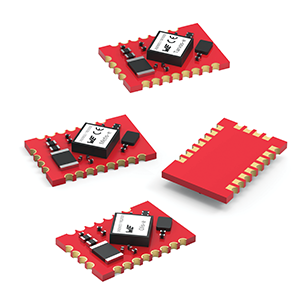
Würth Elektronik has introduced two highly compact radio modules that give developers maximum freedom in designing proprietary wireless solutions that go beyond standard protocols. The hardware of the Tarvos-e and Olis-e modules, measuring just 12 x 8 x 2 mm, is identical to that of the Metis-e radio module and is based on the Texas Instruments SoC CC1310 chipset, operating in the 868 MHz frequency band.
Metis-e was introduced at the end of 2024 as a solution specifically for radio transmission of meter readings (wireless M-Bus). Their compact design, together with their energy-efficient operating modes, make the radio modules ideal for use in battery-powered devices - in the standby and shutdown power-saving modes, they require only 1,6 µA and 200 nA, respectively.
The Tarvos-e module uses Würth Elektronik’s proprietary WE-ProWare radio protocol and is compatible with Tarvos-III and Thebe-II. It allows targeted optimisation of wireless communication, either for high data rates up to 400 kbps or for a range up to 2,7 km. It offers maximum flexibility and is ideal for applications where standard protocols have reached their limits. The module delivers an RF output power of 14 dBm and uses a UART interface for communication.
The Olis-e module offers even more design flexibility by allowing designers to build their own firmware. Using the TI SIMPLELINK CC13x0 software development kit, developers can implement their application directly on the SoC – including custom wireless protocols and system logic.
The radio modules use proprietary protocols and thus offer an especially attractive solution for applications in which both the transmitter and receiver sides are individually developed. Compared to Bluetooth, the module has greater range thanks to its use of the 868 MHz frequency band instead of 2,4 GHz. This enables more reliable communication, even through walls and other building structure obstacles.
The radio module is also available in a specially adapted variant for the 915 MHz frequency range for use in markets where the 915 MHz band can be used license-free.
Macom targets broadband radar with time delay MMIC RFiber Solutions
Telecoms, Datacoms, Wireless, IoT
Macom’s MADU FR1012 is a GaAs MMIC 1-bit true time delay device covering 4 GHz to 12 GHz, designed for broadband microwave systems where beam accuracy and signal integrity are critical.
Read more...Compact analogue phase shifter RF Design
Telecoms, Datacoms, Wireless, IoT
The Mini-Circuits JSPHS-150+ is a compact analogue voltage-controlled phase shifter designed for narrowband RF applications between 100 and 150 MHz.
Read more...Harnessing Leakage Inductance Würth Electronics South Africa
Passive Components
Würth Electronics has expanded its WE-MCRI product series with the new 1090HL variant (HL = High Leakage), a coupled inductor specifically designed to improve the performance of SEPIC, ZETA and Cuk converters.
Read more...Wireless connectivity expanded iCorp Technologies
Telecoms, Datacoms, Wireless, IoT
Espressif Systems has introduced two new members of its ESP32 wireless SoC family: the ESP32-E22, the company’s first Wi-Fi 6E connectivity chip, and the ESP32-H21, an ultra-low-power Bluetooth LE microcontroller aimed at coin-cell and battery-powered devices.
Read more...Integrated X-band radar front-end module RF Design
Telecoms, Datacoms, Wireless, IoT
Qorvo has introduced an X-band radar front-end solution that enables defence system designers to achieve higher performance without increasing size, weight or prime power.
Read more...Quick and easy shielding Würth Electronics South Africa
Electronics Technology Manufacturing / Production Technology, Hardware & Services
Würth Elektronik expands its EMC product portfolio with nanocrystalline WE-FNCS sheets.
Read more...Introducing Aurata CST Electronics
Telecoms, Datacoms, Wireless, IoT
Antenova has launched Aurata SR4L112: a compact, high efficiency embedded 4G/LTE antenna engineered for long, narrow PCB designs.
Read more...Multi-constellation GNSS module in a legacy-compatible footprint Altron Arrow
Telecoms, Datacoms, Wireless, IoT
Telit Cinterion has announced the SE869eK2L, a single-frequency L1 GNSS module designed to help device manufacturers upgrade legacy positioning designs with improved performance and cost efficiency, while preserving design continuity.
Read more...Quectel expands 5G portfolio iCorp Technologies
Telecoms, Datacoms, Wireless, IoT
Quectel expands 5G portfolio with new Qualcomm- and UNISOC-based modules.
Read more...Compact RTK design: More than just the receiver iCorp Technologies
Editor's Choice Telecoms, Datacoms, Wireless, IoT
In practice, engineers building compact RTK products keep discovering the same thing: the hardest component in the system is no longer the receiver. It is the antenna.
While every effort has been made to ensure the accuracy of the information contained herein, the publisher and its agents cannot be held responsible for any errors contained, or any loss incurred as a result. Articles published do not necessarily reflect the views of the publishers. The editor reserves the right to alter or cut copy. Articles submitted are deemed to have been cleared for publication. Advertisements and company contact details are published as provided by the advertiser. Technews Publishing (Pty) Ltd cannot be held responsible for the accuracy or veracity of supplied material.









 printer friendly version