


Unfortunately, the battery is also more often than not one of the highest costs on the bill of materials, making it the first target for any manufacturer looking to cut costs. However, before deciding to simply replace the battery with a cheaper imported ‘equivalent’, take a second to consider that not all batteries are created equal.
Once a battery has been manufactured and the final label applied, there is no possible way of differentiating a good quality battery from a poor one. Yes, the open circuit voltage can be measured, as can the voltage under load and, if the means are available, the capacity of the battery can be tested. But none of this will determine whether the battery has been manufactured in accordance with internationally accepted practices and, more importantly, whether it is going to be safe in the end equipment after a few months of use.
Battery manufacturing is a complex process, now more so than ever, given that most new battery powered devices are being designed with rechargeable lithium based batteries (Li-Ion and Li-Po). In the past, the old nickel based batteries (Ni-Cd and NiMh) were relatively easy and safe to manufacture. Lithium based batteries are far more complex, with far smaller margins for error in the manufacturing process.
However, as a result of the subsequent decline in demand for nickel based batteries, the industry is seeing a proliferation of small battery manufacturers who were once previously manufacturing nickel based batteries, now starting to produce lithium batteries.
Ordinarily, this would not be a bad situation; however, the vast majority of these small manufacturers do not have the facilities, equipment or the technical know-how to safely and consistently produce these lithium batteries. Yet, despite this, they continue to do so, regardless of the consequences. As a result, there is currently an influx of cheap and potentially dangerous lithium batteries finding their way into devices, with potentially disastrous consequences.
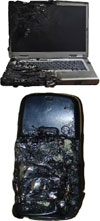
All rechargeable lithium batteries have the potential to catch fire, or even explode. That’s simply the nature of their chemical composition. Lithium is used in these batteries because it has extremely high electrochemical potential. But lithium is also extremely volatile and therefore potentially dangerous. It’s for this reason that reputable manufacturers take such care to protect against possible fire and explosion, by means of external safety devices.
So, if this possibility exists with good quality, reputably manufactured lithium batteries, just imagine the potential for disaster with cheap, substandard batteries produced in inferior facilities. A single lithium battery can cause untold damage if it catches fire, or worse still, explodes. A standard lithium ion penlight battery, for example, can burn at temperatures in excess of 600°C, with a violent open flame which should only be extinguished by means of a Halon extinguisher.
Today, Asia produces many no-name brand replacement batteries that are popular with South African manufacturers because of their low price. Many of these batteries, however, have been manufactured in substandard facilities, with very little, or no, quality control, despite their claims of ISO certification.
Of course, there are many reputable battery manufacturers in Asia, some of whom are in fact manufacturing on behalf of world famous electronic brands. However, there are far more who are anything but reputable. The problem is, it is impossible to know. Sitting half way around the world, on the other side of a website that claims to be a large worldwide manufacturer, one has no idea whether they are reputable, or if they’re even manufacturers at all.
Even if one were to pay the manufacturing facility a visit, without being a battery specialist and knowing something about the battery manufacturing processes, it’s impossible to know the difference between a good manufacturing facility and a poor one. Yet, despite this, countless South African companies continue to blindly put their faith in the hands of these Asian manufacturers or agents representing them, by simply choosing their batteries based on price and price alone.
To be assured of the quality and integrity of a battery powered product, one should choose a battery specialist company that knows what it takes to manufacture a quality battery, that knows which Asian manufacturers to use, and that audits and controls the quality and manufacturing processes. Or beware the consequences, as not all batteries are created equal.
For more information contact Uniross Batteries, +27 (0)11 466 1156, info@uniross.co.za, www.uniross.co.za>
| Tel: | +27 11 466 1156 |
| Email: | info@uniross.co.za |
| www: | www.uniross.co.za |
| Articles: | More information and articles about Uniross Batteries |






© Technews Publishing (Pty) Ltd | All Rights Reserved
 printer friendly version