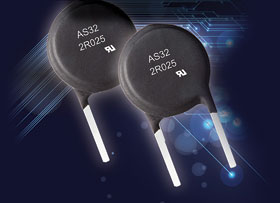
Ametherm has introduced a new series of inrush current limiting NTC (negative temperature coefficient) thermistors designed to withstand high steady-state currents from 6 A to 50 A and 250 J to 800 J of input energy in a wide range of applications.
Recognised by Underwriters Laboratories (UL) for ensured safety, Ametherm claims the AS Series devices provide lower current density, faster reset times and a wider temperature range without derating compared with traditional inrush current limiters.
The components limit inrush currents for the protection of pre-charge circuits in lithium-ion batteries; variable-frequency drives in sports equipment such as treadmills, high-speed computers, and processors; switch mode power supplies for plasma cutters and welders; and audio amplifiers, MRIs and X-ray machines. While traditional inrush current limiters handle approximately 167 A per square inch for the duration of the inrush current, AS Series devices are designed to withstand 400 A per square inch. This lower current density, in combination with a uniform temperature gradient throughout the disc, increases reliability by eliminating hot spots from fatigue.
The AS Series features Hot R from 0,0074 Ω to 0,380 Ω, resistance at 25°C from 0,50 to 50 Ω, and maximum capacitance at 680 V a.c. from 500 μF to 1730 μF. The devices are available with diameters of 30 mm and 36 mm.
EMC limits and levels Altron Arrow
Editor's Choice Circuit & System Protection
As soon as electronics and electrical systems started interfering with each other, the world had to come to some consensus. Considering physics is universal and does not care about what country electrical/electronic products are used in, it should be the same everywhere, right? It is nearly there, but not quite.
Read more...Safety relay for explosive areas IOT Electronics
Circuit & System Protection
Phoenix Contact has expanded its safety portfolio with the new PSR-MC35-EXI safety relay module, specifically engineered for use in potentially explosive environments.
Read more...Clearing the Static: Ensuring effective ESD control Actum
Circuit & System Protection
To maintain reliable electrostatic discharge control, regular testing and accurate measurement are essential, with grounding products and ESD testing equipment being vital.
Read more...Clearing the Static: The importance of ESD audits Actum
Circuit & System Protection
An ESD audit is the first step in establishing an effective static control programme in the workplace, and will help identify vulnerable areas and potentially hazardous static zones that require improvement.
Read more...Build smarter with UNO Q Electrocomp Express
DSP, Micros & Memory
The Arduino UNO Q’s hybrid design combines a Linux Debian-capable microprocessor with a real-time STM32U585 microcontroller making it the perfect dual-brain platform for the next innovation.
Read more...EMI shielding materials application guide
Circuit & System Protection
TE Connectivity’s shielding solutions include electrically conductive elastomers, gaskets, knitted wire mesh, oriented wire, EMI shielding ventilation panels, shielded window, cable shielding and shielding components.
Read more...Clearing the Static: ESD containers and packaging Actum
Circuit & System Protection Vacuum forming ESD
Electronic components can be damaged by electrostatic discharges. To protect against such damage, electronic assembly parts are often transported or stored in vacuum formed component ...
Read more...Electrostatic discharge chairs Actum
Circuit & System Protection
An ESD chair forms an integral part of grounding within the electrostatic discharge protected area to prevent potential damage to products.
Read more...Conductive ESD footwear Actum
Circuit & System Protection
Conductive ESD footwear is used in conjunction with other grounding devices, such as a wrist strap, cord, and ESD surface mats, to provide a continuous path to ground.
While every effort has been made to ensure the accuracy of the information contained herein, the publisher and its agents cannot be held responsible for any errors contained, or any loss incurred as a result. Articles published do not necessarily reflect the views of the publishers. The editor reserves the right to alter or cut copy. Articles submitted are deemed to have been cleared for publication. Advertisements and company contact details are published as provided by the advertiser. Technews Publishing (Pty) Ltd cannot be held responsible for the accuracy or veracity of supplied material.









 printer friendly version