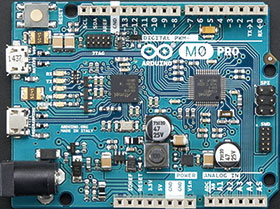
RS Components has announced availability of the Arduino M0 Pro, a simple and powerful extension of the 32-bit platform established by the Arduino Uno board.
Aimed at embedded engineers, hackers and students, the board is designed to help the development of innovative ideas for smart Internet-of-Things (IoT) devices, wearable technologies, high-tech automation, robotics and other imaginative projects. As well as enabling new project opportunities, it is highly suitable as an educational tool for learning about 32-bit application development.
Fuelled by the low-power Atmel SAM D21 microcontroller, which integrates the 32-bit ARM Cortex M0+ core, the Arduino M0 Pro board expands the Arduino family with increased performance and a highly flexible feature set. A key feature of the board is the Atmel Embedded Debugger (EDBG), which provides a full debug interface without the need for additional hardware and significantly increases ease-of-use for software debugging. The EDBG also supports a virtual COM port that can be used for device programming and traditional Arduino boot loader functionality.
Compatible with 3,3 V shields that conform to the Arduino R3 layout, development using the Arduino programming language is fully supported through a custom developed software library, integrated in the Arduino development environment.
Key hardware specifications of the M0 Pro board include the ATSAMD21G18 microcontroller running at 48 MHz and packaged in a 48-pin LQFP, 3,3 V operation, 256 KB of Flash memory, 32 KB of SRAM and EEPROM up to 16 KB via emulation. Input/output options include 14 digital I/O pins with 12 PWM channels and UART, six 12-bit ADC input channels and a 10-bit DAC output.
Large-format table top enclosures RS South Africa
Enclosures, Racks, Cabinets & Panel Products
The COMMUNITEC enclosure range from OKW is ideal for housing large-format electronic assemblies in an elegant, modern, design-oriented package. A key feature is the recessed handle concealed behind the operating panel, which allows the units to be carried comfortably and provides greater flexibility in use.
Read more...AMD Vivado Design Suite 2026.1
Design Automation
AMD Vivado Design Suite 2026.1 is here and features a new tiered licensing model for greater flexibility, new device support, major NoC and QoR improvements, and ease-of-use enhancements for designing with AMD Versal adaptive SoCs.
Read more...Procurement is becoming a competitive advantage RS South Africa
News
As mining, manufacturing and industrial businesses continue to navigate rising costs, supply chain disruption and increasing pressure to improve operational performance, procurement and inventory management have become strategic business priorities rather than simply administrative functions.
Read more...Power modules for solid-state transformers RS South Africa
Power Electronics / Power Management
Microchip’s new 3,3 kV silicon carbide modules deliver the required thermal performance and efficiency for SSTs to increase power available for token generation.
Read more...Innovative MyLegrand app RS South Africa
News
Legrand SA is set to launch the MyLegrand mobile application, a digital platform designed to strengthen engagement across its professional network.
Read more...12-bit 1-wire temperature sensing RS South Africa
Test & Measurement
The DS18B20 digital thermometer from Analog Devices provides 9-bit to 12-bit Celsius temperature measurements in the range -55°C to 125°C.
Read more...Advanced STM32 debugging in VS Code
Design Automation
Once an STM32 project is running in VS Code, the IAR C-SPY Debug extension adds a professional-grade analysis layer that scales with project complexity.
Read more...Introducing STM32CubeMX2 Altron Arrow
Design Automation
STMicroelectronics has launched STM32CubeMX2, a new evolution of its popular configuration and code generation tool for STM32 microcontrollers.
Read more...Collaboration is now critical RS South Africa
Manufacturing / Production Technology, Hardware & Services
The message emerging from RS Connect is clear: Organisations can no longer rely on internal optimisation alone to secure performance. Competitive advantage is increasingly being determined by the strength of external relationships, shared capability and coordinated action across value chains.
While every effort has been made to ensure the accuracy of the information contained herein, the publisher and its agents cannot be held responsible for any errors contained, or any loss incurred as a result. Articles published do not necessarily reflect the views of the publishers. The editor reserves the right to alter or cut copy. Articles submitted are deemed to have been cleared for publication. Advertisements and company contact details are published as provided by the advertiser. Technews Publishing (Pty) Ltd cannot be held responsible for the accuracy or veracity of supplied material.









 printer friendly version