Within the burgeoning Internet of Things (IoT) market, certain lower data rate applications depend on low-cost, battery-operated, long-life sensors.
To meet the antenna needs of such applications, Taoglas is rolling out a new Low Power Wide Area (LPWA) antenna category, addressing the need for IoT devices that use less power, cost less to run and do not need the speeds or bandwidths offered by 4G LTE networks.
According to analyst firm Strategy Analytics, LPWA connections are forecast to have a high growth rate as part of IoT, growing from 11 million in 2014 to just over 5 billion by 2022. In contrast, LTE and cellular networks support markets that need higher-power systems for delivering large volumes of data, but these systems require significant battery power. For products such as M2M sensor devices sending low amounts of data, LPWA networks are ideal because they are one-tenth the price to run and have one-tenth the power drain. Batteries in these scenarios last 20 to 30 years instead of the three or four years of M2M products in cellular networks.
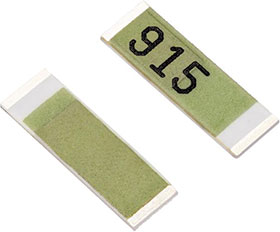
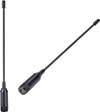
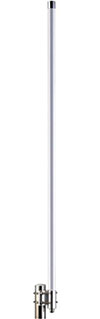
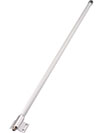
Taoglas’ series of LoRa-LPWA antennas includes models such as the external Barracuda OMB.868 (worldwide) or OMB.915 (North America) – large, high-gain, omnidirectional outdoor antennas which are ideal for the base station side of a typical LPWA network. For the devices themselves there are new direct mount FW.95, FW.86 and FW.43 monopole whip antennas and miniature embedded ILA.02 and ILA.01solutions.
The antennas use the unlicensed Industrial, Scientific and Medical (ISM) bands of 433/868 MHz in Europe and 915 MHz in the United States, so devices don’t need costly carrier certification. They can be used for all sub-GHz protocols in the IoT LPWA market such as LoRa, LoRaWAN, SIGFOX, Weightless, Nwave and Telensa.
Working in the unlicensed bands, these antennas are ideal for manufacturers in healthcare and utilities as well as for asset tracking, which is one of the fastest growing applications along with metering and industrial/environmental monitoring.
Macom targets broadband radar with time delay MMIC RFiber Solutions
Telecoms, Datacoms, Wireless, IoT
Macom’s MADU FR1012 is a GaAs MMIC 1-bit true time delay device covering 4 GHz to 12 GHz, designed for broadband microwave systems where beam accuracy and signal integrity are critical.
Read more...Compact analogue phase shifter RF Design
Telecoms, Datacoms, Wireless, IoT
The Mini-Circuits JSPHS-150+ is a compact analogue voltage-controlled phase shifter designed for narrowband RF applications between 100 and 150 MHz.
Read more...Wireless connectivity expanded iCorp Technologies
Telecoms, Datacoms, Wireless, IoT
Espressif Systems has introduced two new members of its ESP32 wireless SoC family: the ESP32-E22, the company’s first Wi-Fi 6E connectivity chip, and the ESP32-H21, an ultra-low-power Bluetooth LE microcontroller aimed at coin-cell and battery-powered devices.
Read more...Integrated X-band radar front-end module RF Design
Telecoms, Datacoms, Wireless, IoT
Qorvo has introduced an X-band radar front-end solution that enables defence system designers to achieve higher performance without increasing size, weight or prime power.
Read more...Introducing Aurata CST Electronics
Telecoms, Datacoms, Wireless, IoT
Antenova has launched Aurata SR4L112: a compact, high efficiency embedded 4G/LTE antenna engineered for long, narrow PCB designs.
Read more...Multi-constellation GNSS module in a legacy-compatible footprint Altron Arrow
Telecoms, Datacoms, Wireless, IoT
Telit Cinterion has announced the SE869eK2L, a single-frequency L1 GNSS module designed to help device manufacturers upgrade legacy positioning designs with improved performance and cost efficiency, while preserving design continuity.
Read more...Quectel expands 5G portfolio iCorp Technologies
Telecoms, Datacoms, Wireless, IoT
Quectel expands 5G portfolio with new Qualcomm- and UNISOC-based modules.
Read more...Surface mount power amplifier for high-power applications RF Design
Power Electronics / Power Management
The GNA-63-5W+, from Mini-Circuits, is a GaN MMIC Power Amplifier (PA) designed for demanding RF applications requiring high efficiency, excellent linearity, and a compact footprint.
Read more...Compact RTK design: More than just the receiver iCorp Technologies
Editor's Choice Telecoms, Datacoms, Wireless, IoT
In practice, engineers building compact RTK products keep discovering the same thing: the hardest component in the system is no longer the receiver. It is the antenna.
Read more...Microchip advances Space-Grade timing performance ASIC Design Services
Telecoms, Datacoms, Wireless, IoT
Microchip Technology has expanded its atomic clock portfolio with the radiation-tolerant Space CSAC-SA65, a Chip Scale Atomic Clock designed to deliver precise timing for space systems.
While every effort has been made to ensure the accuracy of the information contained herein, the publisher and its agents cannot be held responsible for any errors contained, or any loss incurred as a result. Articles published do not necessarily reflect the views of the publishers. The editor reserves the right to alter or cut copy. Articles submitted are deemed to have been cleared for publication. Advertisements and company contact details are published as provided by the advertiser. Technews Publishing (Pty) Ltd cannot be held responsible for the accuracy or veracity of supplied material.









 printer friendly version