


Connecting devices is a key requirement in the IoT, and this can be an even greater challenge in an industrial environment.
The Industrial IoT (IIoT) requires many devices to be connected reliably in environments that are harsh both physically and electromagnetically. This can present a challenge for wireless systems, especially in the busy 2,4 GHz band where Wi-Fi and Bluetooth operate.
Using licence-free bands under 1 GHz – 433 MHz, 868 MHz or 915 MHz – gives longer range than 2,4 GHz but lower data rates. This works for industrial applications that are not required to stream video data but transfer data from sensors and diagnostic information from equipment. This also allows developers to trade off data rate and range for lower power consumption, allowing longer battery life or energy harvesting power sources. This can provide a significant saving by reducing operating costs with regards to replacing batteries with cycles as long as 20 years with the right design.
However, these links need to be highly reliable, and that depends on the combination of the transceiver radio hardware, microcontroller and embedded protocol stacks. Having a range of options in all three of these areas provides system developers with the flexibility to optimise their designs for the specific industrial implementation.
Narrowband sub-GHz links can reach up to 10 km as there is less attenuation from walls or buildings, reducing or eliminating the need for gateway or repeater devices and so reducing the cost of the network implementation. The less crowded spectrum also means easier transmissions and fewer retries, which is more efficient and saves battery power.
The radio sensitivity is inversely proportional to channel bandwidth, so a narrower bandwidth creates higher receiver sensitivity and allows efficient operation at lower transmission rates. For example, at 300 MHz, if the transmitter and receiver crystal errors are both 10 ppm (parts per million), the error is 3 kHz for each. For the application to efficiently transmit and receive, the minimum channel bandwidth is twice the error rate, or 6 kHz, which is ideal for narrowband applications. The same scenario at 2,4 GHz requires a minimum channel bandwidth of 48 kHz, which wastes bandwidth for narrowband applications and requires substantially more operating power.
One of the disadvantages can be that a larger antenna is needed for a sub-GHz node, with a 17 cm antenna needed at 433 MHz. However, this can be less of an issue for industrial networks where space is less of a premium, and can be overcome with newer design techniques such as fractal antennas for shorter range implementations or using higher bands such as 915 MHz where an 8 cm antenna is sufficient.
The EZR32LG330 wireless microcontroller from Silicon Labs (Figure 1) combines an ARM Cortex-M3 CPU, USB and sub-GHz radio with low-energy optimisations for IoT designs. The EZR32LG family of pin-compatible devices scales with 64/128/256 KB of Flash and supports Silicon Labs’ EZRadio or EZRadioPRO transceivers covering the sub-GHz frequency bands from 142 to 1050 MHz. These devices have sensitivity of up to –133 dBm using the EZRadioPro to give the maximum range or reduced to minimise the power consumption.
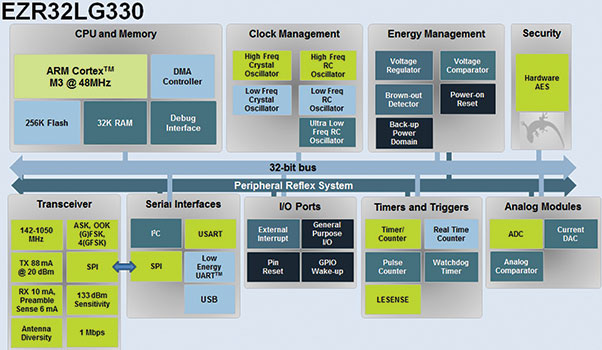
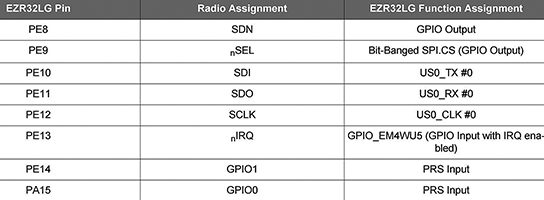
The device covers all major frequency bands and achieves optimal phase noise, blocking and selectivity performance for narrowband and licensed band applications, such as FCC Part 90 and 169 MHz wireless Mbus. Adjacent channel selectivity of 69 dB with 12,5 kHz channel spacing means that there is minimal interference between channels and any other electrical noise can be efficiently filtered out to prevent interference with the radio link. Communications between the radio and MCU are done over USART, PRS and IRQ, which requires the pins to be configured as shown in Table 1.
A key element in the EZR32LG is an AES accelerator to provide security for the wireless node. This handles the AES encryption and decryption with 128-bit or 256-bit keys.
Encrypting or decrypting one 128-bit data block takes 52 cycles with 128-bit keys and 75 cycles with 256-bit keys. The AES module is an AHB slave which enables efficient access to the data and key registers so all write accesses to the AES block must be via 32-bit operations.
To link to sensors or directly to the equipment, there are 38 general purpose input/output (GPIO) pins, which are divided into ports with up to 16 pins each. These pins can be individually configured as either an output or input. More advanced configurations such as open-drain, filtering and drive strength can also be configured individually for the pins. The GPIO pins can also be overridden by peripheral pins such as timers, pulse width modulator outputs or USART communication.
The GPIO supports up to 16 asynchronous external pin interrupts, which enables interrupts from any pin on the device. Designers can also make use of Silicon Labs’ Peripheral Reflex System where the input value of a pin can be routed through other peripherals. This provides flexibility for pin allocations so that changes to board designs can be easily made either during development or between product generations.
Higher level support is also possible on an integrated device. The SimpleLink CC1310 controller developed by Texas Instruments combines the RF transceiver with a microcontroller that is optimised for a real-time operating system as well as dedicated, independent controllers for power management and sensors.
The sub-GHz transceiver has its own Cortex-M0 microcontroller (Figure 2) to handle the time-critical aspects of the radio protocols without needing the main processor, leaving more resources for the user application. It can support a wide range of modulation formats, frequency bands and accelerators, from 625 bps for long range and high robustness to data rates up to 4 Mbps, with a range of modulation formats from multilevel FSK and MSK to on-off keying (OOK).
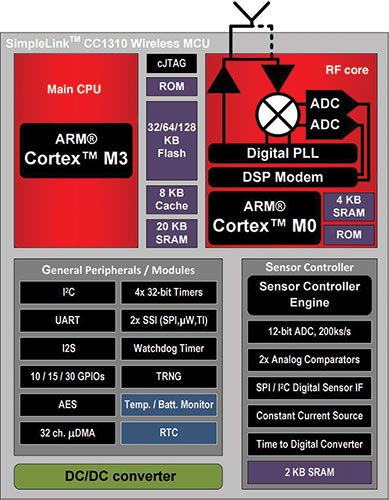
The 48 MHz Cortex-M3 microcontroller then supports multiple physical layers and RF standards and runs the RTOS that configures the power and clock management. The sensor controller is an independent processor to control a range of peripherals so that the main CPU does not have to wake up, for example to execute an ADC sample or poll a digital sensor over SPI, saving both current and wakeup time.
There can be advantages to having a separate transceiver. The MRF49XA from Microchip (Figure 3) is aimed at bidirectional, short-range wireless applications in the 434/868/915 MHz ISM frequency band and frequency shift keying (FSK) modulation with a frequency hopping spread spectrum (FHSS) capability similar to that used in the Bluetooth standard, and can be easily integrated with Microchip’s 8- 16- or 32- PIC controllers.
FHSS provides the ability to move between different frequency bands in a set order to avoid channels that become too noisy, but can interfere with adjacent direct sequence spread spectrum (DSSS) channels. This provides high resistance to adjacent channel interference, and the bit error rate (BER) and larger communication coverage of the lower frequencies, along with higher output power, is suited to industrial IoT designs.
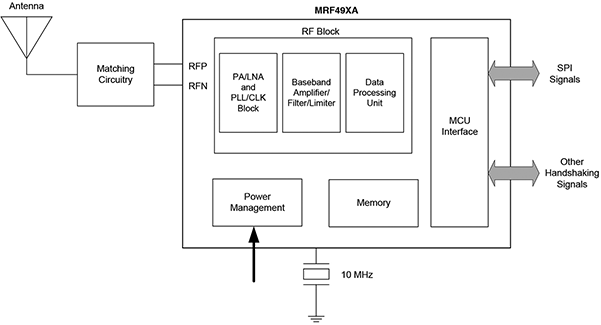
In order to minimise the total system cost, the transceiver uses a low-cost, generic 10 MHz crystal, a bypass filter and an affordable microcontroller. The MRF49XA provides a clock signal for the microcontroller and avoids the need for a second crystal on the circuit board, and works with PIC microcontrollers through a 4-wire SPI, interrupt and reset. The interface between the microcontroller and MRF49XA is shown in Figure 4.
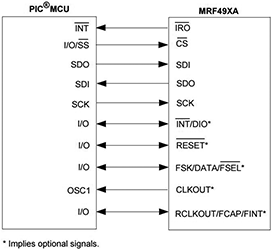
The MRF49XA RF transceiver is also available on a PICtail daughter board for integration with the 8-bit PIC18 Explorer and 16-/32-bit Explorer 16 modular microcontroller development boards.
Conclusion
Sub-GHz designs can dramatically extend the battery life of a wireless sensor node in the industrial Internet of Things. When there are thousands of nodes in a network, the operating cost of battery replacement can be prohibitive, so reducing the replacement cycle to 10 or even 20 years can make a significant difference.
By trading off narrowband data rates and range for battery life in the sub-GHz bands, with either an integrated device or separate transceiver and low-cost microcontroller, a developer can optimise the design of the node to get the best overall performance and feed essential data from equipment into the Internet of Things.
| Email: | [email protected] |
| www: | www.trxe.com |
| Articles: | More information and articles about TRX Electronics |






© Technews Publishing (Pty) Ltd | All Rights Reserved
 printer friendly version