10-year forecast of relationship between MCUs and SBCs
13 July 2016
Editor's Choice
Computer/Embedded Technology
By Dr Jon Harrop, Director, IDTechEx.
The unique new IDTechEx Research report, ’Microcontrollers and Single-board Computers 2016-2026’, is the first to reveal the big picture developing from the close relationship between these devices. It provides newly researched forecasts leading to figures such as $300 billion in 2026 for single-board computers (SBC) alone.
Applications, technologies, players and markets are revealed in easily understood infographics yet at a depth never seen before. For example, the ten-year forecasts for microcontrollers (MCU) and single-board computers are backed by forecasts for such things as wearable electronics and cars (traditional and electric).
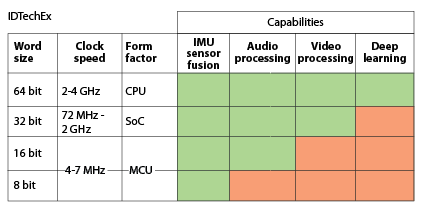
Capabilities and limitations of microcontrollers.
The situation is complex because some applications are not growing significantly – such as smartcards – whereas others are not only growing rapidly – such as the electric car business – but the number used per equipment is increasing, giving a multiplier effect.
An applications chapter embraces smart cars, home and office, automotive, DC-DC converters for battery monitoring, energy harvesting and microgrids, education, wearable technology, touch screen controllers, motor control including quadcopters, control of stepper and traction motors. It even takes a look at artificial intelligence and deep learning, control of 3D printers, microwave ovens and washing machines, with examples of products offered and how they work.
The following chapter goes more deeply into MCU architectures, co-processors: PLDs and CPLDs, software and programming languages and case studies. Relevance to a wide variety of sensors is detailed, including coverage of hot topics such as 3D cameras, artificial intelligence and inertial measurement units in autonomous vehicles.
The report explains radical changes in the value chain where the Arduino, for example, is a hobbyist product that actually goes into production. Little wonder then that there are now many mergers of the suppliers in order to efficiently address these now giant markets from AppleTV to Internet of Things. A chapter on players explains and evaluates these trends. This includes Apple, Samsung, Google and Amazon but also Arduino, Raspberry Pi Foundation and Beagleboard – because they matter.
The chapter on trends is replete with new forecasts and explanations such as the huge impact of ARM wrong-footing many competitors. Consolidation on the ARM architecture, open source hardware, conformance to Moore’s Law, prices equilibrating and an introduction to trends of MCUs, and adjacent developments.
The report provides a host of new statistics and forecasts including value chains, MCU market by revenue, supplier overall and MCU revenue, Ardu-ino sales, Raspberry Pi by geography and much more. It also has car forecasts by technology (more electric means more MCUs), wearable technology, IOT, motor controller and other new forecasts from other IDTechEx departments. It is not all roses: the decline of desktop computers is displayed, not just the rapidly growing SBC market.
For more information visit www.idtechex.com/mc
Further reading:
Locate underground cable faults faster with the Fluke AF2082 A-Frame
Comtest
Editor's Choice Test & Measurement
Underground cable faults can lead to costly downtime, service disruptions, and extensive excavation if the fault location is uncertain. The AF2082 simplifies this process by guiding operators directly to the fault point.
Read more...
Here is what we learnt from three supply chain crises
Seven Labs Technology
Editor's Choice
Component crises are not random events. They follow a pattern. After fifteen years and three major disruptions, Seven Labs knows exactly what that pattern demands, and what it takes to keep production lines moving.
Read more...
The new reality of PCB material supply
Jemstech
Editor's Choice Manufacturing / Production Technology, Hardware & Services
How resilient manufacturing strategies are helping OEMs navigate a changing global supply chain.
Read more...
Strengthening local electronics manufacturing through investment and innovation
Microtronix Manufacturing
Editor's Choice Manufacturing / Production Technology, Hardware & Services
Microtronix South Africa cements its commitment to local manufacturing with ongoing investments in production capacity, skills development, and job creation.
Read more...
From the editor's desk: Local can be international
Technews Publishing
Editor's Choice News
Welcome to the July 2026 issue of
Dataweek. As you can see from this introduction,
Dataweek’s regular editor, Peter Howells, is on extended leave and I am filling the void in his editor’s column – hopefully without being too boring.
Read more...
Solving South African power problems with locally built intelligence
Editor's Choice Power Electronics / Power Management
Smart metering infrastructure in South Africa remains patchy. The rollout has been slow, coverage is inconsistent, and for the most part, granular per-unit measurement simply does not exist.
Read more...
From the editor's desk: The art of measuring the truth
Technews Publishing
Editor's Choice News
All electronic measurements are a lie. The trick is making the lie as small as possible.
Read more...
Engineering for failure: why resilient telemetry matters more than perfect connectivity
Sigfox South Africa
Editor's Choice Telecoms, Datacoms, Wireless, IoT
One of the biggest assumptions in modern tracking systems is that connectivity will always be available. From an engineering perspective, this creates an interesting problem.
Read more...
Lesley Havenga: Building partnerships for Africa’s electronics future
Editor's Choice News
As Würth Electronik expands its footprint across South Africa and the broader sub-Saharan region, Havenga’s blend of manufacturing expertise, supply chain knowledge, and people-centred leadership appears well suited to the task.
Read more...
Generating negative voltages from a positive supply
Altron Arrow
Editor's Choice Passive Components
It is common for IoT devices, industrial sensors, meters, and medical equipment to require both a positive and negative voltage, and this article explains the options available to produce a negative rail from a positive rail supply.
Read more...









 printer friendly version