


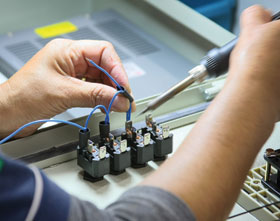
Around the world, the electronics manufacturing industry counts on the IPC to provide guidance and standards to follow. Because these standards are voluntary and created by industry, they are a powerful tool not only for the actual process of manufacturing electronic goods, they also help tremendously with contracting and liability issues, as explains Nkoka Training’s Rian Venter:
“Let’s say Company A contracts Company B to manufacture by IPC 610 standards to Class 3, thereby defining precisely the expected quality of the product. Assume further that the product in question is life-critical, ie, its failure might kill someone. Who will be responsible? Is it the product owner, the manufacturer or perhaps even the person who soldered the PCB? When you use the IPC standards in your contracting you know what to expect from your manufacturer, and that the staff working on your products are properly trained and certified.”
Operating out of Centurion in Gauteng, Nkoka Training is the only centre in Africa accredited by the IPC to give training courses on its behalf. Since IPC certification programmes are governed by strict rules to assure their authenticity, the trainers themselves need to be trained and certified as Certified IPC Specialists (CIS). Nkoka’s IPC trainers must be re-certified every two years to ensure they are always up to speed.
Nkoka Training specialises in the training and certification of companies to manufacture life-critical products, but the types of industries that make use of its services extend all the way from defence, aviation, space and naval, to medical and telecommunications, as well as companies making products for overseas markets. Nkoka certifies designers, managers, operators, inspectors and assembly personnel.
The following is a brief outline of the IPC training courses offered by Nkoka:
IPC-A-600: ‘Acceptability of Printed Boards’. This standard is used to define bare printed circuit board (PCB) quality.
IPC-A-610: ‘Acceptability of Electronic Assemblies’ defines the quality of the final assembly, and is the most commonly used standard in contract manufacturing. Personnel trained to this standard are certified to write contracts, conduct inspection and manage production activities.
J-STD-001: ‘Requirements for Soldered Electrical and Electronic Assemblies’.
This certifies any person who needs to solder to the IPC-A-610 standard. This standard was accepted to replace the MIL STD 200A.
IPC/WHMA-A-620: ‘Acceptability of Electronic Wire Harnesses and Cables’ is dedicated to defining cable and harness manufacturing standards.
IPC-7711A/7721A: ‘Rework, Repair and Modification of Electronic Assemblies’. Personnel trained to this standard are certified to do repair work and modifications to assemblies.
About IPC and its standards
IPC is a US-headquartered, non-profit organisation dedicated to serving the electronics industry. The standards it has defined serve as the de facto gold standards used by the electronics manufacturing sector worldwide.
The Institute of Printed Circuits started in 1957 to assist the electronics industry in developing manufacturing processes for printed circuit boards. The first IPC standard – IPC 600 – was developed during the 1960s. When, in the early 1970s, the IPC became involved with electronics, its name no longer encompassed its scope and it was renamed to the Institute for Interconnecting and Packaging Electronic Circuits. However, to avoid confusion and for the sake of brevity, it stuck with the acronym IPC.
In 1983 IPC released IPC-A-610 ‘Acceptability of Electronic Assemblies,’ of which it has since gone on to print more than 200 000 copies. There are currently more than 3600 trainers worldwide who are certified to train and test on this standard. During the 1990s its scope expanded further still, leading to the change in name, in 1998, to IPC – Association Connecting Electronics Industries.
To date, IPC has published in excess of 1000 technical papers and more than 300 standards. Apart from its certification programmes, it also offers many computer- and video-based training programmes for everything from ESD protection to component identification. Although these are very useful for in-house training, they do not replace, but rather reinforce, the certification programmes.
IPC members are also eligible to participate in statistical programmes in exchange for free monthly or quarterly reports for specific industry and product markets. These reports cover the electronics manufacturing services (EMS), printed circuit board (PCB), laminate, process consumables, solder and assembly equipment segments.
For more information contact Nkoka Training, +27 (0)12 653 2629, [email protected], www.nkoka.co.za






© Technews Publishing (Pty) Ltd | All Rights Reserved
 printer friendly version