Thousand-fold accuracy boost coming to SA time reference
22 July 2015
Editor's Choice
News
The National Metrology Institute of South Africa (NMISA) has committed to upgrading the country’s time and frequency keeping capabilities in order to deliver the accuracy required by the Square Kilometre Array (SKA) and its precursor, MeerKAT.
SKA South Africa, the organisation in charge of this country’s implementation of the futuristic radio telescope, signed a memorandum of understanding with NMISA that will see its time reference accuracy narrowed from 5000 nanoseconds to just 4 nanoseconds.
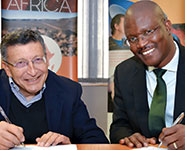
Dr. Bernie Fanaroff, project director of SKA SA, and Ndwakhulu Mukhuhi, CEO of NMISA, signing the memorandum of understanding between the organisations.
NMISA is mandated to maintain the national measurement standards for South Africa, including those for time and frequency. In this capacity, it keeps the national time (known as South African Standard Time or SAST) and contributes to the calculation of Coordinated Universal Time (UTC).
Precise frequency is necessary to form clear images when using an array of antennas, as is the case with the MeerKAT. Time and frequency constitute the best-known measurement standards as they are based on quantum transitions of atoms. Absolute time is essential in breaking new frontiers. This is required in order to look further into space than ever before at objects where time and space itself is distorted or where the footprints of the universe’s birth can be seen.
The signals from each antenna will reach a data processing centre at different times due to the difference in distance from each antenna. Correlation and beam forming of the signals are necessary in order to make the antenna operate as one big receiver to obtain a high-resolution image of the sky. Correlation relies on precise time tagging of the received signals. The correlating beam former must be very accurately synchronised to the master time reference of the data centre, which itself must be synchronised to UTC.
According to Dr Johan Burger, the man in charge of SKA SA’s time and frequency systems, “time and frequency are critical in the observation of celestial bodies via radio techniques. South Africa will benefit from these technological developments as time and frequency are very important in navigation of aircraft and other vehicles, defence and telecommunications.”
Further reading:
Locate underground cable faults faster with the Fluke AF2082 A-Frame
Comtest
Editor's Choice Test & Measurement
Underground cable faults can lead to costly downtime, service disruptions, and extensive excavation if the fault location is uncertain. The AF2082 simplifies this process by guiding operators directly to the fault point.
Read more...
Here is what we learnt from three supply chain crises
Seven Labs Technology
Editor's Choice
Component crises are not random events. They follow a pattern. After fifteen years and three major disruptions, Seven Labs knows exactly what that pattern demands, and what it takes to keep production lines moving.
Read more...
The new reality of PCB material supply
Jemstech
Editor's Choice Manufacturing / Production Technology, Hardware & Services
How resilient manufacturing strategies are helping OEMs navigate a changing global supply chain.
Read more...
Strengthening local electronics manufacturing through investment and innovation
Microtronix Manufacturing
Editor's Choice Manufacturing / Production Technology, Hardware & Services
Microtronix South Africa cements its commitment to local manufacturing with ongoing investments in production capacity, skills development, and job creation.
Read more...
From the editor's desk: Local can be international
Technews Publishing
Editor's Choice News
Welcome to the July 2026 issue of
Dataweek. As you can see from this introduction,
Dataweek’s regular editor, Peter Howells, is on extended leave and I am filling the void in his editor’s column – hopefully without being too boring.
Read more...
Yamaha Robotics will show visitors to EFX
Manufacturing / Production Technology, Hardware & Services News
Yamaha Robotics will show visitors to EFX 2026, the Expo for Electronics Manufacturing, in Stuttgart from 6-8 October 2026, how advanced surface-mount automation helps companies grow their business and increase productivity.
Read more...
Solving South African power problems with locally built intelligence
Editor's Choice Power Electronics / Power Management
Smart metering infrastructure in South Africa remains patchy. The rollout has been slow, coverage is inconsistent, and for the most part, granular per-unit measurement simply does not exist.
Read more...
From the editor's desk: The art of measuring the truth
Technews Publishing
Editor's Choice News
All electronic measurements are a lie. The trick is making the lie as small as possible.
Read more...
Engineering for failure: why resilient telemetry matters more than perfect connectivity
Editor's Choice Telecoms, Datacoms, Wireless, IoT
One of the biggest assumptions in modern tracking systems is that connectivity will always be available. From an engineering perspective, this creates an interesting problem.
Read more...
Lesley Havenga: Building partnerships for Africa’s electronics future
Editor's Choice News
As Würth Electronik expands its footprint across South Africa and the broader sub-Saharan region, Havenga’s blend of manufacturing expertise, supply chain knowledge, and people-centred leadership appears well suited to the task.
Read more...









 printer friendly version