Locally made PV modules power REIPPP
23 March 2016
Editor's Choice
News
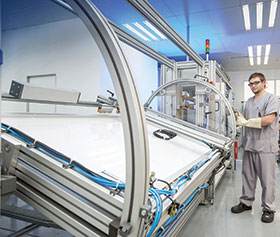
ARTsolar recently completed production of the final consignment of locally produced photovoltaic (PV) modules in the government’s Round 3 of the Renewable Energy Independent Power Producer Programme (REIPPP).
“These PV modules were manufactured at the ARTsolar plant in KwaZulu-Natal, for the Mulilo Sonnedix Prieska PV solar plant project,” explains Derek Lawrance, director at ARTsolar. “This plant, which supplies the electricity it produces to the Eskom Kromos substation in the Northern Cape, is the first 75 MW AC size REIPPP project to have PV modules produced by a South African owned company.”
After winning this Q1 2015 bid, ARTsolar implemented an expansion programme to meet production requirements of this project. The company made a substantial investment in new machinery and increased the total floor space of its New Germany plant from 3500 m² to 10 000 m². The single day shift operation was increased to a 24 hour/six day schedule and the team of staff was expanded to 200.
“We are proud to be the first locally owned solar PV module manufacturer to have been awarded manufacture for the REIPPP programme. Although ARTsolar’s operation has grown significantly through this project, challenges remain for local PV manufacturers outside of the REIPPP programme.
“Local industry is struggling to adapt to the ‘stop-start’ nature of REIPPP projects, which present extended inactive manufacturing periods between contracts. This situation requires assistance from the Industrial Development Corporation (IDC) and the Department of Trade and Industry (DTI). Unlike solar water heaters, the local PV module manufacturing sector is not protected by locally designated modules outside of the REIPPP.”
Based on this, ARTsolar is currently restructuring its operations in preparation for REIPPP Round 4 in Q4 of 2016. The company expects to operate at its pre-expansion capacity, whilst escalating its penetration of the local and sub-Saharan market, in anticipation of once more participating in the REIPPP later in the year.
For more information contact ARTsolar, +27 (0)31 705 7162, sales@artsolar.net, www.artsolar.net
Further reading:
Women and the future of engineering in South Africa
Editor's Choice
With women making up just 16% of registered engineering professionals in South Africa, AvenirHoldings CEO, Tshidi Mndzebele, is calling on women engineers and graduates to pursue formal professional registration as a key step to unlocking career growth and industry leadership.
Read more...
The effect of seasonal changes on ESD performance in South Africa
Actum
Editor's Choice Circuit & System Protection Manufacturing / Production Technology, Hardware & Services
Electrostatic discharge performance is influenced by several environmental factors, with relative humidity being one of the most important. This is particularly relevant in South Africa, where seasonal changes can result in significant differences in humidity levels.
Read more...
Compact RTK design: More than just the receiver
iCorp Technologies
Editor's Choice Telecoms, Datacoms, Wireless, IoT
In practice, engineers building compact RTK products keep discovering the same thing: the hardest component in the system is no longer the receiver. It is the antenna.
Read more...
The signal-to-noise challenge in large-scale IIoT
Sigfox South Africa
Editor's Choice Telecoms, Datacoms, Wireless, IoT
For much of the last decade, the industrial IoT industry has been driven by a relatively simple assumption: if a little data is useful, more data must be better. That thinking shaped countless deployments.
Read more...
Women building South Africa’s power infrastructure
Editor's Choice
As South Africa celebrates Women’s Month in August, women are increasingly taking their place on the factory floor, in technical workshops and across engineering environments, helping manufacture the infrastructure that keeps the country’s electricity network running.
Read more...
More efficient production with optimised procurement
Editor's Choice
The smallest part on the BOM is usually the one that holds it up. Interconnect, passive and electromechanical components rarely get attention until they are missing. That is starting to change, and it is reshaping how procurement teams think about risk.
Read more...
Locate underground cable faults faster with the Fluke AF2082 A-Frame
Comtest
Editor's Choice Test & Measurement
Underground cable faults can lead to costly downtime, service disruptions, and extensive excavation if the fault location is uncertain. The AF2082 simplifies this process by guiding operators directly to the fault point.
Read more...
Here is what we learnt from three supply chain crises
Seven Labs Technology
Editor's Choice
Component crises are not random events. They follow a pattern. After fifteen years and three major disruptions, Seven Labs knows exactly what that pattern demands, and what it takes to keep production lines moving.
Read more...
The new reality of PCB material supply
Jemstech
Editor's Choice Manufacturing / Production Technology, Hardware & Services
How resilient manufacturing strategies are helping OEMs navigate a changing global supply chain.
Read more...
Strengthening local electronics manufacturing through investment and innovation
Microtronix Manufacturing
Editor's Choice Manufacturing / Production Technology, Hardware & Services
Microtronix South Africa cements its commitment to local manufacturing with ongoing investments in production capacity, skills development, and job creation.
Read more...









 printer friendly version