

Power Electronics / Power Management


Solar-powered bakery developed at UJ

26 June 2019 Power Electronics / Power Management Editor's Choice

Despite being ranked as the eighth most developed country in Africa in the United Nations Development Programme’s annual report in 2018, several challenges still plague South Africa.

The need for employment, access to energy, economic activity, community development and access to affordable essential foods is still very prominent in both rural and urban areas.

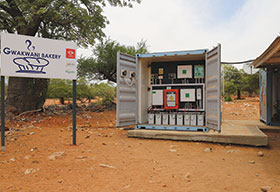
While working on a project to empower a remote village in the northern part of South Africa through locally available renewable energy sources, Profs Johan Meyer and Sune von Solms of the University of Johannesburg’s (UJ) School of Electrical and Electronic Engineering Sciences conceptualised the Solar Bread Box – a first for commercial sized photovoltaic solar bakeries.

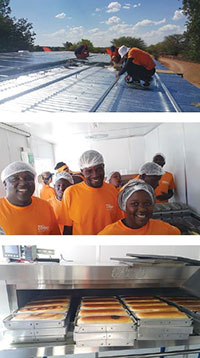
Boasting the same equipment and baking cycle as a standard grid tied commercial bakery, the Solar Bread Box eliminates the dependence, purchase and monthly bills associated with grid tied electricity. Not only that, but the bakery is also an instantaneous employment and skills development opportunity for youths, a tool for economic stimuli and an avenue for an essential product.
Low income households in rural and urban communities where there is no grid connection; communities where the residents cannot afford electricity; or communities where there are underlying social issues regarding the access and distribution of electrical power consider bread an everyday staple. The affordability and access of wholesome, fresh bread is essential in such areas.

Prof Meyer clarifies that the Solar Bread Box should not be confused with other solar solutions such as concentrated solar power or solar thermal technologies that are used for heating and cooling. He explains that this solution uses a photovoltaic system, which converts solar energy into electrical power used for the baking process.

Prof von Solms says that the idea is for the bakery to function on the conversion of solar energy as much as possible – minimising the cost of solar energy storage solutions. This means that baking will be seasonally dependent, and bakers will have to adjust their baking times in accordance with the sun to harness maximum power during baking cycles.

The UJ School of Electrical Engineering, in collaboration with Bakery and Food Technology Incubator of South Africa (BICSA), offers training on how to bake, how to run a bakery as a business and how to maintain a solar PV system, enabling communities to thrive independently.

So far, the Solar Bread Box has sparked economic activity, created jobs for eight individuals, created an enterprise that now serves neighbouring villages, enabled access to wholesome foods and the production of at least 100 loaves of bread a day, and boosted skills development in Gwakwani – a small, remote village in Limpopo that initially had no grid connection.

When used as a tool for community development, the Solar Bread Box becomes a self-sustaining, economy stimulating, job creating and skills development platform – creating communities that have access to healthy, wholesome baked goods, are self-dependent and economically active.

For more information contact Cornay Keefer, University of Johannesburg, [email protected]


Share this article:
Share via emailShare via LinkedInPrint this page

Further reading:

Quality batteries are critical for IIoT
Uniross Batteries Power Electronics / Power Management
Batteries intended for use in industrial operations must indeed offer complete reliability under extreme environmental conditions, resistance to vibration and harsh environments.

Read more...
12 kW hybrid inverter
Power Electronics / Power Management
Sungrow recently unveiled its next-generation residential energy storage solution, expanding its power range from 5 kW to 12 kW with the introduction of the new MG12RL hybrid inverter.

Read more...
40 W and 75 W railway DC/DC converter
Brabek Power Electronics / Power Management
RECOM has announced two new cost-efficient DC/DC converters for the rail market with an ultra-wide 11:1 input range to cover all nominal input voltages from 24 to 110 V DC.

Read more...
Power modules for solid-state transformers
RS South Africa Power Electronics / Power Management
Microchip’s new 3,3 kV silicon carbide modules deliver the required thermal performance and efficiency for SSTs to increase power available for token generation.

Read more...
Solving South African power problems with locally built intelligence
Editor's Choice Power Electronics / Power Management
Smart metering infrastructure in South Africa remains patchy. The rollout has been slow, coverage is inconsistent, and for the most part, granular per-unit measurement simply does not exist.

Read more...
Wide range power module
Power Electronics / Power Management
The latest DC-DC modules from Würth Elektronik are characterised by high resilience to voltage transients on the 24 V bus and an extremely wide input-voltage range from 3,5 V to 38 V.

Read more...
Selecting primary batteries for maximum service life
Uniross Batteries Power Electronics / Power Management
Primary batteries play an important role in IoT applications. Designed for longevity, they have a high-energy capacity and are often used in standalone applications where charging is impractical or impossible.

Read more...
4 kW e-mobility DC-DC converter
Brabek Power Electronics / Power Management
The RECOM RMOD4000 series of compact, plug-and-play DC-DC converters is a cost-effective solution to provide isolated 14 V, 28 V, or 56 V DC network rails from a high input voltage between 180 and 950 V DC.

Read more...
Aluminium case upgrade boosts performance
Vepac Electronics Power Electronics / Power Management
The SQBF Quarter Brick 300 W DC to DC Converter is now available in a newly upgraded metal case designed to deliver improved durability and superior electrical performance across demanding applications.

Read more...
Extending the range of power converters
RS South Africa Power Electronics / Power Management
Power Integrations recently announced a breakthrough in flyback topology extending the power range of flyback converters to 440 W - well beyond the limits that traditionally required more complex resonant and LLC topologies.

Read more...


While every effort has been made to ensure the accuracy of the information contained herein, the publisher and its agents cannot be held responsible for any errors contained, or any loss incurred as a result. Articles published do not necessarily reflect the views of the publishers. The editor reserves the right to alter or cut copy. Articles submitted are deemed to have been cleared for publication. Advertisements and company contact details are published as provided by the advertiser. Technews Publishing (Pty) Ltd cannot be held responsible for the accuracy or veracity of supplied material.


© Technews Publishing (Pty) Ltd | All Rights Reserved

