Instead of the walls having ears, they can talk now too
30 June 2004
News
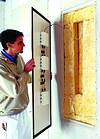
The world of speaker-free sound, where the walls themselves become the speakers has arrived. Now you can listen to Handel’s ‘Water Music’ playing from the bathroom tiles while you take a shower, feel the house shake with the footsteps of dinosaurs while you watch ‘Jurassic Park’ on your home entertainment system and hear Robbie Williams as if he is literally singing in your living room.
A new speaker-less sound system has been developed by German polyurethane specialist Puren, where the walls, ceilings and floors produce the sound themselves. Puren developed the system in cooperation with Siemens and Bayer MaterialScience, one of the largest plastics producers in the world.
The soundboard element is composed of a special polyurethane that allows its thickness to be reduced to seven millimetres
Said Hans Bommer, managing director of Puren: "The principle of generating sound using a vibrating surface rather than through speakers in the usual way is based on a Siemens patent. The only thing missing up till now was a really good digitally-controlled soundboard. Now, after just 18 months of development, we are ready to unveil the complete system."
The heart of the 'pursonic' sound technology is a thin soundboard. This element is composed of a special polyurethane made from the Bayer raw materials Desmophen and Desmodur. These materials allowed the thickness of the board to be reduced to seven millimetres, which means it takes up the minimum of space in the wall and is still highly stable. The company gives the example of an acoustic guitar sound. This also makes the thin outer walls vibrate, but unlike the trumpet, it does not generate a strong air pressure wave. So how does it work exactly?
"Ah well, that is our secret," smiles Bommer. "All I can say is, it took hundreds of attempts to arrive at the sound we were looking for."
Ensuring that the speaker elements still sound good when they have been fitted into walls, ceilings and floors and covered with plaster, carpet or tiles, high-precision digital technology is required. That is where Siemens comes in. Every soundboard is made to vibrate by sound generators on the reverse side. These receive signals from a freely programmable digital processor. The company says the art lies in the fine-tuning of the frequencies - treble, mid-range and bass - to the surface material of the wall behind which the soundboard is concealed. Emission angles are also almost twice the width of those of standard speakers, eliminating the so-called 'sweet spot' as with standard speakers.
Further reading:
Rooibos heads to space
News
A South African scientific initiative linking agriculture and space research has officially launched today with the Rooibos in Space programme at Parklands College’s Innovation Centre in Cape Town.
Read more...
From the editor's desk: Local can be international
Technews Publishing
Editor's Choice News
Welcome to the July 2026 issue of
Dataweek. As you can see from this introduction,
Dataweek’s regular editor, Peter Howells, is on extended leave and I am filling the void in his editor’s column – hopefully without being too boring.
Read more...
Landis+Gyr EMEA introduces new company name: EYKON
News
EYKON is the new company name of Landis+Gyr EMEA, formerly part of the Landis+Gyr Group. The company supports electricity, gas, water and thermal utilities in managing increasingly complex networks, improving operational efficiency and enabling more sustainable use of resources.
Read more...
Yamaha Robotics will show visitors to EFX
Manufacturing / Production Technology, Hardware & Services News
Yamaha Robotics will show visitors to EFX 2026, the Expo for Electronics Manufacturing, in Stuttgart from 6-8 October 2026, how advanced surface-mount automation helps companies grow their business and increase productivity.
Read more...
From the editor's desk: The art of measuring the truth
Technews Publishing
Editor's Choice News
All electronic measurements are a lie. The trick is making the lie as small as possible.
Read more...
TSE has relocated
News
The Technology Station in Electronics (TSE) has entered a new chapter with its relocation from the CSIR campus to TUT-owned building at Ditsela Place in Hatfield.
Read more...
Innovative MyLegrand app
RS South Africa
News
Legrand SA is set to launch the MyLegrand mobile application, a digital platform designed to strengthen engagement across its professional network.
Read more...
Kulani Energy acquires critical assets from Optipower
News
Kulani Energy preserves engineering, procurement, and construction capability and positions a wholly women-owned firm at the forefront of South Africa’s grid expansion.
Read more...
From Cape Town to Johannesburg
News
Würth Elektronik South Africa has taken a significant step forward with its recent relocation from Cape Town to Johannesburg, marking a new phase of growth and ambition for the company.
Read more...
Lesley Havenga: Building partnerships for Africa’s electronics future
Editor's Choice News
As Würth Electronik expands its footprint across South Africa and the broader sub-Saharan region, Havenga’s blend of manufacturing expertise, supply chain knowledge, and people-centred leadership appears well suited to the task.
Read more...









 printer friendly version