


The main objective of a battery system is to provide standby and emergency power to operate industrial, consumer, commercial or protective devices connected to it. These devices include emergency lighting, uninterruptible power supplies, continuous process systems, operating controls, switchgear components and protective relays. It is essential that these devices are in proper operating condition in emergency situations because failure of a battery system can also result in failure of these devices.
It often happens that a battery system develops grounds within the system. When both the positive and negative terminals are partially or completely grounded, a short circuit is formed across the battery. This can cause the protective device to fail to operate when needed.
Current test methods
Although utilities and industrial complexes have gone to great lengths to find grounds within their battery systems, locating these battery grounds proves very elusive and time-consuming. The current ground-fault location method involves sectionalising or interrupting DC branches to isolate the ground fault. Unfortunately sectionalising disables the system protection and has been known to cause inadvertent line and generator tripping. Therefore, many utilities have banned sectionalising.
New test method
The AC injection test method measures fault resistance in the battery system without sectionalising the DC system. By reducing the fault locating time from days to hours the system is protected at all times.
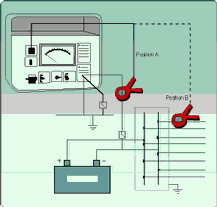
The AC injection method measures single or multiple ground faults by injecting a low-frequency AC voltage between the station ground and the battery system. The resulting current is then measured by using a clamp-on sensing current transformer. The resistance value can also be calculated using the in-phase component of the circulating current, thus rejecting the effect of capacitive loads. Therefore, if the signal is injected at the battery terminal and the clamp-on CT is connected to the outgoing lead, the instrument will measure the total ground resistance present on the battery system (Figure 1, position a). If the CT is clamped on a feeder, then the instrument will measure the ground resistance on that feeder (Figure 1, position b).
Analysis of these pictures shows how easy it is to locate faults with the AC injection method. After injection of a low-frequency AC waveform, a resistive fault on a branch of the battery system will be indicated by a low-resistance value. For example, if the total resistance on a battery system showed 10 kW, this would indicate a resistive fault on the battery system. The resistive fault can be located by clamping on each individual circuit until a resistive value of 10 kW is found.
This method can be adapted easily to the location of multiple faults by using the theory of parallel paths. For example, if the total system resistance indicates 100 W and an individual branch indicates 10 kW resistive fault, the user would know that the system has a second fault because the total system resistance and the branch resistance do not match.
Operation of the multi-amp, battery ground fault locator
The technician can simplify his life by investing in AVO International's multi-amp battery ground fault locator. It is lightweight and portable, reads directly in resistance and can operate on live battery systems. Its resistance range is from 1 W to 100 kW and it works on battery systems up to 260 V nominal with a maximum ripple current of 0,5 A a.c. and maximum DC bias current of 20 A.
The battery ground fault locator is user-friendly and virtually anyone can be trained to use the instrument. The unit can substantially reduce the amount of time needed to locate battery ground faults.






© Technews Publishing (Pty) Ltd | All Rights Reserved
 printer friendly version