


There’s undeniable opportunity in consumer and industrial electronics, given the staggering size of the market for TV sets, telephone systems, computers, smart metering, vehicle tracking and much else besides.
At the same time, electronics manufacturing is a highly competitive industry with exacting standards for reliability and performance, and the need to reduce out-of-box and field failures is paramount.
Any discussion concerning quality and reliability in electronics must therefore include testing throughout the manufacturing cycle, as this sub-discipline of electronics manufacturing ensures that products don’t only work as intended, but do so unfailingly in the environmental conditions in which they must operate and be transported.
In this, Grand Tellumat Manufacturing’s (GTM) turnkey contract manufacturing offering includes comprehensive testing solutions for its customers. These customers may range from small innovators needing end-to-end help with devising and executing testing routines on new products, to large companies with product sets and testing regimes that have been refined over many years.
All testing strategies

Duncan Pollock, business development manager at GTM, says the safe assumption is that no manufacturing process is perfect and will invariably reveal process failures and faults. “The ideal is to get as close to 100% test coverage of all the functions, features and operating scenarios as one can,” he explains.
That being said, a particular testing approach will depend on the customer, he says: “Some manufacture very simple assemblies and give us very basic test requirements, while others set very stringent conditions right down to a complete functional test with 100% coverage, known as a bed-of-nails test.”

Some tests are devised by customers for their own products and have evolved over many years, however, while GTM can also execute tests it has designed with its years of experience in particular fields, or built up as necessitated by customer needs. “There are multiple strategies, and GTM accommodates all of them,” says Greg Chin, GTM test engineer.
Specialist experience
GTM has, for example, built up specialist testing expertise in radio frequency communications equipment, due to its experience in manufacturing and integrating defence electronics. “Our capability in this regard is quite unique. We have instrumentation dedicated to measuring fairly high-frequency RF products such as microwave links, and our specialised experience, broad engineering capability and investment over many years have given us expertise beyond that of most other electronics contract manufacturers,” continues Chin.
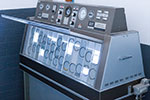
Over and above the need to test the functions and features of a piece of electronics, the company also performs environmental testing. “We must satisfy ourselves that what leaves the factory can withstand normal operating conditions and the circumstances under which it may be transported,” says Chin.
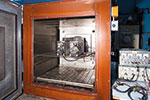
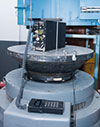
It may, for example, be necessary to expose units or assemblies to extreme temperatures, such as the avionics products made for Tellumat Defence. Vibration testing might be required to ensure a piece of equipment can withstand being transported over rough terrain or continue to operate over time when mounted in a particular environment, an example of this being a car radio mounted on a dashboard. Other tests include accelerated ageing, focusing on exposure of sensitive electronics and their enclosures to extreme humidity, sunlight and salt air.
Seen it all
Most customers hope for as much test point coverage as possible, and a contract manufacturer must be prepared for a wide range of requirements. “If it’s a large company developing its own product and testing protocols, it is fairly certain they’ve put a lot of money into it over a fairly long period, and we can offer a satisfactory array of tests to meet their needs,” says Chin. “But just as often we encounter a situation in which an entrepreneur comes up with his first product, and then looks stunned when someone brings up the issue of testing it. This can be problematic and often results in us having to come up with a suitably effective yet cost-efficient array of tests within a very pressing time frame.”
The only way for a customer to do this with any confidence is to work with a contract manufacturing partner that has experience with similar products. “There is a lot of commonality in the technologies out there,” adds Pollock. “Smart electricity meters are becoming increasingly popular, as many innovators seek to capitalise on the energy supply problems in the country. We’ve seen many, with some sort of smart backend component, doing monitoring of usage and remote shutdowns of geysers and secondary appliances and devices. But whatever it is, chances are we know the tech and have worked with it.”
GTM’s experience in the market is far-reaching, having been involved in everything from renewable energy, energy management, telecommunications, radio frequency equipment, televisions, set-top boxes and even baby monitors and gambling slot machines.
Full turnkey
Finally, GTM does the entire process under one roof. “In many electronics contract manufacturing scenarios, customers are very likely to have to go to one company for prototyping, another for manufacture, another for testing, and still have to collect and transport it,” says Pollock. “With GTM, you can literally place the order for whatever you need manufactured and we will do it, test it, integrate it into its housing, test it again, put it in a box ready to go and ship it to our customer’s customer, if required. The customer will get the final product, box and all, without touching anything at any part of the product cycle.”
“And let’s face it, there’s something to say for the peace of mind of having it all seen to. As the owner of valuable intellectual property, you want to focus on design and marketing and not on driving from pillar to post and hand-holding various actors in bringing your idea to fruition. One factory that will cost-effectively do the ordering, picking, placing, component testing, software testing, PCB integration, assembly testing, wrapping, and package testing is most likely to get your vote,” Pollock concludes.
For more information contact Duncan Pollock, Grand Tellumat Manufacturing, +27 (0)21 710 2911, [email protected], www.grandtellumat.com






© Technews Publishing (Pty) Ltd | All Rights Reserved
 printer friendly version