


The electronics industry always has a need for trusted, quality cable harnesses in various industries and applications, and one of the companies supplying that demand is Otto Marketing/Otto Wireless Solutions.
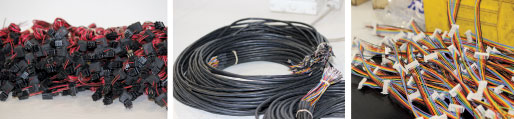
Dataweek quizzed Chris Viveiros and Barry Culligan, respectively the general manager and CEO, about what goes on behind the scenes to produce its cable harnesses.
Dataweek: What are the benefits of ‘bundling’ cables into a harness?
Otto: The main benefits are ease of integration into end equipment, consistency of final product performance and cost saving. Most significantly the cables are usually integrated into customer products as part of final assembly, which is when the pressure to deliver is at its peak, considering that all other potential and likely production delays will have already occurred. So one wants to save money and integrate quickly in order to finish final assembly and testing.
There is also the ergonomics to consider. . . no-one wants to open a product (down the line) and see a spiderweb of cables, you want to see a neat, professional presentation, as the ‘look and feel’ of the final product is commonly considered a reflection of the due diligence and professional approach taken to design the entire product.
Dataweek: What modern techniques and equipment are used in the making of cable harnesses?
Automated stripping, crimping and testing machinery comprise the typical top-of-the-range approach. This type of approach works well for very large production runs, but has its challenges when it comes to smaller, niche/custom cable assemblies. For the bulk of the South African industry, a semi-automated approach is more versatile and still very cost effective.
In a semi-automated approach, the cables are cut and stripped as one step, and then crimping, final product integration and testing are all separate processes. In our local market, custom moulding also appears to be coming to the fore, as more and more clients are requesting customised moulding. To attend to this, one needs medium scale moulding machinery, where tooling cost for the cable is not prohibitive, and there is a good balance between workmanship and ease of running small batches.
Dataweek: Is it a highly automated process or is there a significant amount of manual labour?
It is a 50/50 process. Cable harnessing is not the sort of thing which can be fully automated unless you are doing high volumes of repeat assemblies. For example USB cables are made in the East for a fraction of the cost at which a similar product could be manufactured locally. However, when one evaluates costing for more niche, lower volume custom assemblies, local pricing tends to be very competitive versus global suppliers.
Dataweek: How do you test your harnesses before delivering them to the customer?
All cables are individually tested on semi-automated Cami cable test equipment. Cami Research is a world renowned manufacturer of cable testing equipment, situated in Massachusetts, USA, and has more than 20 years’ experience in the field of cable test equipment.
By way of explanation, the process for a new assembly is a basic test jig made by ourselves, and a customer approved, tested sample is then used by the test system to learn the profile of the cable assembly. The system then tests for continuity, short circuits and pinout. Each cable is individually tested, and then goes through a level of visual inspection, as well as pull-force testing.
It is also important to note that during production, before cables reach the final test point, our QA manager conducts in-process inspections and records the results on job cards. Quality is also maintained by ensuring all operators are trained and pass tests set by international certification bodies, so all operators have intimate knowledge of the assembly standards which must be adhered to at all times. This holistic approach ensures that when products reach our test bench, the pass rate will be very high.
Dataweek: What are some dos and don’ts customers should be aware of when specifying, designing and installing cable harnesses?
It’s easier to go through don’ts than dos. The most common problem we see is customers specifying wire gauges which cannot be accommodated by the connectors which they have selected, or selecting wire gauge which cannot accommodate their application’s operating voltage or current.
On the RF cabling side, we very often see customers specifying return losses or insertion losses which disregard their operating frequency and connector specifications, and consider only the ‘typical’ factors of the cable. Also, with RF cable harnesses, the length of the assembly vs. operating frequency is also important. In general, for all custom cables, the length is important – one does not want to make cables too long, because this will invariably lead to cables being coiled, which forms inductors.
Choose good quality connectors. Very often one spends a lot of time doing the perfect design, the connectors are the last thing to be selected and this typically gets done when one is approaching the limit of one’s financial budget. The entire system relies upon sound quality connections and whereas cost is always important, this is not the place to try to be penny-wise, because it may be a case of being pound-foolish. Every connection is a potential point of failure, keep it in mind and mitigate risks by choosing the best quality which you can afford and which will reliably do the job.
When an engineer is making their proof of concept product, remember that the cable assembly needs to be industrialised and easily manufactured. Keeping it as simple as possible means it will be easily and quickly manufactured, it will be reliable, and it will be cost-effective.
For more information contact Chris Viveiros, Otto Wireless Solutions, +27 (0)11 791 1033, chris@otto.co.za, www.otto.co.za
| Tel: | +27 11 791 1033 |
| Email: | wireless@otto.co.za |
| www: | www.otto.co.za |
| Articles: | More information and articles about Otto Wireless Solutions |






© Technews Publishing (Pty) Ltd | All Rights Reserved
 printer friendly version