Solder inspection system offers high magnification for accurate inspections
25 February 2004
Manufacturing / Production Technology, Hardware & Services
Incorporating the versatile Windows 2000 interface, Omron's VT-WIN II PCB solder inspection system can be used either in-line or off-line, for rapid, accurate identification of a variety of circuit board assembly defects. A zoom lens allows multiple magnifications down to 10 microns per pixel. According to the company, the VT-WIN II's magnification is the highest in the industry, allowing it to accurately inspect 0201 components. In addition, with its high speed digital camera and high speed motion control, it is also one of the fastest inspection systems around - and twice as fast as the previous VT-WIN model.
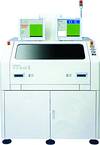
Figure 1. The VT-WIN II offers advances in solder inspection, component fault detection and process speed that gives manufacturers a competitive edge in productivity, waste reduction and quality control
Major improvements with VT-WIN II are: angled-view inspection to detect lifted leads on gullwing devices and heel fillets on SOJ and PLCC devices; industry-leading algorithms to accurately inspect lead-free solder; four times the inspection area and twice the speed; automatic colour extraction tool and other teaching aid functions dramatically reduce setup time.
First introduced in 1996, the original VT-WIN revolutionised in-line PCB inspection with a patented Colour Highlight System and colour image processing. Omron's VT-WIN II handles a variety of PCB styles, increasing production flexibility. The Colour Highlight System enables instant, consistently accurate recognition of solder quality, wettability and correct component placement. Accuracy is also enhanced through the system's position self-adjustment function. This function enables the system to automatically adjust solder land size inspection area allowing simplified programming of varying land sizes.
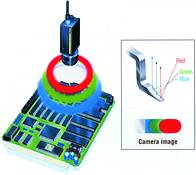
Figure 2. Omron’s Colour Highlight System projects red, green and blue light onto the PCB at different angles. The camera captures these reflected colours, producing a two-dimensional image that conveys three-dimensional information that allows the VT-WIN II to detect minute flaws that would commonly be missed
The Colour Highlight System uses a multicolour LED light source to project red, green and blue light onto the PCB at different angles. The camera captures these colours as they reflect off the board's surface, producing a two-dimensional image that conveys three-dimensional information. This image allows the VT-WIN II to detect minute flaws that would ordinarily be missed. Compared to gray-scale inspection methods, where solder fillet image settings are defined with numerical values for brightness and contrast, this process is significantly easier, reduces errors due to misinterpretation of data or colours, and ultimately reduces start-up time.
Another aspect of the VT-WIN II's functionality is its optical character recognition (OCR) capability, in which it distinguishes correct component values, thus preventing incorrect assemblies. The system also has advanced algorithms that enable proper inspection of leading technology processes such as lead-free solder. The software, which is programmed via CAD placement data, incorporates intelligent algorithms to reduce operator programming time. Omron's graphical user interface allows parameter settings to be defined via a 'point-and-click method' rather than requiring numerical values to be entered.
For more information contact Hawker Richardson, 011 792 2766.
Further reading:
Soldering day highlights
Manufacturing / Production Technology, Hardware & Services
JAPAN UNIX has published a new event report and highlight video from their UNIX SOLDERING DAY 2026 in Hungary. This event reflects on their commitment to supporting manufacturers not only through soldering automation systems, but also through technical education, live demonstrations, hands-on training, and practical engineering know-how.
Read more...
Clearing the Static: Electrostatic Discharge
Actum
Manufacturing / Production Technology, Hardware & Services
A cordless ESD (Electrostatic Discharge) wrist strap does not work by grounding the person in the same way as a traditional wired wrist strap. Instead, it works by reducing or balancing the static charge on your body so that you are less likely to discharge electricity into sensitive electronic components.
Read more...
Engineering trust in South Africa’s SMT sector
ZETECH ONE
Manufacturing / Production Technology, Hardware & Services
From a small Johannesburg start-up to a trusted SMT technology partner, Zetech One has spent four decades helping South African electronics manufacturers improve production quality, efficiency and reliability.
Read more...
The new reality of PCB material supply
Jemstech
Editor's Choice Manufacturing / Production Technology, Hardware & Services
How resilient manufacturing strategies are helping OEMs navigate a changing global supply chain.
Read more...
Streamlining Device Programming with the AutoBee-D1
Vepac Electronics
Manufacturing / Production Technology, Hardware & Services
The AutoBee-D1 desktop automated programmer is designed to simplify the programming of devices, while delivering consistent accuracy, high throughput and reduced manual intervention.
Read more...
Zero PFAS die attach paste
Testerion
Manufacturing / Production Technology, Hardware & Services
With silver price volatility increasing and sustainability requirements accelerating across semiconductor assembly, MacDermid Alpha Electronics Solutions introduces ATROX CD 560-1, a zero per- and polyfluoroalkyl substance (PFAS) alternate silver filler die attach paste.
Read more...
Precision jet printing for advanced PCB designs
MyKay Tronics
Manufacturing / Production Technology, Hardware & Services
Mycronic’s BA 01 small dot ejector delivers unmatched precision in solder paste jet printing for advanced PCB designs.
Read more...
Strengthening local electronics manufacturing through investment and innovation
Microtronix Manufacturing
Editor's Choice Manufacturing / Production Technology, Hardware & Services
Microtronix South Africa cements its commitment to local manufacturing with ongoing investments in production capacity, skills development, and job creation.
Read more...
Polypropylene pole-top boxes support smarter, more secure electricity networks
Manufacturing / Production Technology, Hardware & Services Enclosures, Racks, Cabinets & Panel Products
As South Africa accelerates the rollout of smart prepaid electricity metering, innovative enclosure technology from Power Process Systems (PPS) is helping utilities improve network security, reduce electricity theft and protect critical electrical infrastructure.
Read more...
200 W of power in a space-saving design
Vepac Electronics
Manufacturing / Production Technology, Hardware & Services
The Hakko FX-972 Soldering Station delivers high-performance soldering in a compact package, making it suitable for a wide range of soldering applications.
Read more...









 printer friendly version