


Plastic film capacitors, now widely used by the electronics industry, vary with a number of factors. When selecting Supprescraft capacitors, the manufacturer suggests that the following reference information be taken into consideration.
Frequency
Polyester capacitors with a high dielectric loss factor are generally suitable to use at frequencies below 10 kHz at comparatively wide temperatures. Polypropylene, with lower D.F. (dissipation factor), is the most popular selection for high frequency and higher pulse current applications although its size is larger and it has a lower temperature range. Polycarbonate has features of both polyester and polypropylene, but the high material cost prohibits wide use.
Peak voltage
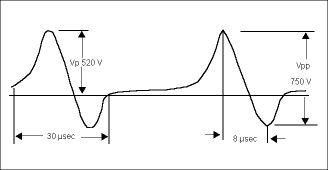
The peak voltage against a zero potential reference shall always be less than the nominal DC voltage rating of the capacitor. The rate of voltage change (dv/dt) of individual specifications are valid for pulse voltages equal to the rated voltage. If the pulse voltages are of lower values, a factor of 'V dc/applied voltage' may be used. See Figure 1.
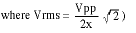
Vp=<VDC rated and the V rms voltage shall always be less than the nominal AC voltage rating of the capacitor.
V rms less than and equal to VAC rated (for sinusoidal wave
Pulse current
Proper selection of Supprescraft capacitors should be done in conjunction with the pulse rise tables for each type.
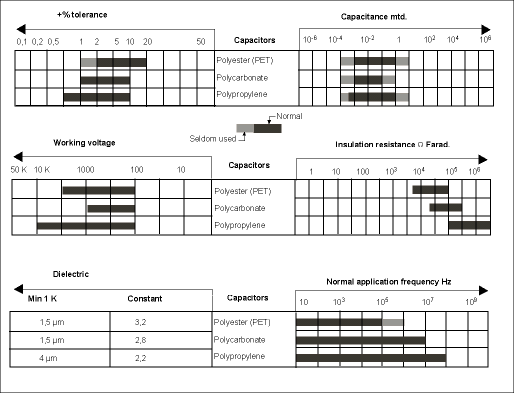
Figure 2 shows the general characteristics of capacitance, tolerance, insulation resistance, working voltage, dielectric constant, minimum thickness and application. For further details for example, temperature and frequency characteristics, contact the local distributor, refer to each individual type and curves or contact Supprescraft.
Capacitors
Supprescraft offers a range of metallised film polyester, polypropylene and polycarbonate dipped and box capacitors that are manufactured to IEC 384 standards and can be custom-produced to the AC/DC voltages required. Specialising in small batches at short turn-around times, the Supprescraft range of capacitors covers units of 0,001 µF to 10 µF at 63 to 630 V d.c., as well as 250 and 500 V a.c. for use in X and Y suppression applications.
| Tel: | +27 11 458 9000 |
| Email: | [email protected] |
| www: | www.electrocomp.co.za |
| Articles: | More information and articles about Electrocomp |






© Technews Publishing (Pty) Ltd | All Rights Reserved
 printer friendly version