

Circuit & System Protection


Reliable and safe - protection components: Part III

7 April 2004 Circuit & System Protection

Epcos, a world leader in passive components, is one company that has years of experience, competence and innovation in developing and designing protective components such as gas-filled surge arresters, thermistors and varistors, for electronics.

Following our brief look at NTC thermistors in Part II, this article continues now with a look at PTC thermistors.

PTC thermistors

PTC thermistors protect equipment against overcurrent and excessive temperatures. PTC, for positive temperature coefficient, are thermistors that have the unique property in that their resistance is low when they are cold and rises abruptly when they are heated. So in the cold state, they do not affect the functions of the device protected. The PTC thermistor is connected in series with the load to be protected against overcurrent. When an overcurrent flows through the PTC thermistor, its resistance rises steeply, limiting critical currents to safe levels.
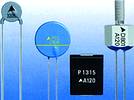
Thanks to their steep R/T curve, PTC thermistors can be used as threshold temperature monitors. Connected in series, they operate as self-resetting fuses. Damaged loads can thus cause no consequential damage. PTC thermistors can also be used as (pre-)heating elements

Annette Justl, product marketing manager for ceramic semiconductors at Epcos, sums up their benefits: "PTC thermistors are superior to conventional fuses because they are self-resetting. As soon as the fault has been eliminated, they cool down, their resistance drops, and they resume their full protective function without having to be replaced. Smaller electric motors, line cards, output stages of small amplifiers and many other loads can thus be economically protected against overcurrent without time-consuming replacement of fuses or resetting of circuit breakers."

The 'telecom pair protector' is an innovative module from Epcos for subscriber line protection. It comprises two PTC telecom thermistors in a common four-pin package. Capable of surface mounting, it saves up to 40% of the space required by conventional solutions. The configuration with two PTC thermistors in a single package version permits cost-efficient design and placement. The insulation voltage between the two disks is more than 3000 V. And the two PTC thermistor disks are resistance-matched, thus ensuring balance between the lines. The telecom pair protector can be equipped with various PTC thermistor disks.

PTC thermistors for thermal protection are operated with only a low evaluation voltage. They are used in electric motors, transformers and many other applications in which high temperatures represent a hazard to components or users. Progressive miniaturisation of power supplies is taking its toll. Their designs become more compact, but their outputs remain constant or even rise. This results in problems of temperature management. Epcos has developed a solution - PTC thermistors as SMDs. If a certain limit temperature is exceeded, the resistance of the PTC thermistor rises sharply. The voltage drop across the thermistor then reduces the output, effectively protecting the power supply from overheating.

PTC thermistors from Epcos for thermal protection are, of course, also available in leaded versions or with stranded-wire and screw terminals. In Part IV of this series to follow, we will look at a very versatile component called a varistor.


Credit(s)


Share this article:
Share via emailShare via LinkedInPrint this page

Further reading:

DC-link capacitors with ultra-low inductance
Electrocomp Passive Components
TDK Corporation recently released its new series of MKP DC high-frequency film capacitors, a high-performance DC link capacitor platform for next-generation SiC-based power electronics.

Read more...
EMC limits and levels
Altron Arrow Editor's Choice Circuit & System Protection
As soon as electronics and electrical systems started interfering with each other, the world had to come to some consensus. Considering physics is universal and does not care about what country electrical/electronic products are used in, it should be the same everywhere, right? It is nearly there, but not quite.

Read more...
Non-contact linear position sensor
Electrocomp Test & Measurement
The Vishay 40 LHE Linear Position Sensor, designed for industrial motion control and automation, delivers robust, non-contact measurement performance using Hall effect technology.

Read more...
Clearing the Static: The importance of cleaning in ESD control
Circuit & System Protection
The proper cleaning of ESD-safe areas and equipment such as workstations, floors, mats, trays, and tools using specialised antistatic cleaners is vital to prevent ESD damage.

Read more...
Safety relay for explosive areas
IOT Electronics Circuit & System Protection
Phoenix Contact has expanded its safety portfolio with the new PSR-MC35-EXI safety relay module, specifically engineered for use in potentially explosive environments.

Read more...
Compact 1250 V choke solution
Electrocomp Passive Components
TDK Corporation has introduced a new high-voltage common-mode choke series designed to support more compact and efficient 1250 V DC converter architectures in next-generation power electronics.

Read more...
Clearing the Static: Ensuring effective ESD control
Actum Circuit & System Protection
To maintain reliable electrostatic discharge control, regular testing and accurate measurement are essential, with grounding products and ESD testing equipment being vital.

Read more...
Clearing the Static: The importance of ESD audits
Actum Circuit & System Protection
An ESD audit is the first step in establishing an effective static control programme in the workplace, and will help identify vulnerable areas and potentially hazardous static zones that require improvement.

Read more...
EMI shielding materials application guide
Circuit & System Protection
TE Connectivity’s shielding solutions include electrically conductive elastomers, gaskets, knitted wire mesh, oriented wire, EMI shielding ventilation panels, shielded window, cable shielding and shielding components.

Read more...
Clearing the Static: ESD containers and packaging
Actum Circuit & System Protection
         Vacuum forming ESD Electronic components can be damaged by electrostatic discharges. To protect against such damage, electronic assembly parts are often transported or stored in vacuum formed component ...

Read more...


While every effort has been made to ensure the accuracy of the information contained herein, the publisher and its agents cannot be held responsible for any errors contained, or any loss incurred as a result. Articles published do not necessarily reflect the views of the publishers. The editor reserves the right to alter or cut copy. Articles submitted are deemed to have been cleared for publication. Advertisements and company contact details are published as provided by the advertiser. Technews Publishing (Pty) Ltd cannot be held responsible for the accuracy or veracity of supplied material.


© Technews Publishing (Pty) Ltd | All Rights Reserved

