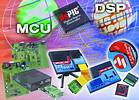
Microchip has introduced a range of 19 new tools and application aids to enhance development for Microchip's dsPIC 16-bit digital signal controller (DSC) architecture. This is a series of software development tools, high-level libraries, application designs and development boards that give designers the resources they need.
The development tools for Microchip's 16-bit dsPIC DSC include the MPLAB integrated development environment (IDE). The MPLAB in-circuit debugger 2 (ICD 2), which is also a device programmer, now supports the dsPIC DSC architecture. In fact, these tools are the platform for all of Microchip's microcontrollers and DSCs. Additional software tools include the MPLAB visual device initialiser (VDI), as well as three realtime operating systems (RTOS) from CMX. In addition, there is a filter design package and its companion dsPICworks Visual Algorithm Analyser.
Microchip is also introducing several high-level and utility libraries that give developers the ability to add powerful functionality to their application with a minimal learning curve. Initial high-level libraries include software modems, TCP/IP, and motor control. Microchip also offers free DSP, Math and Peripheral utility libraries.
The new hardware development boards are:
* The dsPICDEM Starter Demonstration Board allows the user to validate a development idea using the dsPIC30F6012 (144 KB Flash).
* The dsPIC30F2010-based (12 KB Flash) dsPICDEM 28-pin Starter Demonstration Board enables the user to validate a development tool set-up using a 28-pin SDIP or SOIC dsPIC30F device.
* The dsPIC30F6014-based (144 KB Flash) dsPICDEM 1.1 General Purpose Development Board provides the application designer with a development tool to become familiar with the dsPIC30F 16-bit architecture. The dsPIC30F6014 also features on the dsPICDEM Connectivity Development Boards.
For more information contact Arrow Altech Distribution, 011 923 9600, Avnet Kopp, 011 809 6100, or Memec SA, 011 897 8600.
Accelerate development of physical AI deployments Altron Arrow
DSP, Micros & Memory
With Avocado OS now available on the HummingBoard RZ-V2N-
AIoT and SolidSense AIoT V2N from SolidRun, teams can move from prototype to deployed fleet in weeks.
Read more...AI-ready edge MPU for HMIs Future Electronics
DSP, Micros & Memory
The Renesas RZ/G3E MPU is a high-performance microprocessor designed to enable advanced HMI systems with integrated artificial intelligence capabilities at the edge.
Read more...Industrial-grade ESP32-S3 controller
DSP, Micros & Memory
Erqos Technologies has introduced the EQSP32CE, a CE-certified, industrial-grade ESP32-S3 controller designed for developers who want the flexibility of the ESP32 ecosystem in hardware that can be deployed directly into real-world automation.
Read more...Universal NFC device Altron Arrow
DSP, Micros & Memory
Delivering high-end performance in a compact 4 x 4 mm package, the multipurpose NFC reader from ST Microelectronics, enables the convenience of contactless interaction and features for various end applications.
Read more...Compact low-power 32-bit platform EBV Electrolink
DSP, Micros & Memory
Microchip’s PIC32CM PL10 microcontroller family expands the company’s Arm Cortex-M0+ portfolio, delivering a compact, low-power 32-bit platform designed for cost-sensitive embedded applications.
Read more...Bridging the gap between prototype and production
DSP, Micros & Memory
Choosing between the FRDM i.MX 93, FRDM i.MX 91 and FRDM i.MX 91S development platforms can be intimidating, but once designers understand how each platform aligns with their application’s requirements, the decision becomes straightforward.
Read more...Low-power memory born for edge AI iCorp Technologies
DSP, Micros & Memory
As intelligence moves from the cloud to the device, memory become one of the most important design decisions in modern electronics. Edge-AI products – from smart speakers and surveillance cameras to ADAS modules and wearables – need to move data fast, but they also need to sip power. Winbond’s low-density LPDDR4/LPDDR4X SDRAM range is built to strike that balance.
Read more...Compact direct Time-of-Flight 3D LiDAR module Altron Arrow
AI & ML DSP, Micros & Memory
The VL53L9 from STMicroelectronics is the first direct Time-of-Flight (dToF) 3D LiDAR all-in-one module in ST’s portfolio, offering a resolution of 2,3K zones, wide field of view, on-chip processing, 100 frames per second, and sensing range from 5 centimeters to 9 meters.
Read more...SoC brings scalable edge AI to life Altron Arrow
AI & ML
The NXP i.MX 937 applications processor is optimised for performance without excessive power draw and bridges the gap between entry-level chips and high-end processors.
While every effort has been made to ensure the accuracy of the information contained herein, the publisher and its agents cannot be held responsible for any errors contained, or any loss incurred as a result. Articles published do not necessarily reflect the views of the publishers. The editor reserves the right to alter or cut copy. Articles submitted are deemed to have been cleared for publication. Advertisements and company contact details are published as provided by the advertiser. Technews Publishing (Pty) Ltd cannot be held responsible for the accuracy or veracity of supplied material.









 printer friendly version