GaAs Schottky diodes have improved performance
2 June 2004
Power Electronics / Power Management
Security Services & Risk Management
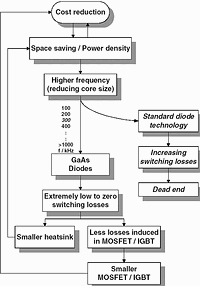
Ixys offers a new generation of high speed Gallium Arsenide Schottky diodes. An extended product range offering breakdown voltage from 180 to 600 V, a much reduced reverse current and higher current density, are the advantages of the second generation of GaAs Schottky rectifiers, says the company. High frequencies up to 1 MHz or more, extremely low reverse recovery current, high temperature operating up to 175°C and a very small temperature dependence are still the dominating features of GaAs Schottky diodes compared with other technologies.
Today, the most important demands for new electronic products are space saving and power density increasing with simultaneous cost reduction. The use of GaAs Schottky rectifiers, especially for high frequency switch mode power supplies, UPSs and power factor correction (PFC) systems, is the best alternative to improve efficiency and performance.
The diagram shows which improvements are possible and how to benefit from GaAs diodes. GaAs products are available in several standard packages - surface mount and leaded - and also including in Ixys' industry recognised Isoplus packages.
Further reading:
High-precision current transducer
Power Electronics / Power Management
Danisense announces its new high-precision DP12IP current transducer designed for isolated DC and AC current measurement in demanding PCB-mounted power electronics applications.
Read more...
Secure holder for protected 18650 batteries
Power Electronics / Power Management
Designed for protected 18650 batteries up to 70 mm long, the holder offers secure retention for portable, industrial, and embedded applications.
Read more...
More room to scale
Altron Arrow
Power Electronics / Power Management
With the latest STM32H5 lines from STMicroelectronics, you can now scale within the same platform, from a compact 1 Mbyte device to higher-memory MCUs for graphics-rich and feature-heavy designs.
Read more...
Surface mount power amplifier for high-power applications
RF Design
Power Electronics / Power Management
The GNA-63-5W+, from Mini-Circuits, is a GaN MMIC Power Amplifier (PA) designed for demanding RF applications requiring high efficiency, excellent linearity, and a compact footprint.
Read more...
1200 V QSiC modules
Power Electronics / Power Management
SemiQ Inc has launched the QSiC Dual3, a family of 1200 V half-bridge MOSFET modules for motor drives in data centre cooling systems, grid converters in energy storage systems, and industrial drivers.
Read more...
MCOTS transient filter for military applications
RFiber Solutions
Power Electronics / Power Management
SynQor has announced the new MCOTS-F-28-T-HE transient half-brick filter, the latest addition to its MCOTS product family.
Read more...
Expanded range of high-thermal-performance QSiC modules
Power Electronics / Power Management
SemiQ’s half-bridge series for data centre power converters and industrial motor drives features low RDSON SiC MOSFETs and parallel SBD diodes for best-in-class power density and conversion efficiency.
Read more...
Transporting lithium batteries and IoT devices
Power Electronics / Power Management
With billions of rechargeable and non-rechargeable lithium cells and batteries powering most of the world’s consumer and industrial electronic devices, shipping them to customers through vast global logistics chains is often an overlooked topic.
Read more...
AI assistants learn bad workplace habits
AI & Data Analytics Security Services & Risk Management
An employee under pressure at a logistics firm finds a productivity-boosting shortcut. Instead of manually parsing a 40-page supplier contract, they paste the confidential PDF into a public generative AI tool for a quick summary.
Read more...
Shadow AI: The next evolution of Shadow IT
AI & Data Analytics Security Services & Risk Management
Today, as AI gains traction in all aspects of life and business, African organisations face a new challenge, known as ‘Shadow AI’, where employees at all levels make use of AI without considering the potential impact.
Read more...









 printer friendly version