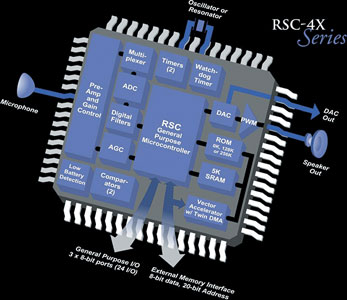
A new English language training technology implemented on low cost chips is being introduced in Hong Kong at Sensory's 'Designing a Voice User Interface' seminar. Sensory, a leader in embedded speech technologies, is using the language training technology on its RSC-4x family of integrated circuits. These ICs have the ability to support a wide variety of speech technologies on a general purpose 8-bit microcontroller core.
The Chinese government has mandated that all service employees will learn English by the 2008 summer Olympics in Beijing. This has caused a rapidly growing market to emerge for handheld language training devices. Typically, these language trainers use voice chips to play samples of the English phrases and to allow a Chinese speaker to compare his/her recorded voice with that of the English speaker. Sensory says that its new technology goes one step beyond this to perform an analysis of the Chinese speakers' phrases so that the speakers can get immediate feedback on their pronunciation. It is much like an English instructor on a chip.
The way it works is that the technology in the handheld device analyses the phrase's phonemic content, which is compared with that in stored templates. Playback can be sped up or slowed down, and an LED or LCD display can provide feedback on the quality of the spoken phrase during playback in order that the user can visually assess the performance. Settings can be adjusted to switch between a 'lenient,' or a 'tough' instructor.
Sensory's RSC-4x family is supported by a full suite of tools including, assembler, C-Compiler, debugger, and voice coding tools. It plans to bring its language training technology to other embedded platforms, including the ARM line of microcontroller products popular in cellphones. Sensory is seeking strategic partners to roll out English language training handheld products around the world.
Quick and easy shielding Würth Electronics South Africa
Electronics Technology Manufacturing / Production Technology, Hardware & Services
Würth Elektronik expands its EMC product portfolio with nanocrystalline WE-FNCS sheets.
Read more...Compact direct Time-of-Flight 3D LiDAR module Altron Arrow
Opto-Electronics Electronics Technology AI & ML
The VL53L9 from STMicroelectronics is the first direct Time-of-Flight (dToF) 3D LiDAR all-in-one module in ST’s portfolio, offering a resolution of 2,3K zones, wide field of view, on-chip processing, 100 frames per second, and sensing range from 5 centimeters to 9 meters.
Read more...What happens when trust can no longer live only in software?
Computer/Embedded Technology Electronics Technology
[Sponsored] For years, many enterprise security architectures treated hardware primarily as the execution layer, while software handled authentication, access control and trust decisions.
Read more...140 W USB-C PD reference design Altron Arrow
Electronics Technology
The design has a wide input range of 90 to 264 V AC, 50-60 Hz, and supports an output voltage range of 5 to 28 V (USB-PD 3.1 specification).
Read more...Nanometre-precision piezo actuators RS South Africa
Electronics Technology
TDK Corporation has announced two new piezo actuators that are characterised by a wide dynamic range, a high force-to-volume ratio, but with precision in the nanometre range.
Read more...Webinar: The evolving electrification of the power distribution system Infineon Technologies UK
Electronics Technology
New connected car functionality, along with the necessity to reduce the cost, weight and complexity associated with wire harnesses, has led to the transformation of the power distribution system in automotive engineering.
Read more...Common mode filter for automotive Ethernet Avnet Abacus
Electronics Technology
TDK Corporation has announced the introduction of its new ACT1210E Series common mode filter for automotive Ethernet 10BASE-T1S.
Read more...Energising the industrial edge
Electronics Technology
As if the drive to decarbonise energy as part of sustainability and climate change efforts was not enough, the recent rise in energy prices has brought into sharp contrast the need to re-examine how we generate, distribute, and consume electricity.
While every effort has been made to ensure the accuracy of the information contained herein, the publisher and its agents cannot be held responsible for any errors contained, or any loss incurred as a result. Articles published do not necessarily reflect the views of the publishers. The editor reserves the right to alter or cut copy. Articles submitted are deemed to have been cleared for publication. Advertisements and company contact details are published as provided by the advertiser. Technews Publishing (Pty) Ltd cannot be held responsible for the accuracy or veracity of supplied material.









 printer friendly version