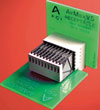
With the second variant of its AirMax VS backplane connector, FCI says system design engineers can reduce the number of layers in their high-speed backplanes and daughtercards by as much as 50% while improving the electrical performance of interconnections. Unique in its construction, the AirMax VS (virtual shield) connector uses an insert moulded leadframe assembly or 'IMLA' to carry both differential pair and single ended signals. Each signal path and each IMLA is separated by air, which eliminates the need for interleaving grounding shields. The use of air as a dielectric minimises both insertion loss and crosstalk.
Comprising 10 IMLA columns each equipped with 12 signal contacts, the latest AirMax VS vertical receptacle/right angle header connector configuration supports a reduced daughtercard slot spacing of 20 mm and offers a maximum of 40 differential pairs or 120 single ended connections. Compared to the previous 150-pin version, this 120-pin AirMax VS connector increases the air gap between the IMLAs from 2 mm to 3 mm, thereby allowing system designers to route high speed signals using only two layers of PCB backplanes and daughtercards. The consequent cost saving is accompanied by a further reduction in near-end multi-active crosstalk to less than 1,75% and far-end multi-active crosstalk to less than 2,25%, says the company.
In reference designs, the AirMax VS connector demonstrates superior signal integrity at speeds ranging from 2,5 Gbps to 6,25 Gbps, and allows users to scale systems to greater than 12 Gbps without requiring a basic platform redesign.
For more information contact Quentin van den Bergh, Arrow Altech Distribution, +27 (0)11 923 9600, qvandenbergh@arrow.altech.co.za
More room to scale Altron Arrow
Power Electronics / Power Management
With the latest STM32H5 lines from STMicroelectronics, you can now scale within the same platform, from a compact 1 Mbyte device to higher-memory MCUs for graphics-rich and feature-heavy designs.
Read more...4 mm pitch power connectors Spectrum Concepts
Interconnection
Mill-Max has introduced a new line of high-reliability, 4 mm (.157”) pitch sockets and headers designed for power connections and rugged field applications.
Read more...56 G MezzaWave connectors and cable assemblies
Interconnection
Engineered to deliver notable signal integrity, TE Connectivity’s high-speed, high-density 56 G MezzaWave connector family is built on an open-pin-field array platform that supports data rates up to 56 Gbps PAM4 for next-generation modular system
Read more...Space SMPM and SMPM-Lock connectors Hiconnex
Interconnection
Radiall has released the Space SMPM and SMPM-Lock, miniature Space connectors for high-frequency performance and high-density applications.
Read more...Compact, high density, heavy duty, thermoplastic connectors TRX Electronics
Interconnection
Amphenol Sine Systems ATD series connectors, available from Mouser, are a compact, high density, heavy duty, thermoplastic solution with superior environmental seals and end caps for exceptional rear seal retention.
Read more...Samtec supports SGeT oHFM.c with high-performance interconnects Spectrum Concepts
Interconnection
Samtec has announced a new product portfolio designed for the SGeT oHFM.c standard. These connectors are based on Samtec’s proven AcceleRate HD and AcceleRate HP high-density, high-performance product families.
Read more...Multi-constellation GNSS module in a legacy-compatible footprint Altron Arrow
Telecoms, Datacoms, Wireless, IoT
Telit Cinterion has announced the SE869eK2L, a single-frequency L1 GNSS module designed to help device manufacturers upgrade legacy positioning designs with improved performance and cost efficiency, while preserving design continuity.
Read more...Compact SSI family for industrial automation Altron Arrow
Passive Components
Infineon Technologies has introduced the ISSI20BxxF Solid State Isolator (SSI) family, bringing solid-state isolation technology into high-volume applications traditionally served by photovoltaic isolators (PVIs), photovoltaic relays (PVRs), and electromechanical relays (EMRs).
Read more...Rev 2.0 PolarFire FPGA ethernet sensor bridge Altron Arrow
Computer/Embedded Technology
Smaller, multi-camera platform enables scalable Ethernet architectures for NVIDIA Edge AI systems, while lowering power, cost and integration complexity.
Read more...Universal IR receiver module Altron Arrow
Telecoms, Datacoms, Wireless, IoT
Vishay Intertechnology has introduced a new series of infrared (IR) receiver modules for IR remote control applications, which feature a wide modulation frequency acceptance from 30 kHz to 68 kHz.
While every effort has been made to ensure the accuracy of the information contained herein, the publisher and its agents cannot be held responsible for any errors contained, or any loss incurred as a result. Articles published do not necessarily reflect the views of the publishers. The editor reserves the right to alter or cut copy. Articles submitted are deemed to have been cleared for publication. Advertisements and company contact details are published as provided by the advertiser. Technews Publishing (Pty) Ltd cannot be held responsible for the accuracy or veracity of supplied material.









 printer friendly version