Fuel cell technology is one of the most interesting future technologies for power generation. As an emergency power supply for outdoor applications it has outstanding potential to replace conventional battery-based backup systems.
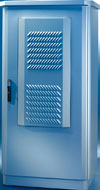
At CeBIT 2005, Rittal unveiled pioneering fuel cell technology for use as an emergency 48 V d.c. back-up supply for outdoor applications, based on its CS Outdoor enclosure and climate control technology. Hydrogen can be supplied, for example, in the form of gas bottles situated outside the enclosure or rack. H2 can also be supplied via alternative methods, such as natural gas or methanol, converted using the reformer system. Flexible supply management means that the backup time may be individually adapted for each location.
Rittal believes that in future, the clear advantages of fuel cell technology over battery-buffered 48 V d.c. backup systems will become apparent, particularly among globally linked network infrastructures of base stations for mobile communications. Advantages:
* A long service life helps to minimise essential servicing and maintenance work.
* Potential savings from an improved ability to adapt to temperature fluctuations.
* Flexible scalable backup times allow the costs per location to be individually optimised.
* Overall, the fuel cell reduces the total cost of ownership compared with current emergency power supply options.
Improved reliability
For applications with exacting demands on reliability, fuel cell systems offer an independent electricity supply of high dependability. Unlike conventional battery-buffered emergency power supplies, which are dependent upon temperature and sunlight, and which have disadvantages associated with ageing, as well as their size and weight, fuel cells from Rittal function well within a broad temperature range inside the enclosure. Fuel cells are also both low-maintenance and fully functional at all times, and have a significantly longer service life than batteries.
Particularly for critical high-availability applications, where reliable redundancy must be maintained, fuel cell technology offers a convincing alternative.
Expanded range of high-thermal-performance QSiC modules
Power Electronics / Power Management
SemiQ’s half-bridge series for data centre power converters and industrial motor drives features low RDSON SiC MOSFETs and parallel SBD diodes for best-in-class power density and conversion efficiency.
Read more...Transporting lithium batteries and IoT devices
Power Electronics / Power Management
With billions of rechargeable and non-rechargeable lithium cells and batteries powering most of the world’s consumer and industrial electronic devices, shipping them to customers through vast global logistics chains is often an overlooked topic.
Read more...Setting a new benchmark for high-power DC load testing Conical Technologies
Test & Measurement Power Electronics / Power Management
The new ITECH IT8900G/L high-speed, high-power DC electronic load offers a powerful combination of speed, scalability, precision and high-power density.
Read more...Quality batteries are critical for IIoT Uniross Batteries
Power Electronics / Power Management
Batteries intended for use in industrial operations must indeed offer complete reliability under extreme environmental conditions, resistance to vibration and harsh environments.
Read more...12 kW hybrid inverter
Power Electronics / Power Management
Sungrow recently unveiled its next-generation residential energy storage solution, expanding its power range from 5 kW to 12 kW with the introduction of the new MG12RL hybrid inverter.
Read more...40 W and 75 W railway DC/DC converter Brabek
Power Electronics / Power Management
RECOM has announced two new cost-efficient DC/DC converters for the rail market with an ultra-wide 11:1 input range to cover all nominal input voltages from 24 to 110 V DC.
Read more...Power modules for solid-state transformers RS South Africa
Power Electronics / Power Management
Microchip’s new 3,3 kV silicon carbide modules deliver the required thermal performance and efficiency for SSTs to increase power available for token generation.
Read more...Solving South African power problems with locally built intelligence
Editor's Choice Power Electronics / Power Management
Smart metering infrastructure in South Africa remains patchy. The rollout has been slow, coverage is inconsistent, and for the most part, granular per-unit measurement simply does not exist.
Read more...Wide range power module
Power Electronics / Power Management
The latest DC-DC modules from Würth Elektronik are characterised by high resilience to voltage transients on the 24 V bus and an extremely wide input-voltage range from 3,5 V to 38 V.
Read more...Selecting primary batteries for maximum service life Uniross Batteries
Power Electronics / Power Management
Primary batteries play an important role in IoT applications. Designed for longevity, they have a high-energy capacity and are often used in standalone applications where charging is impractical or impossible.
While every effort has been made to ensure the accuracy of the information contained herein, the publisher and its agents cannot be held responsible for any errors contained, or any loss incurred as a result. Articles published do not necessarily reflect the views of the publishers. The editor reserves the right to alter or cut copy. Articles submitted are deemed to have been cleared for publication. Advertisements and company contact details are published as provided by the advertiser. Technews Publishing (Pty) Ltd cannot be held responsible for the accuracy or veracity of supplied material.









 printer friendly version