

DSP, Micros & Memory


New speech compression/decompression library now available for dsPIC controllers

29 June 2005 DSP, Micros & Memory

Microchip has introduced a speech encoding (compression) and decoding (decompression) library for its 16-bit dsPIC digital signal controllers (DSCs). The dsPIC30F Speech Encoder/Decoder Library enables embedded designers to transmit more messages over a given bandwidth or store longer amounts of speech in a given memory space, while maintaining superior sound quality and intelligibility.

This library is based on the Speex (www.speex.org/fsos.html) open source compression format and achieves a 16:1 compression ratio and toll quality speech (PESQ 3.7-4.2).

Many design engineers are seeking to add speech compression to their bandwidth or memory-constrained applications, but have opted for lower compression methodologies to avoid a stiff per-unit royalty for the intellectual property. Microchip says that the adoption of the open-source Speex audio compression format in the dsPIC30F library offers a significant cost reduction over competitive options and brings non-royalty bearing 8 Kbps encoding to the embedded world. Any embedded application that transmits voice over limited bandwidth or has memory constrained playback can benefit from this speech compression/decompression library.

Some product applications are, VoIP, tapeless answering machines, voice announcement systems, medical equipment, building and home safety systems, intercoms and proprietary communications equipment.

This library has a well-documented application programmer's interface (API) that makes it easy to incorporate speech functions into an application. It also supports optional voice activity detection. The speech encoder samples data at 8 kHz, using either the dsPIC DSC's on-chip 12-bit ADC or a 16-bit input obtained from an external codec, via the on-chip codec interface port. The encoder achieves up to a 16:1 compression ratio and generates a fixed 8 Kbps output rate.

Output of decoded speech can be accomplished using the dsPIC DSC's standard PWM or via the interface to an external Codec. The encoder requires 19 MIPS (worst case), 33 Kbytes of program memory and 6,2 Kbytes of RAM. The decoder requires 3 MIPS, 15 Kbytes of program memory and 3,2 Kbytes of RAM. Storing speech requires 1 Kbyte of memory for each second of speech.

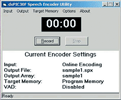
The library permits the compressed speech data to be stored in on-chip memory (Flash, EEPROM or RAM) or to an external Flash memory. Playback-only applications can benefit from a PC-based speech encoder utility that is included on the library CD. This utility creates encoded speech files from a PC microphone or WAV files.

The following dsPIC DSCs have the on-chip resources needed for this library: dsPIC30F5011/3, dsPIC30F6011/2/3/4.

For more information contact Arrow Altech Distribution, +27 (0)11 923 9600, Avnet Kopp, +27 (0)11 809 6100, Memec SA, +27 (0)21 674 4103, or Tempe Technologies, +27 (0)11 452 0530.


Credit(s)


Share this article:
Share via emailShare via LinkedInPrint this page

Further reading:

Memory shortage 2026: Engineering implications for South Africa
DSP, Micros & Memory
[Sponsored] Addressing this challenge requires system-level thinking and adoption with McKinsey Electronics providing the engineering and sourcing framework required to maintain system resilience despite ongoing global constraints.

Read more...
Cost-effective microcontroller series
Altron Arrow DSP, Micros & Memory
The STM32C5 series from STMicroelectronics delivers an excellent balance of performance, efficiency, and affordability for embedded designs that require more capability without increasing bill of materials cost.

Read more...
Understanding two key tools for cleaner serial data
Altron Arrow Editor's Choice Analogue, Mixed Signal, LSI
Understanding how pre-emphasis and equalisation works, and when to use one over the other, is critical when designing reliable high-speed systems.

Read more...
Battery-friendly Thread and BLE solution
iCorp Technologies DSP, Micros & Memory
Positioned as an incremental upgrade to the ESP32-H2, Espressif’s ESP32-H21 adds an integrated DC-DC converter that reduces active current draw and helps extend battery life in power-sensitive consumer and industrial devices.

Read more...
Connected without limits: An engineering perspective on Altron Arrow’s wireless ecosystem
Altron Arrow Editor's Choice Design Automation
Wireless connectivity is no longer a supporting technology, but rather, a core design consideration that underpins modern electronic systems across industries.

Read more...
Next generation HMI processing platform
Future Electronics DSP, Micros & Memory
Microchip’s latest hybrid MCU SiP integrates an Arm926EJ-S processor with 512 Mb of DDR2 SDRAM and is engineered to meet the rising demand for sophisticated HMI solutions in modern vehicles.

Read more...
Analogue reservoir AI chip capable of real-time learning
Altron Arrow AI & ML
TDK Corporation has jointly developed a prototype of a reservoir AI chip using an analogue electronic circuit that mimics the cerebellum with Hokkaido University.

Read more...
Ultra-low jitter clocks
Altron Arrow Telecoms, Datacoms, Wireless, IoT
Skyworks has introduced a new family of ultra-low jitter programmable clocks designed to meet the increasing demands of next-gen connectivity.

Read more...
Efficient Bluetooth SoC
Altron Arrow Telecoms, Datacoms, Wireless, IoT
The EFR32BG29 wireless SoC from Silicon Labs is a highly efficient, high memory, low-power, and ultra compact SoC designed for secure and high-performance wireless networking for IoT devices.

Read more...
RTOS – The future of embedded systems
Altron Arrow Edge Computing & IIoT
At the heart of the next generation of embedded devices is efficient yet powerful system-level code, often based on an open-source real-time operating system.

Read more...


While every effort has been made to ensure the accuracy of the information contained herein, the publisher and its agents cannot be held responsible for any errors contained, or any loss incurred as a result. Articles published do not necessarily reflect the views of the publishers. The editor reserves the right to alter or cut copy. Articles submitted are deemed to have been cleared for publication. Advertisements and company contact details are published as provided by the advertiser. Technews Publishing (Pty) Ltd cannot be held responsible for the accuracy or veracity of supplied material.


© Technews Publishing (Pty) Ltd | All Rights Reserved

