


When a cabinet is chosen for a specific application, the most diverse demands play a significant role.
Apart from EMC and climate control, the static and dynamic load-carrying capacities have to be taken into account. During transport and at their final site cabinets are exposed to varying stresses and strains.
On site, the static load-carrying capacity is the most dominant. In particular for applications in information technology, where heavy servers are often used, the maximum load-carrying capacity is an important point. However, if cabinets are installed on ships or trains, or if the site is situated in areas prone to earthquakes, dynamic load-carrying capacities have to be taken into account. During transport to the site the cabinets are exposed to varying dynamic stresses and strains that try the stability of the cabinets severely. Apart from specific accessories for heavy installations, a stable frame construction is required.
The new Varistar cabinet platform from Schroff (Figure 1) takes into account all these requirements with specifically-developed frame profiles.
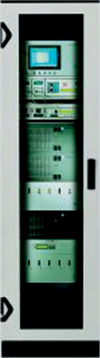
Static and dynamic stresses and strains
International standards describe all fundamental demands and tests, which cabinets, subracks and plug-in units have to fulfil with regard to properties such as shock and vibration (IEC 61587-1) and earthquake stability (IEC 61587-2). Mechanical tests aim to guarantee that the cabinets withstand the usual stresses and strains during manufacturing, storage, assembly and operation. Apart from lifting tests, stability tests are also conducted to verify the cabinet's capability to meet these demands. For the shock and vibration tests on cabinets (Figure 2) it is clearly defined how a cabinet must be configured and how the load must be distributed.
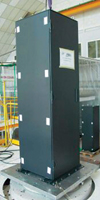
Three levels are defined (DL4, DL5 and DL6), depending on the intended application. The cabinet under test is secured on a vibration table, the specified vibration levels and times are run and the cabinet is verified if it maintains its original integrity, its form, fit and function.
The seismic tests to IEC 61 587-2 are equally detailed and confirm earthquake stability of the cabinet platform to Bellcore Zone 3. If the corners are strengthened with small brackets, the earthquake stability is further guaranteed to Bellcore Zone 4 and as such, is fit for global use. The tests for seismic demands on cabinets require the top section be measured, whereby the largest swing in relation to the anchoring point must not go beyond 50 mm. Furthermore, the load-carrying parts must not be distorted or even damaged, doors are not allowed to open and locks have to remain functional.
The Varistar cabinet platform has undergone these tests and passed with very good results.
High stability is guaranteed
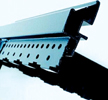
Varistar is is intended for applications in test and measurement technology, in automation, traffic and defence technology, in telecommunications, in data and network technology. To cover very different demands in these areas, two versions of the cabinet frame have been designed. The so-called Slim-Line version guarantees a maximum static load-carrying capacity to 400 kg. With minimum material cost, the specifically-developed hollow chamber profile (Figure 3) fulfils the static and dynamic demand levels of DL5 and DL6 to IEC 61 587-1.
If a higher static load-carrying capacity is required or if the cabinet has to be earthquake-proof, the second version is used, the so-called 'Heavy-Duty version' (Figure 4), which guarantees a maximum static load-carrying capacity to 800 kg.
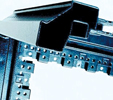
It meets the requirements for Level DL5, 'shock and vibration', as experienced in railway and track signal boxes, as well as in the vicinity of rotating machinery.
Not only stable but also functional
Apart from the high load-carrying capacity, Varistar has, of course, further properties that are geared to the demands of six market sectors. Even though the demands of the specific market sectors are very different, there is a common denominator with practical solutions.
Both cabinet versions are configured for 19" internal assembly, the Slim-Line frame is also suitable for ETSI assembly (telecommunications standard). The outer dimension of both frames also corresponds to the ETSI standard. As the 'footprint' of both frames is the same, they can be arranged side-by-side. All cover parts, such as doors, side and rear panels, top covers and base plates can be combined with both frame versions.
The 45° angle of the frame is the basis for the new sealing concept for the EMC and IP protection. The EMC shielding is carried out via the covers and the seal, directly to the neighbouring cover.
| Tel: | +27 11 608 3001 |
| Email: | [email protected] |
| www: | www.actum.co.za |
| Articles: | More information and articles about Actum |






© Technews Publishing (Pty) Ltd | All Rights Reserved
 printer friendly version