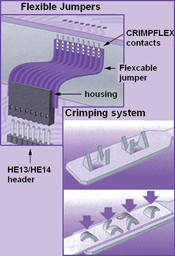
Nicomatic’s Crimpflex connection system complies with most rigorous electrical and mechanical requirements. The crimping of the contacts is obtained by piercing the conductor in six points. This ensures superior mechanical retention by two points and electrical contact by four points with the lowest possible contact resistance, according to the manufacturer.
The Crimpflex housings are made of thermoplastic material filled with glass fibre and classified UL94V0. They are available for male and female contacts, single or double-row, locking or not, polarised or non-polarised. The Crimpflex machines (manual and pneumatic presses) save time and money as they are simple and quick in setting up, and cost is quickly amortised due to lower assembly costs, says Nicomatic. Another advantage is the mass termination of all contacts in one press stroke, which saves time and allows more accuracy.
Other advantages: the crimp is easily inspected; the housing is assembled after crimping; the width of the circuit is not limited by the width of the housing; the housing can be removed; use of contacts in reel at final pitch of 2,54 mm.
The Crimpflex flexcable jumpers, meant for board-to-board connections, are made of flat copper conductors to both sides (with polyester laminated and terminated with the Crimpflex connector system).
Nicomatic manufactures FFC Card Cables in pitches: 0,5 mm, 1 mm, 1,25 mm, 1,27 mm, 2,54 mm; in different styles and lengths.
4 mm pitch power connectors Spectrum Concepts
Interconnection
Mill-Max has introduced a new line of high-reliability, 4 mm (.157”) pitch sockets and headers designed for power connections and rugged field applications.
Read more...56 G MezzaWave connectors and cable assemblies
Interconnection
Engineered to deliver notable signal integrity, TE Connectivity’s high-speed, high-density 56 G MezzaWave connector family is built on an open-pin-field array platform that supports data rates up to 56 Gbps PAM4 for next-generation modular system
Read more...Space SMPM and SMPM-Lock connectors Hiconnex
Interconnection
Radiall has released the Space SMPM and SMPM-Lock, miniature Space connectors for high-frequency performance and high-density applications.
Read more...Compact, high density, heavy duty, thermoplastic connectors TRX Electronics
Interconnection
Amphenol Sine Systems ATD series connectors, available from Mouser, are a compact, high density, heavy duty, thermoplastic solution with superior environmental seals and end caps for exceptional rear seal retention.
Read more...Samtec supports SGeT oHFM.c with high-performance interconnects Spectrum Concepts
Interconnection
Samtec has announced a new product portfolio designed for the SGeT oHFM.c standard. These connectors are based on Samtec’s proven AcceleRate HD and AcceleRate HP high-density, high-performance product families.
Read more...Connectivity solutions for hydrogen technologies Hiconnex
Interconnection
As the production distribution and utilisation of hydrogen continue to scale, connectivity becomes a key enabler for efficient energy transmission, data communication, and system control.
Read more...Mixed-density Combo-D connectors Hiconnex
Interconnection
Positronic’s SCBM connector series is a rugged, high-performance family of mixed-density D-sub connectors engineered for demanding environments.
Read more...Same Sky expands rectangular connector portfolio Future Electronics
Interconnection
The portfolio includes male pin headers, female pin headers, and box headers, giving engineers the flexibility to select the most appropriate connector style for their specific design requirements.
Read more...Optical Ethernet connectivity for rugged environments Hiconnex
Telecoms, Datacoms, Wireless, IoT
The rugged Stratos T2 Series media converter maintains high data throughput and durability in mission-critical applications in security, tactical, and military communications.
Read more...Rugged USB-C for modern designs
Interconnection
Same Sky has expanded its USB Type-C connector portfolio to meet the growing demand for faster data transfer and higher power delivery in modern electronic designs.
While every effort has been made to ensure the accuracy of the information contained herein, the publisher and its agents cannot be held responsible for any errors contained, or any loss incurred as a result. Articles published do not necessarily reflect the views of the publishers. The editor reserves the right to alter or cut copy. Articles submitted are deemed to have been cleared for publication. Advertisements and company contact details are published as provided by the advertiser. Technews Publishing (Pty) Ltd cannot be held responsible for the accuracy or veracity of supplied material.









 printer friendly version