


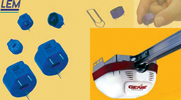
Power openers, used for garage doors, gates, shutters or awnings, are becoming more common in day-to-day life, and protection is a concern that must be taken into account during their design. Imagine the consequences of a garage door closing on a person or a vehicle. Current measurement can ensure this protection function while also allowing fast and efficient operation.
LEM's HTS 10 current sensor models provide bipolar current measurement whilst only requiring a single 5 V power supply. These products are ratiometric, causing a direct variation of their sensitivity and offset with respect to the power supply voltage. This ratiometric output and the single 5 V power supply make them well-suited for use with ratiometric A/D converters. The low supply consumption (under 12 mA) allows the HTS to be powered from the same source as the A/D reference. This eliminates any susceptibility to supply and/or reference voltage changes, even though this voltage may have a ±10% tolerance. This configuration provides a nominal resolution of 0,5% of IPN with a 10-bit A/D converter.
As a very low cost transducer, the tolerance of the sensitivity and offset has an influence on the measuring range. As an example: with a power supply of +5 V ±0%, a sensitivity tolerance of ±30% and an offset tolerance of ±12%, the HTS 10-P transducer may have a maximum initial offset of 2,8 V, and a sensitivity of 130 mV/A at +25°C.
Under these conditions of use, the sensor provides a measuring range of +13 A and -17 A. The full scale output is limited at Vdd -0,5 V = 4,5 V for the positive side, and Vss +0,5 V = +0,5 V for the negative side.
* Positive measuring range: (+4,5 V - initial offset)/sensitivity = (4,5 V - 2,8 V)/0,13 = +13 A pk.
* Negative measuring range: (+0,5 V - initial offset)/sensitivity = (+0,5 V - 2,8 V)/ 0,13 = -17,7 A pk.
Solution
The HTS 10-P/SP1 current transducer with a better sensitivity (20%) and initial offset tolerance (3%) is the solution for a measuring range with less fluctuation (thermal drift values are also improved). When the sensor is used with a microcontroller, the device can be calibrated into the application. These tolerances can be cancelled or adjusted out in the accuracy calculation to ensure repeatable results.
The HTS 10-P and HTS 10-P/SP1 are rated for 10 A r.m.s. (15 A pk) measurement and provide max. linearity of 1% and 0,5% respectively at +25°C which is adequate for the detection requirements in this type of application. The tolerances and price are the differences between the two transducers, the HTS 10-P being the least expensive.
In this application, protection refers to the action taken after the detection of a person or some object located in the path of the moving doors, gates, shutters or awnings, preventing its intended closing or opening.
This protection can be achieved thanks to the measurement of the current drawn by the motor used for the moving of the doors. The use of a compact current transducer (such as the HTS 10-P with a 17 x 19 mm footprint) is essential when the available real estate dedicated to the electronics is minimal. At the same time, the accuracy is not considered vital in this type of application. The aim is not to control and regulate the motor but to ensure protection by detection. In conjunction with the microcontroller, the current transducer is used to detect when the motor is drawing too much current at any given moment, for example, when the door attempts to move against interfering obstacles thus creating an overcurrent into the motor.
The DC brush motor as used for a garage door opener, or electrical gates, awnings or shutters, has its own, particular and repeatable, current profile during normal opening and closing operations. This profile can be stored in the microcontroller.
The transducer provides the measured motor current versus time to the microcontroller, which verifies that it matches the expected profile within a certain window defined by the electrical opener systems manufacturer. If it does not match, the safety mechanism/procedure is activated.
Further, the transducer can also detect the motor stall current in the case of when the operation of the electrical power seats are locked by obstruction (detection for motor protection). Finally, low price is key in applications such as these. And, since the HTS 10 models are competitively priced, this family of transducers help keep low cost drive systems, low cost.






© Technews Publishing (Pty) Ltd | All Rights Reserved
 printer friendly version