


Smaller process geometries drive more multivolt devices and are more susceptible to voltage and temperature fluctuations. While system management designs can run into hundreds of discrete components, Actel’s Fusion programmable system chip (PSC) can integrate these system management functions and provide programmable flexibility and system-level integration – all in a single chip.
High integration in Fusion devices can offer cost and space savings of 50% or greater relative to current implementations. Actel now offers the only single-chip system management solution. The Actel Fusion PSC integrates configurable analog, large Flash memory blocks, comprehensive clock generation and management circuitry, and high performance programmable logic in a monolithic device.
System management
System management is a collection of seemingly unrelated tasks with the goal of ensuring the proper operation of the system. These tasks focus on maximising system uptime, identifying and communicating alert conditions, and logging data and alarm conditions. Boards must also be able to initiate corrective action when fault conditions occur. Driven by the need to increase system uptime and reliability, many systems are adding in-system diagnostics and prognostics, not only to help debug systems that have failed but also to identify potential failures before they arise. In standards-driven markets, reliability and uptime are key metrics by which OEMs can differentiate themselves.
Today's solution
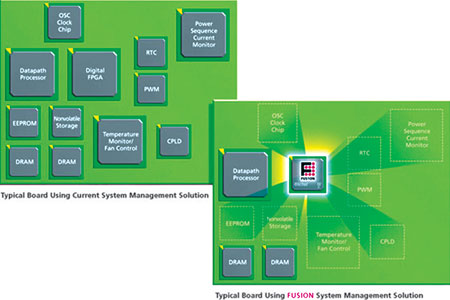
Current system management implementations require a large number of discrete components (sometimes numbering in the hundreds), occupy large amounts of board space, and are inflexible to change. These solutions are a collection of fixed function chips and discrete components that must work in concert to create a cohesive solution: CPLD, realtime clock, power sequencer, temperature monitor, fan controller, nonvolatile memory, PWM, configuration memory, etc.
In addition to consuming board space, the large number of components adds to cost both directly (unit cost, assembly cost, inventory cost) and indirectly (design time, procurement, discontinuation). Increased component count also contributes directly to the failure rate: eliminated parts will not fail. Further, these hardware-implemented discrete solutions often require board respins even for incremental design changes, making it impossible to create platform solutions and realise higher economies of scale.
System management in one chip
Fusion integrates mixed-signal analog, Flash memory, and FPGA fabric in a monolithic PSC. These devices enable designers to quickly move from concept to completed design and deliver feature-rich systems to market. It takes advantage of the unique properties of Actel Flash-based FPGAs, including a high-isolation, triple-well process, and the ability to support high-voltage transistors to meet the demanding requirements of mixed-signal system design.
As a single-chip implementation, Fusion simplifies design implementation, enabling all system management functions to be configured in a single design environment with superior reliability.
Power management
Considered the most critical element of system management, Fusion takes aim at power management with an I/O structure specifically designed to effectively and efficiently manage multiple power rails directly. Fusion can manage up to 10 power supplies and connect directly to power rails from -11 V to 12 V without any external components.
The Fusion Analog Quad I/O structure combines three analog inputs with a gate driver output. Each analog I/O is individually configurable and can operate independently. Additionally, these I/Os are grouped together to work in concert to support power management.
The robust functionality of the Analog Quad allows for the following:
* Power-on detection and reset.
* Power-up sequencing and tracking.
* Voltage monitoring and trimming.
* Current monitoring.
Fusion can monitor the various power rails, keeping them gated from the rest of the system until they have stabilised. It can then turn on the power rails in the appropriate sequence and ramp-rate.
Thermal management
Today's intelligent systems not only monitor and manage thermal environmental conditions, but also distribute system traffic to better balance the system and maximise performance. Fusion integrates temperature monitoring capabilities into the Analog Quad, requiring only an external transistor. It supports up to 10 external transistors, enabling designers to track the temperature of many off-chip locations. It is advantageous to track temperatures at various points on the board, including high-end processors and FPGAs. In addition, Fusion can handle the fan control to enable closed loop thermal management.
SRAM FPGA management
A drawback to SRAM FPGAs is the hand-holding required to keep them operational. At power-on, volatile SRAM devices must be configured with their respective designs. Fusion integrated Flash memory can store the design files for many different types of FPGAs, eliminating a separate configuration PROM. As volatile devices, SRAM FPGAs are very concerned with supply voltage 'brownouts', which place the device in an unknown state. Fusion's feature set makes it an ideal SRAM FPGA management device, eliminating boot PROMs and brownout detection devices, sequencing the power-up, and further reducing board space.
System clocking
Proper clock generation and distribution is critical to system operation. Whether the clock source is external to the system or internally generated, the robust Fusion clock distribution and generation resources are up to the task. Fusion devices support both internal and external clock sources, including an integrated 100 MHz RC oscillator that requires no components. Integrated clock conditioning circuits and phase-locked loops allow for the manipulation and distribution of very accurate clock sources.
Diagnostics/prognostics
Fusion's on-chip Flash memory provides designers the ability to save and time-stamp key system parameters such as current consumption of power rails, device temperatures, and voltage rail fluctuations. This data can be analysed after failure to identify root cause and this can be an advantage for innovative designers who are looking to analyse system trends during operation.
Remote and local comms
As a programmable device, Fusion supports a wide variety of communication protocols and implementations for both remote and local communication standards. Users can implement their own proprietary communication protocols or a number of communication IP cores available from Actel.
ID/authentication
Security continues to be a primary concern for both users and developers. Fusion is designed with security in mind. As a single-chip solution, there is no communication between devices of any design files that could be intercepted and cloned. Backed with AES security, Fusion is secure from external tampering. Designers can implement secure 'handshakes' or device authentication to ensure only authorised components are used within a system. This prevents the manufacturing of 'knock-off' system cards or other devices that can affect system reliability, your reputation, or your bottom line.
Development kit
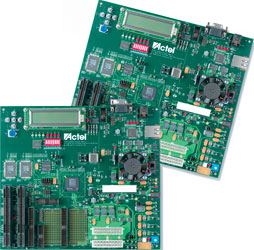
Actel offers a System Management Development Kit that provides an excellent platform for developing system management applications and/or applications with a microprocessor. The kit includes an ARM-enabled Fusion device, a system management GUI, and a platform for systems. The board includes an M7AFS600 device, which is compatible with CoreMP7, Core8051, and other processors, as well as non-processor-based implementations.
| Tel: | +27 11 315 8316 |
| Email: | info@asic.co.za |
| www: | www.asic.co.za |
| Articles: | More information and articles about ASIC Design Services |






© Technews Publishing (Pty) Ltd | All Rights Reserved
 printer friendly version