In principle, the use of air/water heat exchangers for the cooling of electronic equipment and installations is not new. With the project of the IEC Committee SC 48 D however, structural parameters of standardised cabinets and general configurations of heat exchangers are brought together.
The benefit of such a standard is represented by the expected market development for standard products and their possible advance planning of performance parameters. Easy availability combined with cost savings through pre-manufactured components are further advantages of standard solutions.
The new standard
The new IEC/TS 62454 Ed.1.0 standard was published at the beginning of 2007. It relates to cabinets whose dimensions have been defined in the well-known standards IEC 60297 (19") and IEC 60917 (metric). The standard divides the water cooling of enclosures into three levels.
* Level I - Cabinet level.
* Level II - Shelf (subrack) level.
* Level III - Board level.
Level I
This level describes the framework conditions and supplies calculation examples for applications with air/water heat exchangers, which are either assembled at the base or the side of the cabinet. Independently of which solution is selected (base or side assembly), the user can now establish the required footprint for his application with the aid of selection curves or by calculation.
Level II
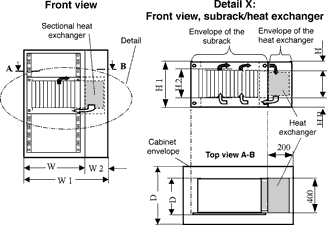
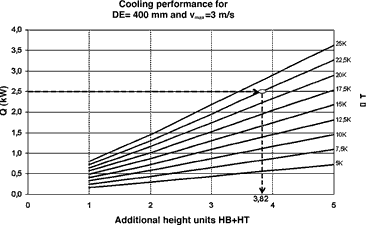
This level describes the framework conditions and supplies calculation examples for applications with small air/water heat exchangers, assembled at the side of the cabinet, which are only cooling parts of the cabinet, such as individual subracks or groups of subracks (Figure 1). The air/water heat exchangers planned for this solution by manufacturers and users - and now being defined by the standard -work with vertical air flow. This means that above and below the subrack/subracks an area for air circulation and redirection has to be allowed. How many U (rack units) the user has to calculate for this can be worked out with selection curves such as those shown in Figure 2, or with the aid of formulae.
Figure 1. Basic installation of an air/water heat exchanger for the partial cooling of a subrack inside a cabinet
Figure 2. Diagram for the establishment of required additional height units necessary for the cooling of a subrack
Level III
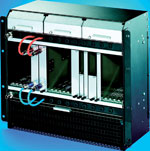
This level deals with water cooling of individual components/chips directly on the boards. The possible cooling solutions are manifold, due to the many different dimensions and positions of the components that need to be cooled, so that the standard does not restrict this by tight definitions. Therefore, Level III only stipulates that there have to be water connections in the cabinet, leading to quick release connectors at the front or rear of the subracks (see Figure 3). Only the principle of water cooling of individual components is outlined. The detailed configuration is left to manufacturers and users.
Figure 3. MicroTCA system with water cooled components on individual boards
Schroff supports Level I with a standard solution, whereby the heat exchanger is assembled laterally inside the cabinet. Thermodynamically, this will achieve the best possible level of effectiveness for a cabinet fully assembled with electronic plug-in units. For Level II and Level III, modular solutions are available which are configured to specific properties of the equipment or subracks. In these scenarios the standard defines the most important performance parameters.
Large-format table top enclosures RS South Africa
Enclosures, Racks, Cabinets & Panel Products
The COMMUNITEC enclosure range from OKW is ideal for housing large-format electronic assemblies in an elegant, modern, design-oriented package. A key feature is the recessed handle concealed behind the operating panel, which allows the units to be carried comfortably and provides greater flexibility in use.
Read more...The effect of seasonal changes on ESD performance in South Africa Actum
Editor's Choice Circuit & System Protection Manufacturing / Production Technology, Hardware & Services
Electrostatic discharge performance is influenced by several environmental factors, with relative humidity being one of the most important. This is particularly relevant in South Africa, where seasonal changes can result in significant differences in humidity levels.
Read more...Clearing the Static: Electrostatic Discharge Actum
Manufacturing / Production Technology, Hardware & Services
A cordless ESD (Electrostatic Discharge) wrist strap does not work by grounding the person in the same way as a traditional wired wrist strap. Instead, it works by reducing or balancing the static charge on your body so that you are less likely to discharge electricity into sensitive electronic components.
Read more...Polypropylene pole-top boxes support smarter, more secure electricity networks
Manufacturing / Production Technology, Hardware & Services Enclosures, Racks, Cabinets & Panel Products
As South Africa accelerates the rollout of smart prepaid electricity metering, innovative enclosure technology from Power Process Systems (PPS) is helping utilities improve network security, reduce electricity theft and protect critical electrical infrastructure.
Read more...Cabinets for industrial applications Vepac Electronics
Enclosures, Racks, Cabinets & Panel Products
Verotec’s VERAK cabinets addresses the most stringent enclosure requirements providing both IP65 environmental protection and EMC screening.
Read more...Flat-pack enclosures
Enclosures, Racks, Cabinets & Panel Products
The launch of Rittal’s FR IT flat-pack enclosure marked a milestone for the company, introducing the local market to a high-capacity, top-tier IT enclosure in a convenient and cost-effective flat-pack format for the first time.
Read more...Clearing the Static: Ensuring effective ESD control Actum
Circuit & System Protection
To maintain reliable electrostatic discharge control, regular testing and accurate measurement are essential, with grounding products and ESD testing equipment being vital.
Read more...Clearing the Static: The importance of ESD audits Actum
Circuit & System Protection
An ESD audit is the first step in establishing an effective static control programme in the workplace, and will help identify vulnerable areas and potentially hazardous static zones that require improvement.
Read more...Flat-pack IT enclosure Rittal
Enclosures, Racks, Cabinets & Panel Products
The introduction of the FR IT flat-pack enclosure by Rittal marked an important milestone for the company, bringing a high-capacity, premium IT enclosure to the local market in a convenient and cost-effective flat-pack format for the first time.
Read more...Click-in module carrier frames Phoenix Contact
Enclosures, Racks, Cabinets & Panel Products
The tool-free Heavycon series click-in module carrier frame from Phoenix Contact simplifies the assembly and installation of heavy-duty connectors significantly.
While every effort has been made to ensure the accuracy of the information contained herein, the publisher and its agents cannot be held responsible for any errors contained, or any loss incurred as a result. Articles published do not necessarily reflect the views of the publishers. The editor reserves the right to alter or cut copy. Articles submitted are deemed to have been cleared for publication. Advertisements and company contact details are published as provided by the advertiser. Technews Publishing (Pty) Ltd cannot be held responsible for the accuracy or veracity of supplied material.









 printer friendly version