Computerised tomography option available for x-ray inspection system
4 October 2006
Manufacturing / Production Technology, Hardware & Services
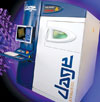
Dage Precision Industries has developed a computerised tomography (CT) option for its XiDAT XD7600NT digital X-ray inspection system.
This new CT option is available for the company's award-winning XD7600NT X-ray inspection system and now facilitates volumetric reconstruction of solder joints.
Computerised tomography is an imaging method employing tomography whereby digital geometric processing is used to generate a three-dimensional (3D) image model of an object from a large series of individual two-dimensional (2D) X-ray images, or slices, taken about a single axis of rotation.
This new CT capability is available as an option with new systems and is suited for analytical analysis of interconnections for critical applications such as stacked die, MEMS, package-in-package and package-on-package. With this CT option, the XD7600NT has the ability to very quickly and easily convert between 2D and 3D modes for different inspection applications, and is capable of ultra fast image reconstruction and of reconstructing a high number of image slices - up to 1440.
With increasing packaging densities, the use of 2D inspection systems is limited, requiring 3D analysis of solder interconnections for many applications such as stacked die. Conventional 3D systems are expensive, have low resolution and slow processing times, and generally do not deliver the analysis performance required for critical, high-density applications.
Dage's approach was to develop a fast, reasonably priced solution that offers suitable resolution in a common platform compatible with its current lineup of digital X-ray inspection systems. The end result is the XD7600NT with CT option that combines digital geometric processing software with the high resolution Dage NT250 X-ray tube.
A reconstructed 3D image model can be viewed on-line or off-line with dedicated image hardware allowing realtime manipulation of 3D models. Image display features include:
* Image manipulation - rotate, pan and zoom.
* Clip image - to eliminate unwanted detail.
* Volume rendering - for creation of solid surfaces and maximum intensity, and to vary the opacity and colour of volumes.
* Slices - multiple cross-section at any orientation and the ability to vary the opacity and colour of individual slices.
* Illumination models - single light source or two light sources with shadow computation for optimal 3D perception.
* Image save - saving 2D images in JPG or TIF formats.
The XD7600NT equipped with the CT option is capable of full 3D inspection of samples, full 2D imaging of any point across the entire 458 x 407 mm inspection area, and rapid and easy conversion between 2D and 3D modes.
Further reading:
Soldering day highlights
Manufacturing / Production Technology, Hardware & Services
JAPAN UNIX has published a new event report and highlight video from their UNIX SOLDERING DAY 2026 in Hungary. This event reflects on their commitment to supporting manufacturers not only through soldering automation systems, but also through technical education, live demonstrations, hands-on training, and practical engineering know-how.
Read more...
Clearing the Static: Electrostatic Discharge
Actum
Manufacturing / Production Technology, Hardware & Services
A cordless ESD (Electrostatic Discharge) wrist strap does not work by grounding the person in the same way as a traditional wired wrist strap. Instead, it works by reducing or balancing the static charge on your body so that you are less likely to discharge electricity into sensitive electronic components.
Read more...
Engineering trust in South Africa’s SMT sector
ZETECH ONE
Manufacturing / Production Technology, Hardware & Services
From a small Johannesburg start-up to a trusted SMT technology partner, Zetech One has spent four decades helping South African electronics manufacturers improve production quality, efficiency and reliability.
Read more...
The new reality of PCB material supply
Jemstech
Editor's Choice Manufacturing / Production Technology, Hardware & Services
How resilient manufacturing strategies are helping OEMs navigate a changing global supply chain.
Read more...
Streamlining Device Programming with the AutoBee-D1
Vepac Electronics
Manufacturing / Production Technology, Hardware & Services
The AutoBee-D1 desktop automated programmer is designed to simplify the programming of devices, while delivering consistent accuracy, high throughput and reduced manual intervention.
Read more...
Zero PFAS die attach paste
Testerion
Manufacturing / Production Technology, Hardware & Services
With silver price volatility increasing and sustainability requirements accelerating across semiconductor assembly, MacDermid Alpha Electronics Solutions introduces ATROX CD 560-1, a zero per- and polyfluoroalkyl substance (PFAS) alternate silver filler die attach paste.
Read more...
Precision jet printing for advanced PCB designs
MyKay Tronics
Manufacturing / Production Technology, Hardware & Services
Mycronic’s BA 01 small dot ejector delivers unmatched precision in solder paste jet printing for advanced PCB designs.
Read more...
Strengthening local electronics manufacturing through investment and innovation
Microtronix Manufacturing
Editor's Choice Manufacturing / Production Technology, Hardware & Services
Microtronix South Africa cements its commitment to local manufacturing with ongoing investments in production capacity, skills development, and job creation.
Read more...
Polypropylene pole-top boxes support smarter, more secure electricity networks
Manufacturing / Production Technology, Hardware & Services Enclosures, Racks, Cabinets & Panel Products
As South Africa accelerates the rollout of smart prepaid electricity metering, innovative enclosure technology from Power Process Systems (PPS) is helping utilities improve network security, reduce electricity theft and protect critical electrical infrastructure.
Read more...
200 W of power in a space-saving design
Vepac Electronics
Manufacturing / Production Technology, Hardware & Services
The Hakko FX-972 Soldering Station delivers high-performance soldering in a compact package, making it suitable for a wide range of soldering applications.
Read more...









 printer friendly version