



[Sponsored]
South Africa’s semiconductor market driven by system deployment
South Africa’s semiconductor market in 2026 is shaped primarily by downstream demand rather than local fabrication capacity. While the country remains dependent on imported semiconductor devices, the electronics content of systems deployed across automotive manufacturing, telecommunications networks, energy infrastructure and data centres continues to rise. Growth is driven by system complexity, digitalisation and the need to improve efficiency, reliability, and operational visibility across industrial sectors. Semiconductor demand is therefore defined less by production volumes and more by the technical, lifecycle, and availability requirements of deployed systems.
This environment places engineers and procurement teams at the centre of semiconductor decision-making. Component selection is no longer guided solely by electrical performance or unit cost. Long-term availability, reliability under constrained operating conditions, and supply continuity have become decisive factors, particularly in a market affected by energy instability, long product lifecycles, and global supply volatility. Semiconductor distributors are consequently assuming a more strategic role, supporting customers through design-in assistance, lifecycle planning, and supply-chain assurance.
Automotive electronics expanding semiconductor integration
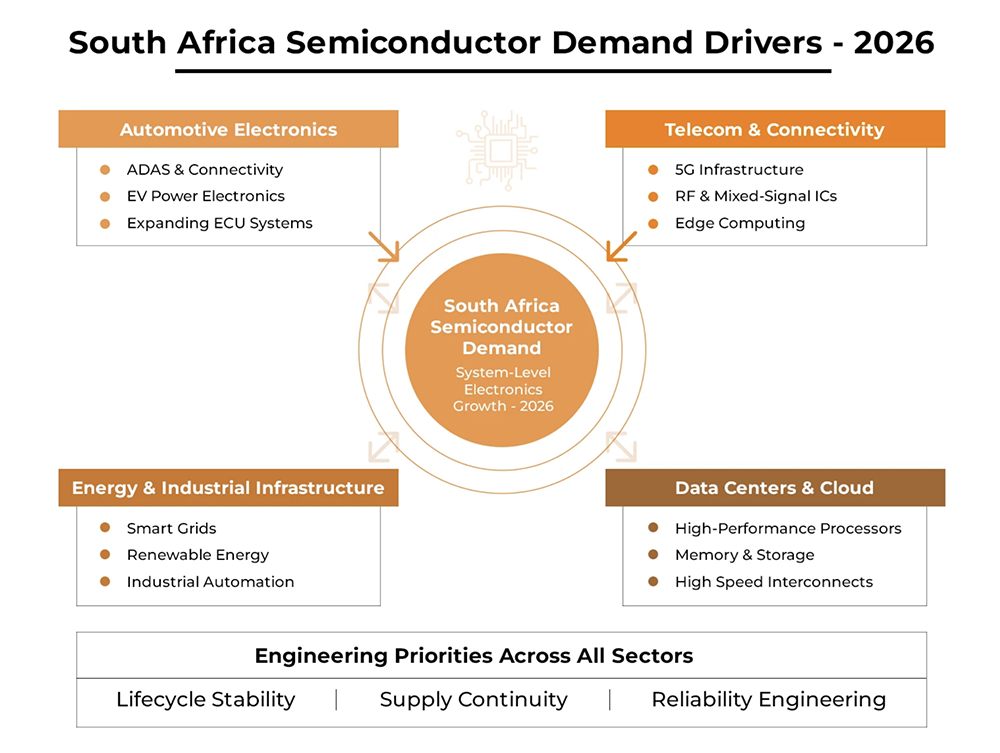
South Africa’s semiconductor market continues to grow steadily on the back of structural downstream demand. Automotive manufacturing remains a major contributor. Vehicles assembled locally contain a rising number of electronic control units managing powertrain operation, safety systems, infotainment, connectivity, and energy efficiency. Electrification trends, even at early adoption stages, significantly increase semiconductor content through battery management systems, power conversion stages, and high voltage control electronics. Advanced driver assistance functions and vehicle connectivity further increase demand for microcontrollers, sensors, and communication devices. These systems must operate reliably over long service lives in harsh thermal and electrical environments, making qualification and long-term support essential design considerations.
Telecommunications infrastructure accelerating connectivity demands
Telecommunications infrastructure represents another key demand driver. Ongoing expansion of mobile networks and fibre connectivity requires deployment of increasingly sophisticated base stations, routers, and edge computing platforms. These systems rely on RF devices, mixed-signal ICs, high-speed processors, and timing solutions capable of supporting higher data rates and lower latency. Energy efficiency is a growing concern as network operators seek to manage operating costs, while expanding capacity, reinforcing the importance of power-efficient semiconductor architectures.
Energy and industrial infrastructure driving reliability requirements
Energy and industrial infrastructure form a third pillar of demand. South Africa’s energy sector is evolving as utilities and private operators invest in renewable generation, grid stabilisation, and digital monitoring. Semiconductors are embedded throughout power conversion equipment, protection systems, and control platforms, enabling real-time monitoring and optimisation. In mining and manufacturing environments, embedded controllers, sensors, and industrial computing platforms support automation, predictive maintenance, and remote operation. These applications demand robust devices designed for extended temperature ranges, electrical noise immunity, and long operational lifetimes.
Data centre growth increasing performance and availability demands
Data centre investment is also contributing to rising semiconductor consumption. As cloud services, enterprise IT modernisation, and data-intensive workloads expand across southern Africa, data centres are becoming more electronics-dense and performance-driven. Servers, storage platforms, and networking equipment integrate advanced processors, memory devices, high-speed interconnects, and power delivery solutions that must operate continuously with minimal tolerance for failure. In this segment, component reliability and supply continuity are particularly critical.
Semiconductor technology categories shaping system architectures
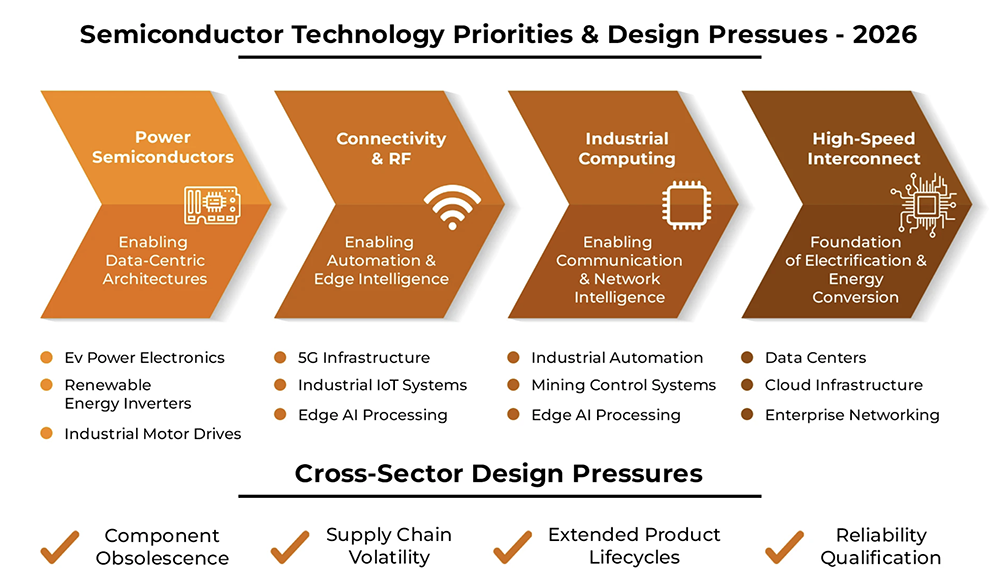
Across these sectors, several semiconductor technology categories consistently emerge as priorities. Power semiconductors are central to automotive electrification, renewable energy systems and industrial motor control, where efficiency and thermal performance are critical. Connectivity and RF devices underpin telecom infrastructure, industrial networking and vehicle communication systems. Embedded processors and microcontrollers form the backbone of industrial computing and control architectures, while high-speed interconnect technologies support data movement within increasingly complex systems.
Lifecycle stability and supply continuity becoming core design criteria
A defining characteristic of the South African market is the emphasis placed on lifecycle stability and supply continuity as core design requirements. Many locally deployed systems are expected to remain operational for a decade or more, particularly in industrial, energy, and transportation environments. Redesigns triggered by component obsolescence are costly and disruptive, prompting engineers to favour devices with extended lifecycles, stable specifications, and clear manufacturer roadmaps. Procurement teams are equally focused on mitigating exposure to long lead times, logistics constraints, and geopolitical disruptions that disproportionately affect import-dependent markets.
The evolving role of semiconductor distribution
These factors have accelerated a shift in semiconductor sourcing practices. Organisations increasingly evaluate the resilience of entire supply chains, the availability of technical support during design and production and the ability to adapt designs in response to availability changes. This shift has fundamentally altered the role of the semiconductor distributor.
In South Africa, distributors are increasingly viewed as technical partners rather than transactional intermediaries. Engineering support during early design stages enables customers to select components that balance performance, cost, availability, and longevity. Lifecycle data, alternative part strategies, and obsolescence planning reduce long-term risk. Supply-chain assurance mechanisms such as forecast-based allocation and strategic inventory planning mitigate the impact of global shortages and demand volatility. Local presence improves responsiveness and supports compliance with regulatory and logistical requirements.
McKinsey Electronics supporting engineering and supply continuity
McKinsey Electronics operates within this evolving landscape as an engineering-driven distributor supporting South Africa’s electronics ecosystem. Its approach reflects the broader shift toward technical enablement and supply continuity. Through investment in field application engineering resources, the company supports customers during early design phases, assisting with component selection, system optimisation, and qualification across automotive, industrial, energy, and connectivity applications.
Supply-chain assurance is also within the company’s focus. Through close alignment with global semiconductor manufacturers and local customers, McKinsey Electronics structures supply programs that account for forecast variability, long lead times, and lifecycle constraints. This includes supporting multi-source strategies, managing safety stock, and advising on roadmap-aligned component choices to reduce exposure to obsolescence. Local technical support enables customers to address design challenges efficiently, while navigating a constrained global sourcing environment.
As South Africa’s semiconductor demand continues to be shaped by downstream system deployment rather than upstream fabrication, the importance of engineering-led distribution will continue to grow. The country’s electronics ecosystem increasingly depends on integrating global semiconductor technologies into local systems designed for reliability and long operational lifecycles. Within this environment, engineering-driven distribution partners, such as McKinsey Electronics, are supporting customers in navigating design, lifecycle, and supply-chain challenges. Organisations seeking to strengthen system reliability and component continuity can reach out to McKinsey Electronics’ engineering team to explore suitable semiconductor and electronic component solutions for their applications.
For more information visit McKinsey Electronics,






© Technews Publishing (Pty) Ltd | All Rights Reserved
 printer friendly version