

Opto-Electronics


Optical controller simplifies GPON transceivers

22 August 2007 Opto-Electronics

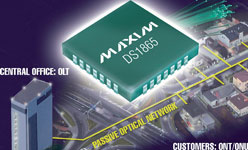
The DS1865 from Maxim is an IC for optical control, calibration and monitoring. It integrates GPON power-levelling functionality, a large bias APC (average-power-control) loop, video amplifier control and SFF-8472 diagnostic and alarm features, making it ideal for BPON (broadband passive optical network) and GPON (gigabit passive optical network) triplexer applications.

Usually a laser diode driver intended for GPON transceiver applications needs to include the laser-bias APC loop or lookup table (LUT), some fault management circuitry to meet eye safety requirements and other control functionality. These additional features add extra complexity to a design and are expensive to implement in the high-speed processes required to meet the GPON specifications. The DS1865 controller, however, is optimised to work with the MAX3643 burst-mode laser driver for a compact GPON system solution. By implementing all control, monitoring and fault management functions using low-cost CMOS technology, the DS1865 minimises the total solution cost for a GPON transceiver.

This device also integrates several analog functions that make the device's performance the best in its class, according to the manufacturer. An integrated 13-bit ADC includes input scaling, which provides 29 dB of dynamic range. The built-in temperature sensor is factory-calibrated and is said to have 50% less error than competing solutions. A tracking error lookup table enables compensation for laser-monitor diode error that occurs across temperature. This feature further increases the accuracy of the laser power control.

The DS1865 includes a 13-bit laser-bias DAC, claimed to be more than four times better than existing solutions, to control the video amplifier and a second DAC to control the boost converter (MAX5026) for the APD (avalanche photodiode) bias. The APD bias can be controlled across temperature to ensure operation in the correct gain range. The RF output power of the video amplifier (MAX3654) is controlled using the MAX4003 to sense the output RF power, an op-amp to make a feedback loop, and the DS1865's DAC output to provide a set point for the control loop.

With all this built-in capability, the DS1865 simplifies GPON transceiver design in several ways. The APC loop controls the laser's bias across temperature and ageing, thus removing the requirement for a laser-bias LUT. The modulation control DAC and APC loop have eight bits of resolution, and another three levels of scaling: +0 dB, -3 dB, and -6 dB. This scaling ability allows a single register to control the ONU (optical network unit) power level. The DS1865 memory map conforms to the SFF-8472 specification.

The DS1865 is available in a 28-pin 5 mm x 5 mm TQFN package and operates from a 2,85 V to 5,5 V power supply over a -40°C to +95°C temperature range.

Also available is the DS1863 burst-mode PON controller, which does not include the additional DACs for video amplifier and APD bias control. The DS1863 is available in a 16-pin TSSOP package.


Credit(s)


Share this article:
Share via emailShare via LinkedInPrint this page

Further reading:

Compact direct Time-of-Flight 3D LiDAR module
Altron Arrow Opto-Electronics Electronics Technology AI & ML
The VL53L9 from STMicroelectronics is the first direct Time-of-Flight (dToF) 3D LiDAR all-in-one module in ST’s portfolio, offering a resolution of 2,3K zones, wide field of view, on-chip processing, 100 frames per second, and sensing range from 5 centimeters to 9 meters.

Read more...
Powering smart sensor networks
CST Electronics Telecoms, Datacoms, Wireless, IoT
NeoCortec’s NeoMesh wireless mesh networking protocol and software stack is ideally suited for powering smart sensor networks where each device is required to send and receive small packets of data infrequently, but with high reliability.

Read more...
Easy to integrate, quick to react
Opto-Electronics
Würth Elektronik has expanded its range of WL-ICLEDs – RGB-LEDs with integrated controller – to include dual-wire ICLEDs.

Read more...
Industrial time-of-flight proximity sensor
EBV Electrolink Opto-Electronics
STMicroelectronics’ VL53L4ED is a compact, high accuracy time-of-flight proximity sensor designed for industrial and embedded applications that require precise short range distance measurement.

Read more...
Flexible enclosure lighting solutions
IOT Electronics Opto-Electronics
Phoenix Contact’s range of enclosure lights is designed to provide uniform illumination throughout control cabinets, while offering flexible installation and energy-efficient operation.

Read more...
Industry’s smallest laser firing system IC
Opto-Electronics
Silanna Semiconductor recently announced that its FirePower laser firing system ICs for smaller, more efficient LiDAR and rangefinder applications are available in production quantities.

Read more...
More light, greater efficiency, better growth
Würth Elektronik eiSos Opto-Electronics
Würth Elektronik has expanded its WL-SMDC Horticulture product line with new LEDs with wavelengths of 450, 660, and 730 nm in the 3535 package.

Read more...
Intelligent control boosts tunnel safety
IOT Electronics Opto-Electronics
Intelligent tunnel lighting systems are helping operators by delivering adaptive illumination that enhances both safety and energy efficiency.

Read more...
Case Study: Turning data into insight
Hamamatsu Photonics UK Editor's Choice Opto-Electronics
Hamamatsu Photonics’ InGaAs PIN photodiode detector has proven consistent, reliable, and robust for more than a decade, helping Axetris to deliver stable, repeatable measurements.

Read more...
Real-time monitoring for smart power distribution
CST Electronics Test & Measurement
By leveraging high-precision measurement, high-speed wave-recording, and AI-enabled analytics, the InHand Wireless Overhead-lines System empowers power utilities to accurately identify line faults and perform comprehensive load analysis.

Read more...


While every effort has been made to ensure the accuracy of the information contained herein, the publisher and its agents cannot be held responsible for any errors contained, or any loss incurred as a result. Articles published do not necessarily reflect the views of the publishers. The editor reserves the right to alter or cut copy. Articles submitted are deemed to have been cleared for publication. Advertisements and company contact details are published as provided by the advertiser. Technews Publishing (Pty) Ltd cannot be held responsible for the accuracy or veracity of supplied material.


© Technews Publishing (Pty) Ltd | All Rights Reserved

