Accelerometers now even smaller
23 January 2008
Electronics Technology
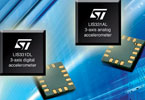
STMicroelectronics has introduced a new generation of 'nano' three-axis linear accelerometers. The versatile, low-power MEMS sensors provide complete output flexibility and embedded smart features, meeting the exploding demand for miniaturised motion-sensing solutions in the consumer and industrial markets.
The new sensors' 3 x 3 x 0,9 mm plastic package effectively addresses the space and weight constraints of portable electronic devices. The LIS331 accelerometers deliver high performance at low power consumption and their compact, robust design provides high immunity to vibration and shock survivability up to 10 000 G.
The LIS331DL integrates a standard SPI/I2C digital interface and a host of embedded features, including click and double-click recognition, wake-up and motion detection, high-pass filters and two dedicated, programmable interrupt lines.
The analog-output LIS331AL provides individual acceleration values for all three (x, y, z) axes. The sensor offers a full-scale output range of ±2,0 G, high temperature stability and tight offset tolerances. It incorporates built-in self-test capability that allows the customer to verify the functioning of the sensor after it has been assembled on board.
Further reading:
Quick and easy shielding
Würth Electronics South Africa
Electronics Technology Manufacturing / Production Technology, Hardware & Services
Würth Elektronik expands its EMC product portfolio with nanocrystalline WE-FNCS sheets.
Read more...
Compact direct Time-of-Flight 3D LiDAR module
Altron Arrow
Opto-Electronics Electronics Technology AI & ML
The VL53L9 from STMicroelectronics is the first direct Time-of-Flight (dToF) 3D LiDAR all-in-one module in ST’s portfolio, offering a resolution of 2,3K zones, wide field of view, on-chip processing, 100 frames per second, and sensing range from 5 centimeters to 9 meters.
Read more...
What happens when trust can no longer live only in software?
Computer/Embedded Technology Electronics Technology
[Sponsored] For years, many enterprise security architectures treated hardware primarily as the execution layer, while software handled authentication, access control and trust decisions.
Read more...
140 W USB-C PD reference design
Altron Arrow
Electronics Technology
The design has a wide input range of 90 to 264 V AC, 50-60 Hz, and supports an output voltage range of 5 to 28 V (USB-PD 3.1 specification).
Read more...
Nanometre-precision piezo actuators
RS South Africa
Electronics Technology
TDK Corporation has announced two new piezo actuators that are characterised by a wide dynamic range, a high force-to-volume ratio, but with precision in the nanometre range.
Read more...
Webinar: The evolving electrification of the power distribution system
Infineon Technologies UK
Electronics Technology
New connected car functionality, along with the necessity to reduce the cost, weight and complexity associated with wire harnesses, has led to the transformation of the power distribution system in automotive engineering.
Read more...
Improved MnZn material for power conversion industry
Sivan Electronic Supplies
Electronics Technology
Cosmo Ferrites Ltd, a leading manufacturer of soft ferrites, has launched an improved version of CF295 for the power conversion industry.
Read more...
Common mode filter for automotive Ethernet
Avnet Abacus
Electronics Technology
TDK Corporation has announced the introduction of its new ACT1210E Series common mode filter for automotive Ethernet 10BASE-T1S.
Read more...
Energising the industrial edge
Electronics Technology
As if the drive to decarbonise energy as part of sustainability and climate change efforts was not enough, the recent rise in energy prices has brought into sharp contrast the need to re-examine how we generate, distribute, and consume electricity.
Read more...
Samsung begins chip production using 3 nm process technology
EBV Electrolink
Electronics Technology
The optimised 3 nm process with GAA architecture achieves 45% lower power usage, 23% improved performance and 16% smaller surface area compared to 5 nm process.
Read more...









 printer friendly version