High-precision IEEE 1588 MCU and module
6 February 2008
DSP, Micros & Memory
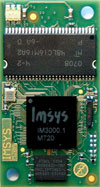
IEEE 1588 is a clock synchronisation standard for communication devices, which has seen a dramatic increase in interest over the past year.
It is today seen as a fundamental cornerstone for future communication systems - wired and wireless, professional and consumer. IEEE 1588 enables these to be synchronised to GPS accuracy and enables the quality of service required for future communication systems. A company called Imsys is addressing these new, demanding applications with the introduction of the IM3220-BA10 MCU and the single board reference module that have been shown to deliver telecom, ITU G.8261, compliance.
The IM3220 combines features of traditional CISC architectures and efficient use of resources with FPGA flexibility for the predefined application of time synchronisation. It reduces the cost of the external (local) oscillator when high precision time is communicated by the IEEE 1588 protocol. The MCU, measuring 24 x 45 mm, supports two 10/100 Ethernet ports, three UARTs at 920 Kbps, I²C or SPI port, and eight DMA channels with a sustained 83 MBps throughput.
According to Imsys, the IM3220's unique memory-centric architecture reduces the program memory requirements by 75 to 80% compared to a RISC architecture, while consuming less than 10% of the power of competing solutions.
Imsys' complete offering includes RTOS, TCP/IP-stack, fail-safe Flash file system, and an IEEE 1588 protocol stack.
For more information visit www.imsystech.com
Further reading:
Flash memory devices for high-capacity mobile storage
DSP, Micros & Memory
KIOXIA has begun sampling new Universal Flash Storage Ver. 4.1 embedded memory devices with 4-bit-per-cell, quadruple-level cell technology.
Read more...
Microchip expands maXTouch M1 touchscreen controller
Altron Arrow
DSP, Micros & Memory
Microchip Technology has again expanded its maXTouch M1 family of touchscreen controllers, now covering free-form widescreen format displays up to 42 inches down to small compact screens in the 2 to 5 inch range.
Read more...
SoC with improved processing and efficiency
Future Electronics
DSP, Micros & Memory
The nRF54L Series of 2,4 GHz SoCs from Nordic Semiconductor is an upgrade on the previous nRF52 Series and offers advanced Bluetooth connectivity, improved processing power and efficiency, and high security capabilities.
Read more...
Microchip expands its Arm Cortex-M0+ portfolio
Altron Arrow
DSP, Micros & Memory
PIC32CM PL10 MCUs feature a rich set of Core Independent Peripherals, 5 V operation, touch capabilities, integrated toolsets, and safety compliance.
Read more...
1 GHz crossover MCU with Arm Cortex Cores
Future Electronics
DSP, Micros & Memory
i.MX RT1170 Crossover MCUs, from NXP Semiconductor, are dual-core devices featuring an Arm Cortex-M7 and Arm Cortex-M4 for real-time microcontroller (MCU) performance and high integration for automotive, industrial and IoT applications.
Read more...
NECTO studio update 7.5.0
DSP, Micros & Memory
MIKROE have continued their collaboration with Renesas by introducing support for the RL78 architecture in NECTO Studio, expanding the IDE beyond its existing MCU platforms.
Read more...
UFS 5.0 flash for on-device AI
EBV Electrolink
DSP, Micros & Memory
UFS 5.0 embedded flash memory solutions, designed to deliver the performance, efficiency and capacity required for the next generation of AI-enabled mobile and edge devices.
Read more...
Accelerate development of physical AI deployments
Altron Arrow
DSP, Micros & Memory
With Avocado OS now available on the HummingBoard RZ-V2N-
AIoT and SolidSense AIoT V2N from SolidRun, teams can move from prototype to deployed fleet in weeks.
Read more...
AI-ready edge MPU for HMIs
Future Electronics
DSP, Micros & Memory
The Renesas RZ/G3E MPU is a high-performance microprocessor designed to enable advanced HMI systems with integrated artificial intelligence capabilities at the edge.
Read more...
Industrial-grade ESP32-S3 controller
DSP, Micros & Memory
Erqos Technologies has introduced the EQSP32CE, a CE-certified, industrial-grade ESP32-S3 controller designed for developers who want the flexibility of the ESP32 ecosystem in hardware that can be deployed directly into real-world automation.
Read more...









 printer friendly version