Printing using micro stencils for LGA/QFN rework
20 February 2008
Manufacturing / Production Technology, Hardware & Services
Bob Willis, process engineering consultant
Bob Willis shows off his new gloves to SMART Group workshop delegates
If you are repairing land grid array (LGA) or area array devices, should you print the circuit board or the device terminations? What is easier and more repeatable? It depends on your own skills. Which one works? They both do.
Hands on rework workshops for SMART Group South Africa held late in 2007 proved very successful for the author and delegates reworking these fairly new packages. Special thanks go to Tecan in the UK for making the handheld manual rework foils specifically designed for QFN (quad flat no lead) and LGA packages.
What follows is a step-by-step guide to the process.
Make sure that the solder paste being used in rework is the same as in production. Often a dispense grade with larger ball size or lower metal content is used in repair areas but may not be suitable for stencil printing these fine pitch parts.
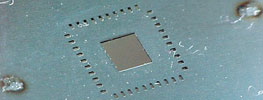
Select a micro stencil for the component footprint for a land grid array; this would normally be 100 μµm foil. The stencil apertures for the outer pads are produced as one to one apertures. The centre aperture can be a single or multiple apertures to cover between 50% and 60% of the surface area. It is recommended to have the paste printed to the centre of the device and not to the edge of the centre pad.
Hand print stencil for LGA package with 100 μm foil
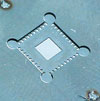
The stencil, being very thin, has a backing foil of between 250 and 300 μm thick, which allows the stencil to be used for manual hand printing. The thicker support foil prevents the image foil from being flexed during printing, which can lead to inconsistent deposits. The support foil also allows the component to be positioned accurately to the terminations.
Laminated support foil welded to stencil foil, providing a location for the package alignment
Place the LGA/QFN component into the stencil guide and check that the right stencil is being used and that the apertures are perfectly aligned with the terminations. One finger can be used to hold the component in position while the stencil is turned over for printing. Alternatively, a small piece of Kapton tape can be used to hold the part in position.
LGA is located in the support foil cavity for printing
The component can now be printed with solder paste using a small metal rework squeegee blade. It is important to use the blade in the same way as a printer; make sure the paste is rolling and the surface of the stencil is clean after the print stroke. Confirm that the paste is completely filling the apertures.
Stencil is turned over while still holding the LGA in place and manually printing with solder paste
Before printing solder paste onto components, try printing paste images onto a flat surface like copper clad laminate, glass or thick white card. This will allow an opportunity to perfect the repair printing process. When the correct technique has been mastered, check the cleanliness of the stencil apertures and base to prevent contaminating the component surface with paste.
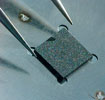
The LGA is lifted from the cavity and placed on the printed board for reflow. Alternatively the stencil is located on a rework system so the machine can lift the printed component directly and place the part on the surface of the board
Turn the stencil over so that the part can be lifted prior to placement. If the component is lifted manually it can be inspected visually prior to placement on the board. If the stencil is going to be located on a rework system, the component can be placed automatically, and inspection of the paste deposits can be conducted on the rework system when the component is aligned with the pads prior to placement.
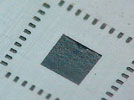
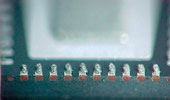
LGA with solder paste after the printing process
For more information visit www.askbobwillis.com
Further reading:
Soldering day highlights
Manufacturing / Production Technology, Hardware & Services
JAPAN UNIX has published a new event report and highlight video from their UNIX SOLDERING DAY 2026 in Hungary. This event reflects on their commitment to supporting manufacturers not only through soldering automation systems, but also through technical education, live demonstrations, hands-on training, and practical engineering know-how.
Read more...
Clearing the Static: Electrostatic Discharge
Actum
Manufacturing / Production Technology, Hardware & Services
A cordless ESD (Electrostatic Discharge) wrist strap does not work by grounding the person in the same way as a traditional wired wrist strap. Instead, it works by reducing or balancing the static charge on your body so that you are less likely to discharge electricity into sensitive electronic components.
Read more...
Engineering trust in South Africa’s SMT sector
ZETECH ONE
Manufacturing / Production Technology, Hardware & Services
From a small Johannesburg start-up to a trusted SMT technology partner, Zetech One has spent four decades helping South African electronics manufacturers improve production quality, efficiency and reliability.
Read more...
The new reality of PCB material supply
Jemstech
Editor's Choice Manufacturing / Production Technology, Hardware & Services
How resilient manufacturing strategies are helping OEMs navigate a changing global supply chain.
Read more...
Streamlining Device Programming with the AutoBee-D1
Vepac Electronics
Manufacturing / Production Technology, Hardware & Services
The AutoBee-D1 desktop automated programmer is designed to simplify the programming of devices, while delivering consistent accuracy, high throughput and reduced manual intervention.
Read more...
Zero PFAS die attach paste
Testerion
Manufacturing / Production Technology, Hardware & Services
With silver price volatility increasing and sustainability requirements accelerating across semiconductor assembly, MacDermid Alpha Electronics Solutions introduces ATROX CD 560-1, a zero per- and polyfluoroalkyl substance (PFAS) alternate silver filler die attach paste.
Read more...
Precision jet printing for advanced PCB designs
MyKay Tronics
Manufacturing / Production Technology, Hardware & Services
Mycronic’s BA 01 small dot ejector delivers unmatched precision in solder paste jet printing for advanced PCB designs.
Read more...
Strengthening local electronics manufacturing through investment and innovation
Microtronix Manufacturing
Editor's Choice Manufacturing / Production Technology, Hardware & Services
Microtronix South Africa cements its commitment to local manufacturing with ongoing investments in production capacity, skills development, and job creation.
Read more...
Polypropylene pole-top boxes support smarter, more secure electricity networks
Manufacturing / Production Technology, Hardware & Services Enclosures, Racks, Cabinets & Panel Products
As South Africa accelerates the rollout of smart prepaid electricity metering, innovative enclosure technology from Power Process Systems (PPS) is helping utilities improve network security, reduce electricity theft and protect critical electrical infrastructure.
Read more...
200 W of power in a space-saving design
Vepac Electronics
Manufacturing / Production Technology, Hardware & Services
The Hakko FX-972 Soldering Station delivers high-performance soldering in a compact package, making it suitable for a wide range of soldering applications.
Read more...











 printer friendly version